
Markets Freeze, AI Build-Out Accelerates
A rare CME data center outage halts futures trading as banks eye $38 billion to expand OpenAI’s infrastructure. Plus, Taiwan’s AI-fueled growth, a Nexperia control showdown, and a robot piecing Pompeii back together.
Episode Infographic
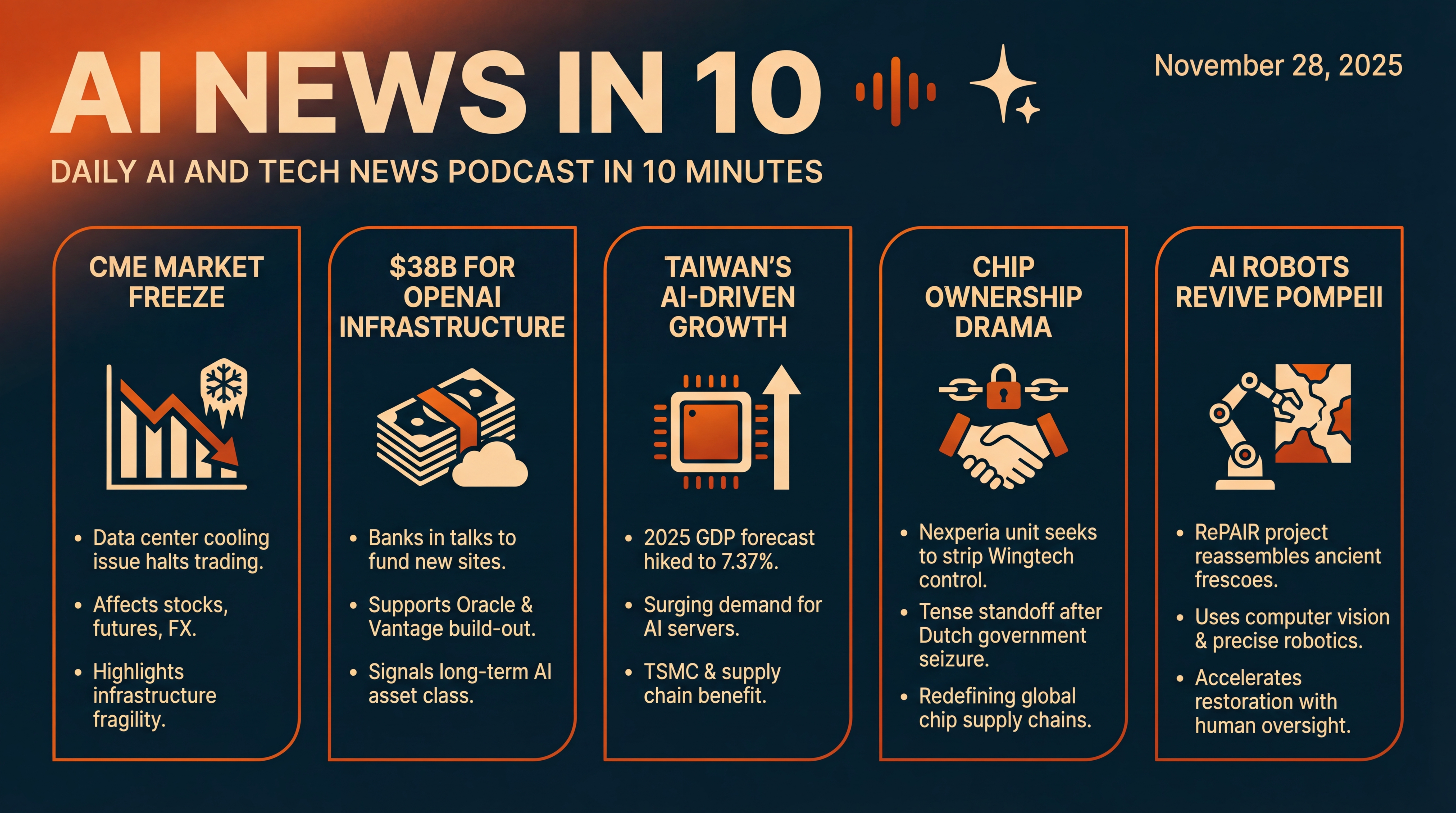
Show Notes
Welcome to AI News in 10, your top AI and tech news podcast in about 10 minutes. AI tech is amazing and is changing the world fast, for example this entire podcast is curated and generated by AI using my and my kids cloned voices...
It’s Friday, November 28th, and we’ve got a packed lineup. First, a rare tech infrastructure failure at CME froze trading in stocks, foreign exchange, and commodities futures overnight — what happened, and why it matters beyond Wall Street. Then, banks are in talks to lend a whopping 38 billion dollars to fund new sites supporting OpenAI — yes, billions with a B — and what that signals for the AI build-out. We’ll zoom out to Taiwan, where the government just hiked its 2025 growth forecast to a 15-year high on surging AI demand... great news for the chip supply chain. After the break, drama in chips: China’s Wingtech says its Dutch unit Nexperia is moving to permanently strip parent control after a government seizure. And we’ll end in Italy, where a remarkable AI-guided robot is helping piece together ancient frescoes at Pompeii.
[BEGINNING_SPONSORS]
Let’s start with the market story that turned heads while most of America was digesting Thanksgiving leftovers. Overnight, a data center cooling issue at CyrusOne disrupted CME Group systems and effectively froze trading across a swath of benchmark futures — S&P 500, Nasdaq 100, Dow, crude oil, Treasuries, even activity on the EBS foreign exchange platform.
CME posted about the outage around 9:40 p.m. Eastern, and by 9:44 p.m., futures were showing their last trades as systems stalled. That’s a big deal, because pre-market futures typically set the tone for the cash session; instead, traders had to look to ETFs like SPY and QQQ for a read on sentiment.
Analysts warned of a possible volatility pop once systems came back up — though the timing, low-liquidity holiday hours, likely limited the immediate damage. Still, it’s a stark reminder: our financial markets depend on very physical infrastructure — power, cooling, networks — and single-point failures can ripple globally. Reuters reports the root cause as a cooling problem at CyrusOne data centers supporting CME.
Story two: follow the money. A consortium of banks is reportedly in talks to lend 38 billion dollars to Oracle and data-center developer Vantage to build additional sites supporting OpenAI.
The report originated in the Financial Times and was picked up by Reuters, which noted it hadn’t independently verified the deal yet. If it closes, it would underscore how the AI build-out is increasingly funded like large-scale energy or telecom infrastructure — long-dated, capital-intensive, and bank-syndicated.
Oracle already hosts significant OpenAI capacity on its cloud; pairing that with Vantage’s real estate and power know-how would add more AI factories to the grid. The takeaway isn’t just the headline number... it’s that traditional lenders are now comfortable underwriting AI capacity as a durable asset class. That suggests confidence in multi-year demand for training and inference — and a vote that the economics pencil out, even with rising power and cooling costs.
Third, a macro snapshot that shows how deep the AI wave runs through the physical economy. Taiwan — a linchpin of the AI hardware world — raised its 2025 GDP growth forecast to 7.37%, the fastest pace since 2010.
The statistics office credited surging demand for AI servers, with U.S. cloud service providers intensifying competition and orders. Taiwan’s role is anchored by TSMC and a cluster of suppliers feeding companies like Nvidia and Apple; that demand is lifting exports and, for now, overall growth.
The agency did flag an important caveat: U.S. tariffs are an uncertainty as we look to 2026 — semiconductors are currently excluded, but policy can change. Still, even the 2026 view was revised higher to 3.54%, and exports are seen up more than 6%. For listeners, the point is straightforward: AI isn’t just model launches and chatbots... it’s factories, logistics, and national accounts moving in tandem.
[MIDPOINT_SPONSORS]
Fourth, the chips and sovereignty file. Wingtech, the Chinese parent of semiconductor firm Nexperia, says Nexperia’s Dutch unit is seeking to permanently strip its control — part of a tense standoff that began when the Dutch government seized the company two months ago.
An Amsterdam court subsequently removed Wingtech’s control. Although The Hague suspended the seizure last week after talks in Beijing, the court ruling still stands. Wingtech accuses the Dutch unit of trying to build a non-Chinese supply chain. Nexperia’s Dutch arm says it has tried repeatedly to reopen dialogue; Wingtech says those overtures fell flat.
Why should you care? Because it illustrates how national security reviews and industrial policy are reshaping who owns — and can direct — critical chip assets inside allied countries. After years of globalization, the pendulum is swinging toward local control and trusted-partner supply chains... and that can redraw ownership maps overnight.
And fifth, an AI story with a very human touch. At Pompeii, an EU-funded project called RePAIR is combining computer vision, AI puzzle-solving, and delicate twin-arm robotics to help archaeologists reassemble fragmented frescoes — some damaged in the AD 79 eruption, others shattered by World War II bombing.
Think of it like solving four or five giant jigsaw puzzles at once... after you’ve mixed all the pieces together and thrown away the box art. The system uses vision sensors to identify fragments and ultra-precise robotic hands to position them without harming the surface, with algorithms matching colors and patterns that can be imperceptible to humans.
Researchers say the approach could transform restoration workflows globally — accelerating painstaking tasks while preserving expert oversight. It’s a lovely counterbalance to the AI takes jobs narrative: here, AI and robotics take on tedium and fragility so human experts can focus on interpretation and storytelling.
Quick bonus thread that connects these dots: whether it’s CME’s outage, Taiwan’s forecast, or OpenAI’s potential new sites, power and cooling have become the new bottlenecks in AI’s story.
Data centers are now central to finance, science, and culture — moving trillions in markets, training foundation models, and, yes, helping piece together antiquity. The investments — and the risks — are scaling together.
That’s our slate for today: a market-shaking data center glitch, 38 billion dollars lining up behind OpenAI’s infrastructure, Taiwan’s AI-driven growth surge, a cross-border chip ownership fight with geopolitical undertones, and robots helping revive ancient art.
Enjoy the rest of your day... and keep an eye on the power and cooling charts — increasingly, they’re the heartbeat of AI and everything it touches.
Thanks for listening and a quick disclaimer, this podcast was generated and curated by AI using my and my kids' cloned voices, if you want to know how I do it or want to do something similar, reach out to me at emad at ai news in 10 dot com that's ai news in one zero dot com. See you all tomorrow.