Open Math Breakthrough, Record AI Shopping, Robots Rise
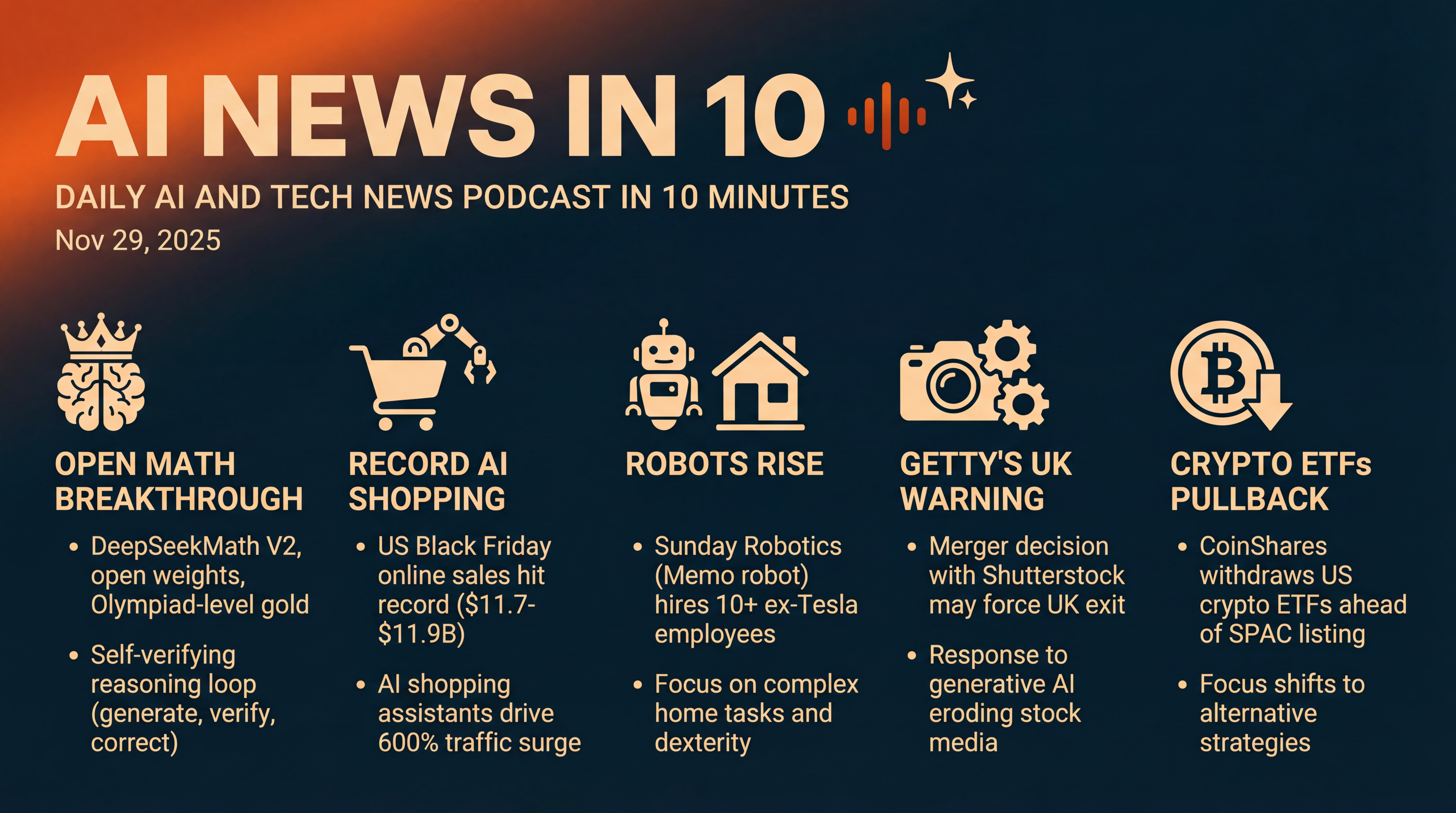
An open weights math model reaches Olympiad-level performance with a self-verifying loop as AI shoppers drive record Black Friday sales. Plus: Tesla alumni power a new home robot, Getty’s UK warning in a Shutterstock probe, and CoinShares pivots away from select US crypto ETFs.
Episode Infographic
Show Notes
Welcome to AI News in 10, your top AI and tech news podcast in about 10 minutes. AI tech is amazing and is changing the world fast, for example this entire podcast is curated and generated by AI using my and my kids cloned voices...
It’s Saturday, November 29, 2025, and here’s your AI News in 10. Today: an open weights breakthrough in mathematical reasoning that’s flirting with Olympiad-level gold... Black Friday sets a US online sales record as AI shopping assistants go mainstream... a new home robot startup snags talent from Tesla’s Autopilot and Optimus teams... Getty Images warns UK regulators its future there could hinge on a merger decision... and a major crypto asset manager pulls back on ETFs ahead of a US listing. Let’s dive in.
[BEGINNING_SPONSORS]
Story one: DeepSeek just lit up the research world with DeepSeekMath V2 — an open weights model that, according to the team’s technical report and model card, reaches gold-medal level on the 2025 International Mathematical Olympiad problems, scores nearly perfectly on the 2024 Putnam with 118 out of 120, and posts top marks on the IMO ProofBench suite.
The headline isn’t just the scores — it’s the method. Rather than optimizing only for final-answer correctness, DeepSeek trained a generator, a verifier, and a meta-verifier loop so the model learns to write proofs, critique its own reasoning, and fix mistakes before presenting a solution. In other words... it learns to check its own work. And they released it under the Apache 2.0 license, with open weights.
To put numbers on it: the Heavy variant reports 99 percent on ProofBench Basic and 61.9 percent on ProofBench Advanced — second only to Google’s proprietary Gemini DeepThink on that advanced set. DeepSeek also claims five of six IMO 2025 problems solved, and that near-perfect Putnam tally, all using scaled test-time compute to sample and verify many proofs in parallel. The model card lists a 685 billion parameter configuration and notes the verifier’s role as the reward model during reinforcement learning. That transparency — and the open release — are why this dropped like a thunderclap across research circles.
Context matters: both OpenAI and Google DeepMind have touted gold-level Olympiad math from proprietary systems this year, but without releasing weights or full technical detail. DeepSeek’s move throws down a gauntlet — open weights, a verifiable write-up, and a blueprint for self-verifying reasoning. If the community can reproduce these results, it’s a shot in the arm for open research — and a pressure test for closed-model claims.
Story two: Black Friday online sales in the US are setting a new record — and AI is part of the story. By early evening Friday, shoppers had already spent 8.6 billion dollars online, up 9.4 percent year over year, and Adobe’s projection pegged the day’s finish between 11.7 and 11.9 billion — record territory. Mobile accounted for about 59 percent of purchases, Buy Now, Pay Later chipped in roughly 762 million dollars, and the hottest items were the Nintendo Switch 2, Apple’s AirPods 4, and the Oura Ring 4. Crucially, retailers reported a 600 percent surge in AI-driven traffic, with nearly half of surveyed shoppers saying they used AI tools to find deals. It’s not just humans hunting bargains anymore — algorithms are scouting for us.
If you’re a retailer, that shift has operational consequences. Price-matching bots and shopper copilots compress margin windows faster, and response time becomes a competitive weapon. If you’re a shopper, it means better discovery — but also a higher likelihood you and thousands of others are pointed at the same limited-inventory lightning deal. That helps explain why doorbusters evaporate in minutes... even online.
Story three: a robotics startup called Sunday Robotics — fresh out of stealth with its Memo home robot — has hired at least ten former Tesla employees, including engineers who worked on Autopilot and Elon Musk’s Optimus humanoid project. Reporting late Friday rolling into Saturday highlighted a cluster of ex-Tesla talent, from AI infrastructure leads to Optimus and robotaxi veterans, now building Memo and its ACT-1 robot foundation model. The company’s demos show the robot performing tricky household tasks like picking up wine glasses, loading a dishwasher, and even folding socks — ambitious dexterity that goes beyond the usual scripted routines.
Why it matters: consumer robotics has been stuck between Roomba-style utility and sci-fi promises. If Sunday can translate the autonomy lessons from automotive — long-horizon planning, closed-loop perception, and robust manipulation — into the home, it could redefine what helpful looks like in a domestic robot. It’s still early days, but the talent migration is a tell that serious engineering challenges are in scope.
[MIDPOINT_SPONSORS]
Story four: Getty Images just warned that if UK regulators block its proposed 3 billion pounds acquisition of Shutterstock, the company may reassess how much it invests — or even whether it keeps certain operations — in the UK. The Competition and Markets Authority pushed the deal into an in-depth Phase 2 probe in October, citing substantial competition concerns. Getty’s CEO, Craig Peters, argues the merger is a survival play as generative AI erodes licensing revenue in the stock-media market, and that combining with Shutterstock creates the scale needed to compete against AI platforms. It’s a stark message: the structure of the AI era’s content pipes could reshape where legacy media marketplaces live.
The subtext is big. Rights-cleared image libraries are rethinking strategy as model training, synthetic media, and AI-assisted search alter demand. If scale and diversified offerings are the only way to withstand AI commoditization, regulators have to weigh potential market concentration against the risk that, without consolidation, the incumbents simply atrophy. The CMA’s ruling could set a template for how creative-content markets adapt — or don’t — to generative AI.
Story five: CoinShares, one of Europe’s largest crypto asset managers, withdrew plans for several US crypto ETFs — specifically registrations tied to XRP, a Solana-staking product, and Litecoin — saying it will focus on higher-margin opportunities as it works toward a US listing via SPAC. The firm, which reported around 10 billion dollars in assets under management earlier this fall, says the US spot-crypto ETF market is consolidating around single-asset giants, narrowing room for differentiation. Expect alternative vehicles — crypto-equity baskets, thematic strategies, and actively managed multi-asset products — over the next 12 to 18 months.
The takeaway here isn’t just fewer tickers. It signals that the economics of mass-market crypto ETFs in the US — especially outside Bitcoin — are getting tougher as fee wars intensify, liquidity concentrates, and distribution favors incumbents. Asset managers will either innovate around structure and strategy... or pivot away from products where scale is the only edge.
Quick recap: DeepSeek’s open weights math model pushes self-verifying reasoning into the mainstream... Black Friday’s new record shows AI copilots are now part of how America shops... Sunday Robotics is building a home robot team with Tesla DNA... Getty’s UK future may hinge on an AI-era merger ruling... and CoinShares is reshaping its US product playbook before going public. We’ll be back tomorrow with more. Until then, stay curious.
Thanks for listening and a quick disclaimer, this podcast was generated and curated by AI using my and my kids' cloned voices, if you want to know how I do it or want to do something similar, reach out to me at emad at ai news in 10 dot com that's ai news in one zero dot com. See you all tomorrow.