Cyber Monday Records, FCC AI Rules, and Agentic AWS
We break down Coupang’s record data breach, the FCC’s move to preempt local AI rules in telecom, Cyber Monday’s spending surge, Taiwan’s tariff push amid chip ties, and what to expect from AWS re:Invent’s agentic AI focus. Fast, clear insights on policy, privacy, and the tech powering the holiday rush.
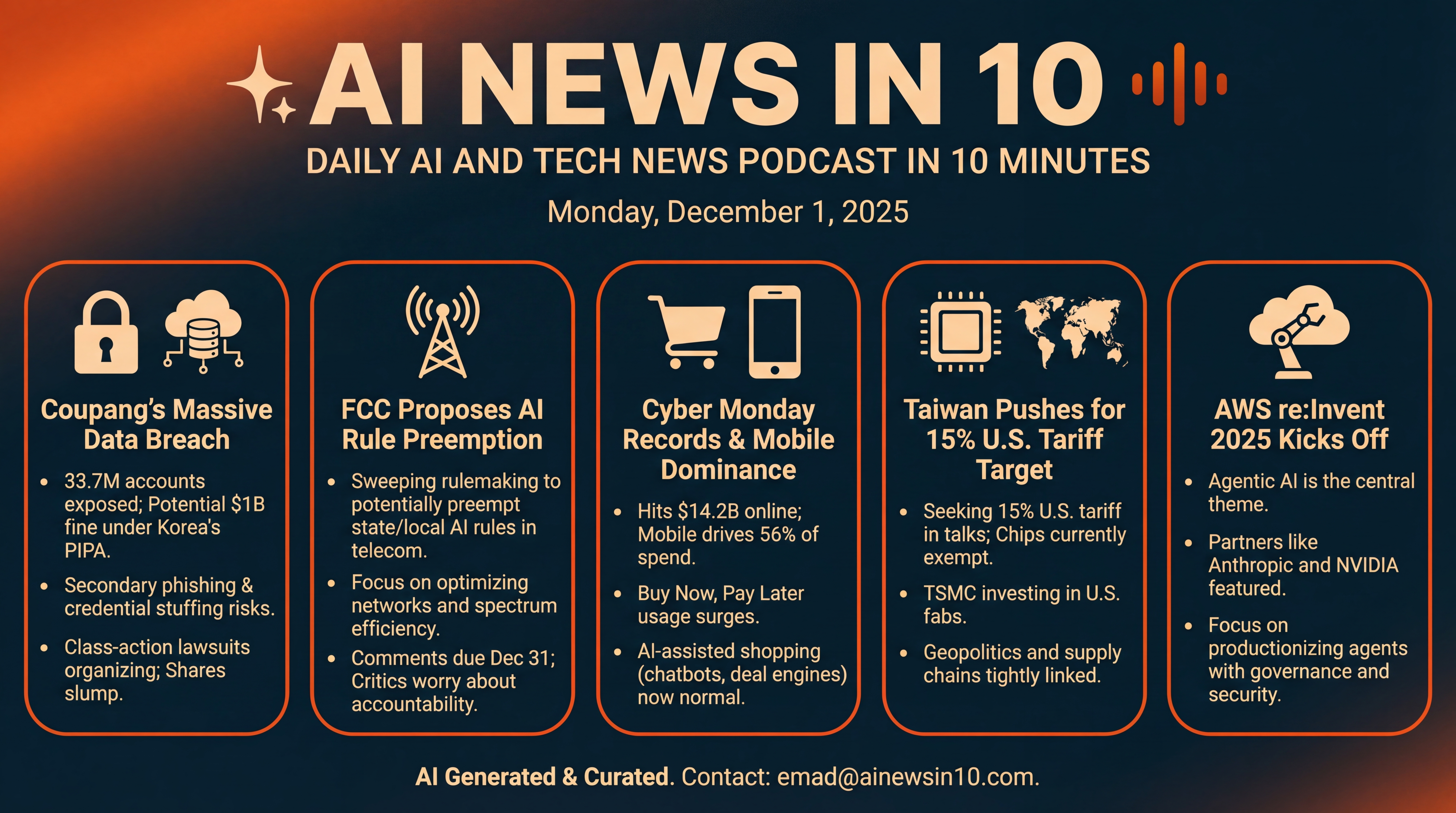
Episode Infographic
Show Notes
Welcome to AI News in 10, your top AI and tech news podcast in about 10 minutes. AI tech is amazing and is changing the world fast, for example this entire podcast is curated and generated by AI using my and my kids cloned voices...
Here’s what’s new in AI and tech on Monday, December 1, 2025... We’ve got a record-scale data breach at South Korea’s e-commerce giant Coupang—and what it could mean for user safety and corporate penalties. The U.S. FCC is opening a sweeping rulemaking that could let it preempt state and local AI restrictions in telecom networks. Cyber Monday is on track for an all-time online spending record, with mobile and buy now, pay later driving the cart. Taiwan is pushing for a 15% U.S. tariff rate in trade talks that touch the chip supply chain. And AWS re:Invent is kicking off in Las Vegas, with agentic AI headlining the week. Let’s get into it.
[BEGINNING_SPONSORS]
First up—Coupang’s massive breach, and what comes next.
South Korea woke up to one of its largest data leaks. Coupang says 33.7 million customer accounts had personal details exposed—names, phone numbers, emails, addresses, and portions of order histories.
Regulators say the intrusion began June 24 and wasn’t detected until November 18, and authorities are probing whether an ex-employee abused authentication keys to get in.
Police and ministries are investigating potential violations of data-protection laws. Reuters calls it the worst breach in over a decade, and class-action organizing has already begun.
Two follow-ups to watch. First—money and penalties: under Korea’s Personal Information Protection Act, fines can reach up to 3% of revenue if negligence is found... which local press estimates could climb toward a billion dollars, given Coupang’s trailing revenue.
Second—secondary risk: Korea’s security agency warned of phishing and credential stuffing attempts that could piggyback off leaked data. Users are being urged to change credentials, and to watch for refund-themed scams.
Investors are already reacting—shares slumped on the news, with financial outlets tying the sell-off to the breach as authorities dig in. Bottom line: this isn’t just a customer trust crisis... it’s a regulatory and financial one, with knock-on effects across Asia’s e-commerce sector.
In Washington, the Federal Communications Commission just published a Notice of Proposed Rulemaking that—if finalized—could reshape how AI is used in U.S. wireless networks.
On the surface, the proceeding looks mundane—streamlining tower permits and densification rules. The kicker is new language asking whether state or local regulations on the use of AI tools in communications networks effectively prohibit service, and should be preempted under Sections 253 and 332(c)(7) of the Communications Act.
The FCC is explicitly asking how providers use AI to optimize networks, and whether local AI rules impede spectrum efficiency. Comments are due December 31, with replies by January 15.
Why it matters: AI now touches everything from radio planning, to dynamic traffic management, to proactive outage detection. If the FCC ultimately preempts a patchwork of AI-related local rules, operators could roll out AI-enabled features more uniformly nationwide—supporters say that could lower costs and improve quality, while critics will worry about accountability and the scope of federal authority. Watch this one... telecom and AI policy just collided in a very public way.
Here in the U.S., Adobe’s trackers point to Cyber Monday hitting roughly 14.2 billion dollars online—up around 6% from last year.
Newswires this morning flagged strong electronics discounts, and a continued surge in buy now, pay later—adding a cushion for tight budgets.
And the shopping battlefield has moved decisively to the phone: mobile is expected to drive about 56% of online spend this holiday season.
The fascinating subplot—AI-assisted shopping. Retailers’ chatbots, search ranking, and deal engines quietly went from novelty to normal. Adobe and others have highlighted a sharp rise in traffic referrals from AI assistants.
If the day lands near projections, we’ll close Cyber Week with record volumes... and a clear signal that mobile and AI-aided discovery are now table stakes in retail.
[MIDPOINT_SPONSORS]
Taiwan pushes a 15% U.S. tariff target—chips in the middle.
Taiwanese officials say they’re seeking to get U.S. tariffs down to 15% in ongoing talks.
The context: even as Washington debates higher headline tariffs on some categories, semiconductor imports are currently exempt—and TSMC is pouring investment into U.S. fabs.
Negotiators in Taipei want a clearer path on tariffs while keeping chip flows steady. Taiwan’s economy minister also noted that training support for U.S. workers isn’t a formal ask, though it could be discussed as TSMC ramps Arizona.
For AI, it’s another reminder that geopolitics and supply chains are joined at the hip—anything that smooths upstream costs or certainty tends to show up months later in hardware pricing.
Keep an eye on the calendar... with U.S. and Asian trade positions in flux, 2026 could be the year we find out whether tariff relief offsets rising power and build-out costs in the AI server world—or whether those costs get passed straight through.
Finally—to Las Vegas, where AWS re:Invent 2025 kicks off today.
Amazon’s preview posts call out agentic AI as the central theme, with five keynotes, hundreds of sessions, and partners like Anthropic and NVIDIA anchoring the week.
Expect a drumbeat of announcements on Bedrock, vector databases, and AI agents tied tightly to AWS services and enterprise governance.
For developers on the ground, Monday’s agenda already features agent-building deep dives, while partner tracks spotlight search, observability, and vector search updates.
If last year’s re:Invent set the stage with model access and Trainium 2 scale-outs, this year looks like the push to productionize agents—wired into identity, monitoring, and cost controls.
In other words, the industry is moving from play with a model to ship an agent safely, and at scale.
Quick recap. Coupang’s breach is huge on both the security and regulatory fronts. The FCC just opened the door to preempt state and local AI rules in wireless networks. Cyber Monday spending is poised to break records, with mobile and buy now, pay later leading. Taiwan wants a 15% U.S. tariff target as chip ties deepen. And AWS re:Invent is underway—with agentic AI likely to dominate the week’s headlines.
We’ll keep tracking what ships out of Vegas... and how policy and privacy developments shape AI in the weeks ahead.
Thanks for listening and a quick disclaimer, this podcast was generated and curated by AI using my and my kids' cloned voices, if you want to know how I do it or want to do something similar, reach out to me at emad at ai news in 10 dot com that's ai news in one zero dot com. See you all tomorrow.