
Lasers, Markets, and the TriFold Future
Washington backs a laser startup to reshape chipmaking as global watchdogs warn AI exuberance could wobble markets. We unpack Apple’s India standoff and Samsung’s tri-fold flagship—and what these moves signal for 2026.
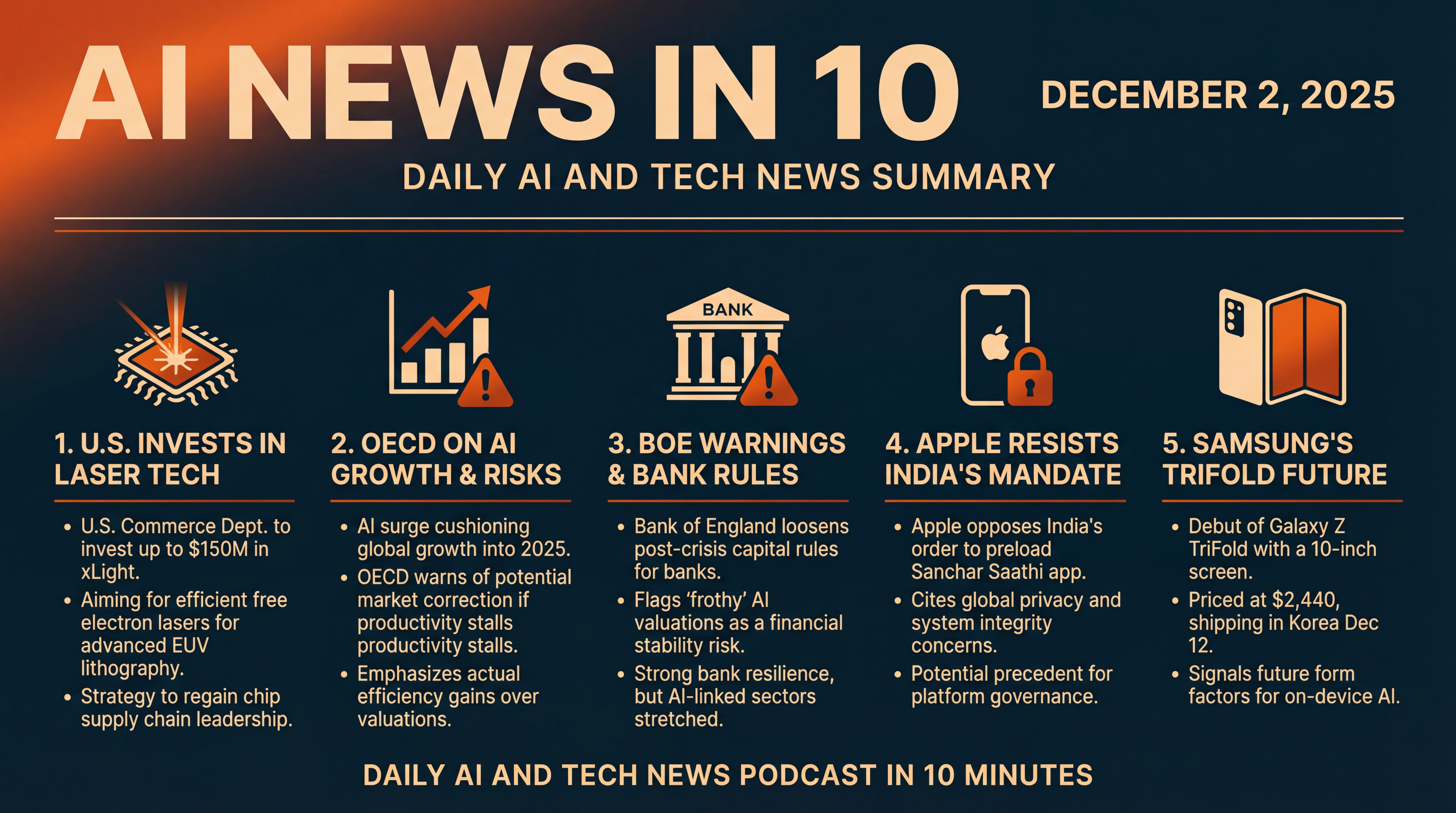
Episode Infographic
Show Notes
Welcome to AI News in 10, your top AI and tech news podcast in about 10 minutes. AI tech is amazing and is changing the world fast, for example this entire podcast is curated and generated by AI using my and my kids cloned voices...
Here’s what’s new in AI and tech today... Tuesday, December 2, 2025.
The U.S. government is putting serious money behind a startup trying to reinvent the lasers at the heart of cutting-edge chipmaking. Global watchdogs say the AI boom is powering growth, but it could crack if expectations run too hot. The Bank of England is loosening post-crisis bank rules even as it warns about frothy AI valuations. Apple is resisting an Indian order to preload a government app on iPhones. And Samsung just debuted a wild three-panel foldable that opens into a ten-inch screen.
Let’s get into it.
[BEGINNING_SPONSORS]
First up — Washington’s bet on laser tech that could shake up the chip supply chain.
The U.S. Department of Commerce signed a preliminary letter of intent to invest up to 150 million dollars in xLight, a startup building free electron lasers for extreme ultraviolet lithography — the most complex, mission-critical gear in advanced chipmaking.
Today, only ASML makes E U V tools. xLight aims to replace the laser subsystem with something far more energy efficient, borrowing from particle accelerator physics so it can slot into existing lithography machines.
The money would come via the CHIPS R and D Office, and yes, it’s equity — the U.S. would take a stake. Commerce Secretary Howard Lutnick framed it bluntly: the U.S. ceded advanced lithography, and now wants it back. Former Intel CEO Pat Gelsinger is xLight’s executive chairman, underscoring how strategic this push is for compute capacity in the AI era.
Why it matters: AI-grade chips — from Nvidia, AMD, and others — all start with photolithography. Anything that lowers E U V power draw or improves uptime can ripple across yields, costs, and the pace at which new AI hardware hits the market. If xLight’s concept proves compatible with ASML’s installed base, it could diversify a critical chokepoint in the global chip supply chain — one concentrated in the Netherlands and Taiwan. That’s a geopolitical and industrial story as much as a technology story.
Second — the O E C D’s new Economic Outlook paints a nuanced picture.
The AI investment surge is cushioning the drag from tariffs, keeping global growth surprisingly resilient into 2025... yet the same enthusiasm could morph into a market correction if earnings and productivity don’t materialize fast enough. The O E C D sees global growth easing from roughly 3.2 percent in 2025 to 2.9 percent in 2026, then ticking back up to 3.1 percent in 2027. In the U.S., it projects about 2 percent growth in 2025, with AI build-outs, fiscal support, and expected rate cuts offsetting tariff headwinds. The kicker — if AI expectations prove too rosy, stock valuations could correct and growth could wobble.
The take for tech: we’ve all watched AI capital spending balloon — tens of billions from hyperscalers and model labs. The O E C D is effectively saying, enjoy the macro tailwind, but don’t ignore concentration risk in AI leaders, or the possibility of a sharp repricing if the promised productivity wave is slower or patchier than hoped. Founders, CIOs, and investors should put actual efficiency gains front and center in 2026 planning — rather than chasing benchmarks alone.
Third — across the Atlantic, the Bank of England is sounding the alarm on AI valuations while giving banks a bit more running room.
In its latest Financial Stability Report, the Bank of England says investor enthusiasm has pushed AI-linked share prices to stretched levels — particularly in the U.S., and to a lesser degree in the U K — raising the risk of a sharp correction that could feed into credit markets. At the same time, U K banks sailed through stress tests, and the Bank of England signaled the first easing of capital requirements since the 2008 crisis, arguing current buffers are above what’s needed for resilience. The message: banks look solid, but parts of the market — especially AI darlings — look hot.
What to watch next: vulnerabilities around leveraged positions in gilt repo markets, and rising private credit exposures. Put that together with the O E C D’s caution, and you’re looking at a 2026 where funding conditions for AI may vary widely — strong balance sheets will keep building, while weaker credits, especially those betting solely on multiple expansion, could face a tougher tape.
[MIDPOINT_SPONSORS]
Fourth — Apple versus New Delhi over a preloaded app mandate.
India quietly ordered smartphone makers to ship devices with a state-run cyber safety app, Sanchar Saathi, that helps block or trace lost phones — and reportedly required it to be undeletable, even via software updates. Apple plans to resist, citing its global approach to user privacy and system integrity. Officials later said the app is voluntary and removable, but the original directive suggests otherwise. Other phone makers are still weighing the order, as opposition lawmakers decry potential surveillance.
Why it matters: India is a huge growth market and a central manufacturing base for many brands. A standoff over preloads and device control could set new precedents for platform governance in the world’s most populous country.
Privacy and platform policy have become competitive moats. The more Apple can fend off mandated, non-removable apps, the more it preserves consistency across regions. Conversely, a forced preload could embolden other governments to make their own demands — complicating security updates and fragmenting user experience at scale.
Fifth — a very different kind of headline: Samsung’s new Galaxy Z TriFold is official.
It’s a multi folding phone that opens into roughly a ten-inch display using three panels, with the company claiming its largest-ever flagship battery and fast charging. Priced at 3.59 million won — about two thousand four hundred forty dollars — the TriFold ships in Korea on December 12, with select international markets to follow by year’s end. Analysts call it a tech showpiece more than a volume driver, but it signals where form factors are heading as on-device AI and bigger canvases converge. Even by 2027, foldables may still be under 3 percent of the smartphone market... but the high end is where user experience experiments tend to start, then trickle down.
What’s the AI angle? Edge models keep getting better, and generative video, multimodal assistants, and AI-enhanced productivity thrive on screen real estate. If Samsung — and its rivals — can marry tri-fold ergonomics with battery life, heat management, and on-device accelerators, the next AI wave could feel truly personal, not just cloud-based. For now, it’s pricey, complex, and niche — but the blueprint is on the table.
Quick recap... the U.S. is seeding a potential breakthrough in E U V lasers to shore up the AI chip pipeline... the O E C D says AI spending is propping up growth even as it warns of a possible market correction... the Bank of England is loosening bank capital rules while flagging overheated AI valuations... Apple is pushing back against India’s app preload order on privacy grounds... and Samsung’s TriFold hints at where AI-centric hardware could go next.
We’ll be watching which of these bets — policy, product, or platform — turn into a durable advantage in 2026.
Thanks for listening and a quick disclaimer, this podcast was generated and curated by AI using my and my kids' cloned voices, if you want to know how I do it or want to do something similar, reach out to me at emad at ai news in 10 dot com that's ai news in one zero dot com. See you all tomorrow.