
AI Goes Mainstream, Data Centers Race Ahead
Google’s Year in Search shows AI’s mainstream moment, with Gemini and DeepSeek trending worldwide, while Palantir and Nvidia debut Chain Reaction to accelerate data center construction. Plus UMC and Polar eye U.S. manufacturing, Jensen Huang weighs in on AI export policy, and Nexus raises a balanced 700 million dollar fund.
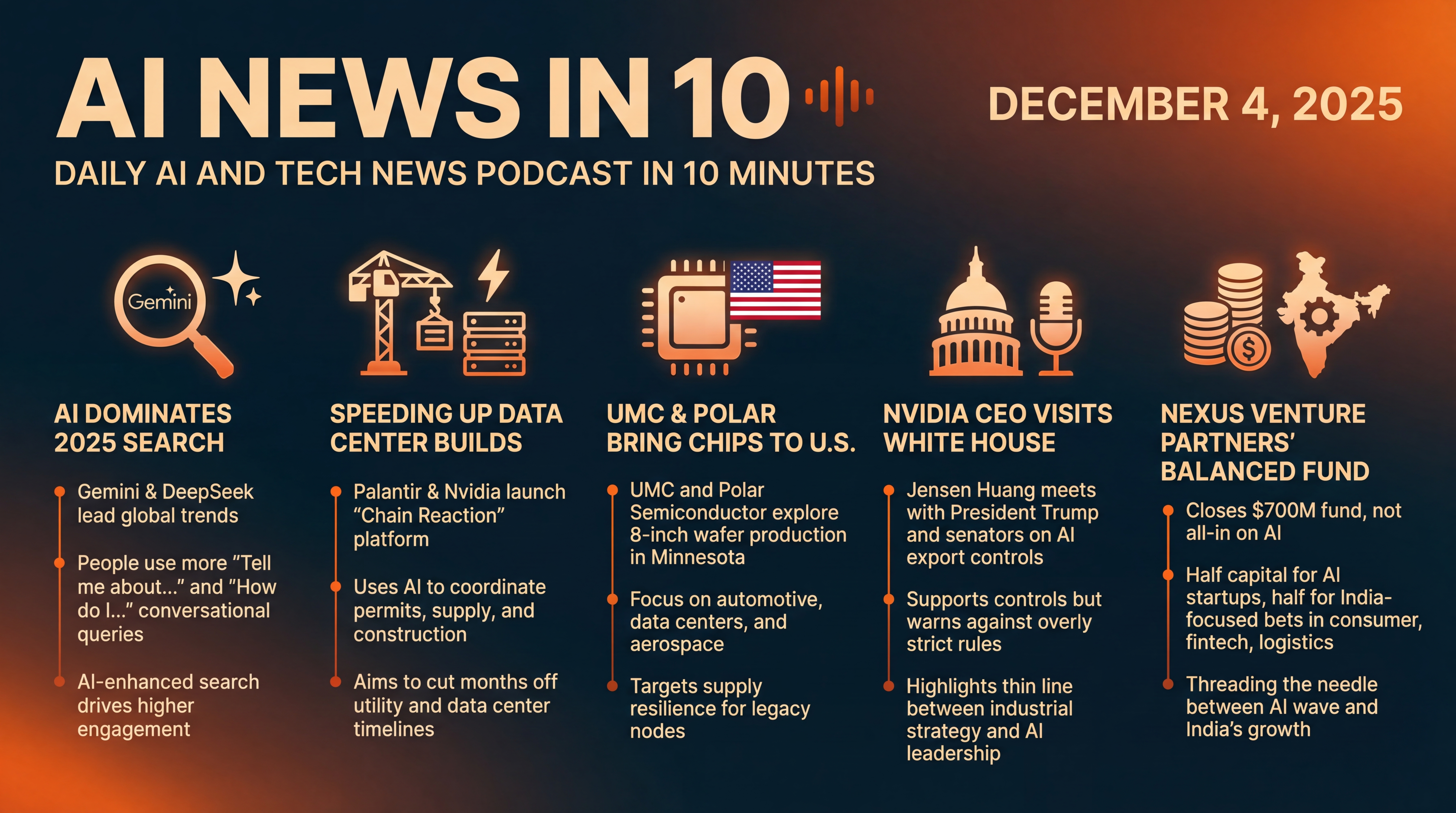
Episode Infographic
Show Notes
Welcome to AI News in 10, your top AI and tech news podcast in about 10 minutes. AI tech is amazing and is changing the world fast, for example this entire podcast is curated and generated by AI using my and my kids cloned voices...
Here's what's new in AI and tech for Thursday, December 4, 2025...
Fresh data shows what the world searched for this year — and yes, AI dominated. Gemini tops the charts. On the industry side, Palantir is teaming with Nvidia and a major utility to speed up AI data center buildouts. In chips, Taiwan's UMC struck a deal with Minnesota-based Polar to bring more eight-inch capacity stateside. Policy-wise, Nvidia's Jensen Huang visited the White House and Capitol Hill as debates over AI exports heat up. And in venture, Nexus Venture Partners closed a 700 million dollar fund — and it's not going all in on AI.
[BEGINNING_SPONSORS]
Let's start with the pulse of the public — Google's Year in Search, 2025.
The official Google Trends wrap says people didn't just look things up, they asked fuller questions, more conversationally. Queries starting with the phrase "Tell me about..." are up roughly 70 percent year over year, and "How do I..." searches hit an all-time high, up about 25 percent.
The top trending search globally? Gemini, Google's AI assistant — reflecting how generative AI became a mainstream curiosity in 2025. DeepSeek also cracked the top trending list. Google points to the spread of AI-enhanced search experiences that encourage natural language questions over short keywords. Those AI Overviews have been driving higher engagement in markets like the U.S. and India — helping explain the shift toward longer, talk-to-search phrasing we all felt in our day to day.
According to Google's Year in Search post — and TechCrunch's readout — Gemini led the trending pack, with AI themes showing up across multiple regional lists.
Story two is all about speed — specifically, speeding up AI data center construction.
Palantir, Nvidia, and CenterPoint Energy just unveiled a software platform called Chain Reaction — it uses AI to coordinate everything from permits and grid hookups to chip supply.
Think of it as a smart command center for building the factories of the AI era... The system can parse messy, unstructured data — emails, PDFs, spreadsheets — to flag bottlenecks, run what-ifs, and nudge stakeholders before delays cascade.
It also aims to align utility timelines with construction crews, and with component deliveries from chipmakers and server vendors. The goal is to cut months off the schedule at a moment when energy capacity, transformers, and skilled labor are the long poles in the tent.
This builds on earlier collaborations between Palantir and Nvidia, and Chain Reaction widens the circle to include grid operators and key suppliers. Given how demand for AI compute is outpacing power availability in many regions, expect lots of utilities and hyperscalers to kick the tires on this. That's according to Reuters reporting.
Third, a noteworthy U.S. manufacturing move.
Taiwan's UMC — the world's number-two pure-play foundry — signed a memorandum of understanding with Polar Semiconductor to explore producing eight-inch wafers in the United States. Polar runs a fab in Minnesota, and UMC brings process IP and a large customer base.
The target sectors are telling — automotive, data centers, consumer, aerospace, and defense — exactly where supply assurance and second-source strategies matter most. While the industry's bleeding edge happens at five nanometers and below on twelve-inch wafers, eight-inch capacity still underpins power management ICs, sensors, and a ton of automotive and industrial parts.
If this effort scales, it could give U.S. customers another domestic option for those essential legacy nodes — important for resilience after years of supply shocks. That's according to Reuters' coverage of the tie-up.
[MIDPOINT_SPONSORS]
Number four: Nvidia's CEO Jensen Huang spent part of his day in Washington — meeting with President Donald Trump and Republican senators — as the U.S. wrestles with how to stay competitive in AI without supercharging rivals abroad.
According to the Associated Press, Huang voiced support for export controls in principle but warned that overly strict rules could backfire if they leave global markets to competitors.
The political split remains sharp — some lawmakers want tighter curbs on advanced AI chips to China, while others worry that blanket restrictions could slow American firms and cede ground. The timing is sensitive, with the administration reworking elements of earlier policies, and Congress weighing several AI-related measures.
It's unusual to see a chip CEO become such a central figure in policy debates, but in 2025 the boundary between industrial strategy and AI leadership is... thin. The Associated Press account underscores just how hands-on top tech executives have become in shaping the rulebook.
And rounding out today's five — venture capital with a twist of discipline.
Nexus Venture Partners just announced a new 700 million dollar fund, and it's deliberately not pouring everything into AI.
Instead, the firm says roughly half the capital will target AI startups, while the other half backs India-focused bets across consumer, fintech, logistics, and digital infrastructure. The partners argue that while AI is a generational platform shift, crowding into the hottest corner of the market can be risky — India offers a counterweight with huge adoption opportunities and localized AI needs, from multilingual models to sovereign data infrastructure.
Nexus operates a single U.S.-India fund and has backed names like Postman, Apollo, MinIO, and Zepto. The team says fund size remains at 700 million by design — big enough to lead early rounds, not so big it pressures strategy. In a year when "AI or bust" has been the default VC posture, this balanced approach stands out. That's from TechCrunch's reporting today.
Quick bonus context to tie a bow on story one.
Google's Year in Search isn't just trivia. When the top trending term worldwide is an AI assistant, it signals a mainstream shift in how people learn, shop, and troubleshoot — exactly the behaviors that push companies toward agentic tools, customer-support bots, and AI-assisted search strategies.
TechCrunch's write-up notes that DeepSeek also made the global list — another indicator that users are sampling multiple AI tools, not just one. Combine that with Google's claim that AI Overviews boosted engagement for complex queries, and you can see why every big platform is racing to optimize for this new, conversational discovery surface.
Recap — today's data says AI curiosity went truly mass-market in 2025. Palantir and Nvidia want to accelerate the AI buildout with a software control tower. UMC and Polar seek to shore up U.S. chip resilience. Nvidia's CEO is lobbying on the front lines of AI industrial policy. And one major VC is threading the needle between the AI wave and a broader India bet.
We'll be back tomorrow with more... Until then, stay curious.
Thanks for listening and a quick disclaimer, this podcast was generated and curated by AI using my and my kids' cloned voices, if you want to know how I do it or want to do something similar, reach out to me at emad at ai news in 10 dot com that's ai news in one zero dot com. See you all tomorrow.