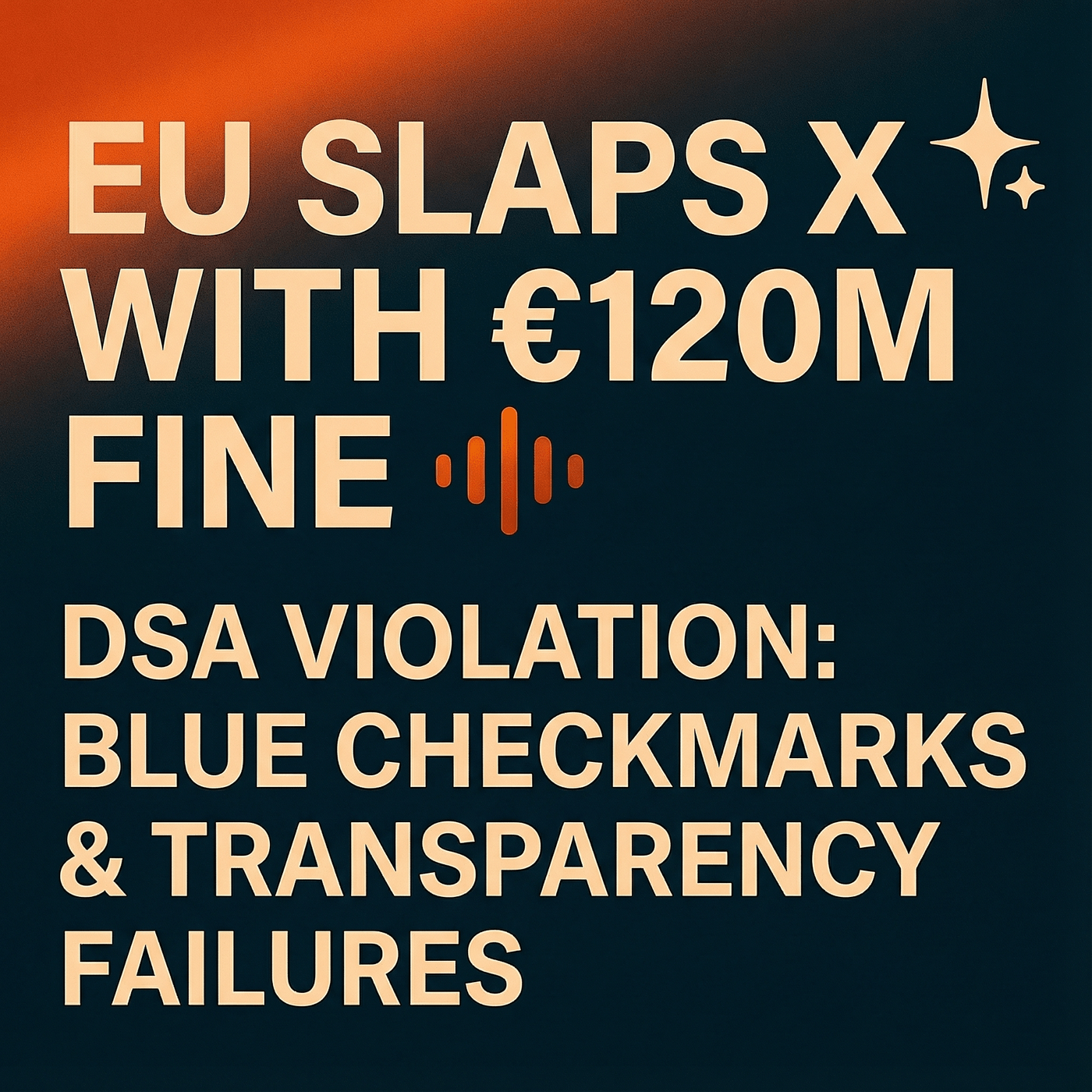
DSA Hits X, Meta Deals, Cloudflare Glitch, OpenAI Buy
Brussels issues the first DSA fine against X, Meta signs AI news licensing deals, and the New York Times sues Perplexity as the fight over training data escalates. Plus, Cloudflare explains a widespread outage, and OpenAI buys Neptune to tighten its MLOps engine room.
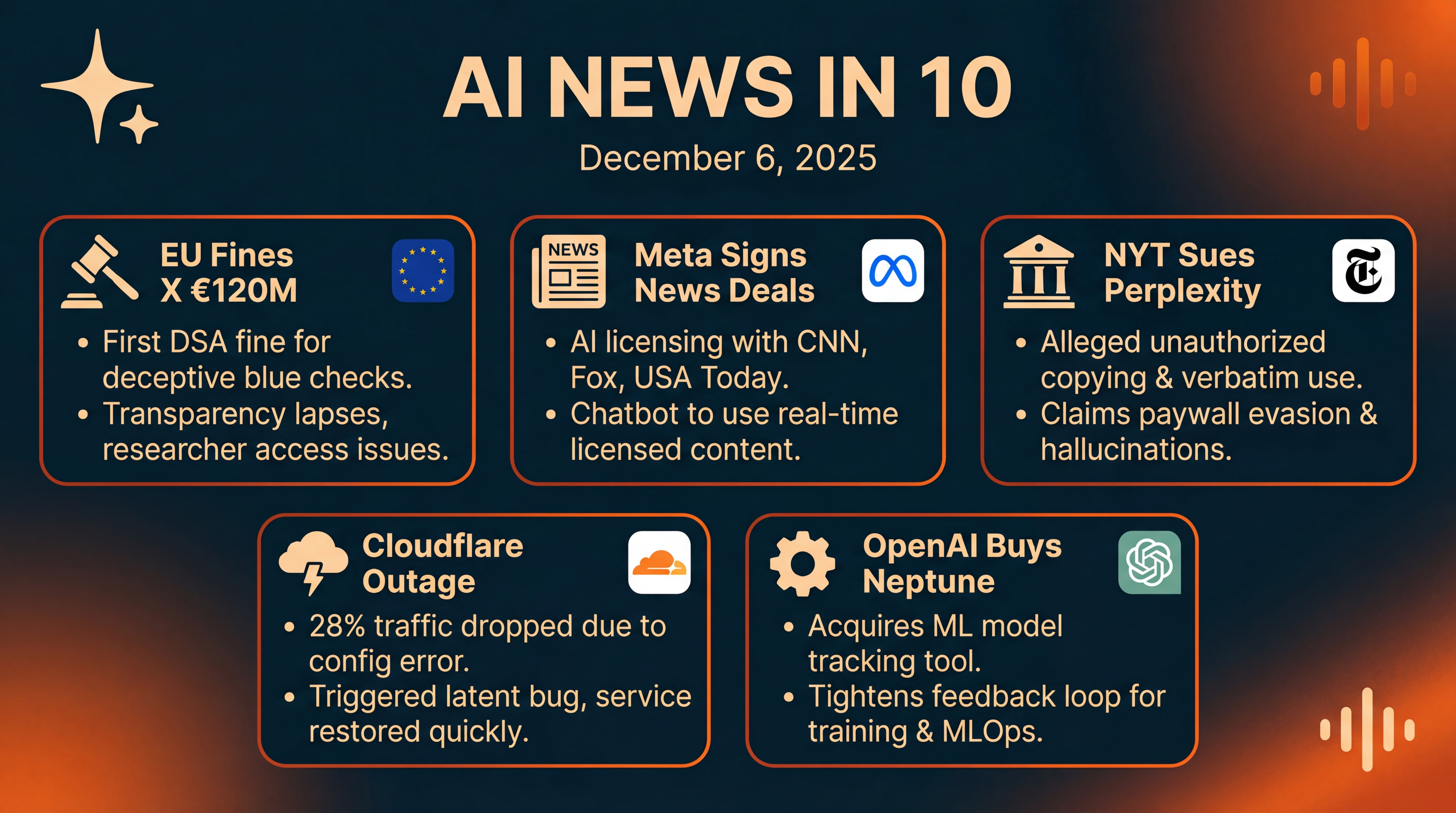
Episode Infographic
Show Notes
Welcome to AI News in 10, your top AI and tech news podcast in about 10 minutes. AI tech is amazing and is changing the world fast, for example this entire podcast is curated and generated by AI using my and my kids cloned voices...
It’s Saturday, December 6th... and we’ve got a busy one.
Europe just issued its first-ever fine under the Digital Services Act—targeting X—for deceptive blue checkmarks and transparency lapses. Meta, meanwhile, is taking a different tack with the news business, signing AI licensing deals with major U.S. and European publishers. On the legal front, The New York Times filed a fresh suit against Perplexity over alleged verbatim copying of its work. We’ll also break down Cloudflare’s latest outage—why about a quarter of its traffic blinked off—and finish with OpenAI’s acquisition of Neptune, a behind-the-scenes toolmaker for tracking model training.
[BEGINNING_SPONSORS]
Let’s start in Brussels.
The European Commission fined X—formerly Twitter—120 million euros, about 140 million dollars, for breaking the DSA’s transparency rules. Regulators say the platform’s pay-to-play blue checkmark is deceptive because it can imply verification even when X hasn’t meaningfully verified identity. The decision also cites a lack of ad library transparency and barriers to researcher access to public data.
This is the DSA’s first noncompliance decision—a signal the Commission is ready to enforce hard. X now faces tight timelines: 60 days to address the checkmark design, and 90 days to improve ad transparency and researcher access—or face further penalties up to 6 percent of global revenue.
U.S. officials have complained that the EU unfairly targets American companies. Brussels says this is about user protection and transparency, not censorship. Expect the transatlantic rhetoric to heat up. Sources include the European Commission, Reuters, and TechCrunch.
Two quick takeaways. One: the EU is treating so-called dark patterns as a compliance risk—not just a UX faux pas. Two: researcher access isn’t a nice-to-have—it’s becoming a regulatory requirement in Europe. If you operate at platform scale in the EU, keeping an up-to-date ads repository and enabling bona fide research access just moved from PR talking point to legal obligation. Sources include the European Commission, Euronews, and Al Jazeera.
To the U.S. now, where platforms are picking their strategy for AI and news.
Meta announced multiple AI licensing deals—with CNN, Fox News, USA Today, People, The Daily Caller, The Washington Examiner, and France’s Le Monde, among others. The idea: Meta’s chatbot can answer news questions and link to these outlets, drawing on real-time content under commercial agreements.
Terms weren’t disclosed, but the direction is clear. Rather than scrape and litigate, Meta is trying to license and integrate—betting that quality, trusted feeds will make its AI more useful and more defensible. Sources include Reuters and The Verge.
It’s interesting timing, because on the same day, another part of the media-and-AI story flared.
The New York Times sued Perplexity in federal court, alleging the startup copied and distributed millions of Times articles without permission—sometimes producing responses verbatim or substantially similar to paywalled work—and even hallucinated content while displaying Times trademarks. The complaint also claims Perplexity evaded robots.txt and other protections. Perplexity says it indexes public pages and disputes the characterization.
However this resolves, it’s setting precedent around how AI services source, summarize, and attribute journalism. Sources include Reuters and The Verge.
Zooming out, you can see two diverging paths. Meta is paying to bring curated news into its AI—while some AI players face litigation over alleged unlicensed use. For publishers, it’s leverage: licensing cash and distribution on one side, legal remedies on the other. For users, it could decide whether your AI assistant answers with vetted links... or with mystery meat.
[MIDPOINT_SPONSORS]
If your favorite sites sputtered yesterday, you weren’t imagining it.
Cloudflare had another outage—its second big one in roughly two weeks—briefly impacting about 28 percent of its HTTP traffic. The company says this was not an attack. Instead, engineers rolled out a configuration change tied to mitigating a newly disclosed React Server Components vulnerability, and that change triggered a long-latent bug in the older FL1 proxy rules engine—causing HTTP 500 errors from 8:47 to 9:12 UTC.
Cloudflare reverted the change and restored service in about 25 minutes. The postmortem is unusually detailed—down to a Lua nil pointer where the failure happened—and the company says it’s freezing nonessential changes while finishing a resilience overhaul that emphasizes gradual rollouts, stronger fail-open defaults, and faster rollback tooling. Sources include the Cloudflare engineering blog and Reuters.
Why it matters: when a provider at Cloudflare’s scale coughs, the internet catches a cold. The incident underscores both the gains and the risks of consolidating security and performance behind a few massive edge networks. Expect more customers to ask for multiregion—and even multiprovider—failovers, and for regulators to keep probing systemic internet fragility after a string of industry-wide outages. Source: Cloudflare engineering blog.
And finally, some deal news that’s small in dollar terms but big for AI plumbing.
OpenAI agreed to acquire Neptune, a startup whose tools track and visualize model training—think experiment logs, metrics, and debugging across massive runs. Financials weren’t disclosed, but reports peg it under 400 million dollars in stock. OpenAI already used Neptune—bringing it in-house tightens the feedback loop between research and operations as models scale and training gets more complex.
Neptune’s customers include Samsung, Roche, and HP. The product originated at Deepsense and spun out in 2018. For enterprises, this is a reminder that MLOps isn’t a buzzword—it’s how frontier labs keep experiments reproducible and ship on time. Source: Reuters.
Quick pulse check on the day’s arc.
In Europe, enforcement is here—the DSA’s first fine is a shot across the bow for UI design and transparency. In the U.S., platforms and publishers are drawing their battle lines: some licensing, some litigating. The internet’s backbone showed its seams again, with a clear lesson on defensive change management. And the AI stack keeps consolidating—OpenAI’s Neptune deal is about making the engine room run hotter... and cleaner.
That’s your wrap for today—five stories, one through-line. AI and tech aren’t just evolving; they’re being negotiated... in code commits, courtrooms, contracts, and compliance deadlines. We’ll see you tomorrow.
Thanks for listening and a quick disclaimer, this podcast was generated and curated by AI using my and my kids' cloned voices, if you want to know how I do it or want to do something similar, reach out to me at emad at ai news in 10 dot com that's ai news in one zero dot com. See you all tomorrow.