Apple’s AI Reset, Robots Rise, NeurIPS Reckoning
From Apple’s AI leadership shake-up to cross-border cyber intrusions, we break down the week’s biggest developments — plus China’s robot momentum, a growing Salesforce-linked breach, and hard truths from NeurIPS. We wrap with practical takeaways for shipping AI and a timely warning on deepfake-enabled kidnapping scams.
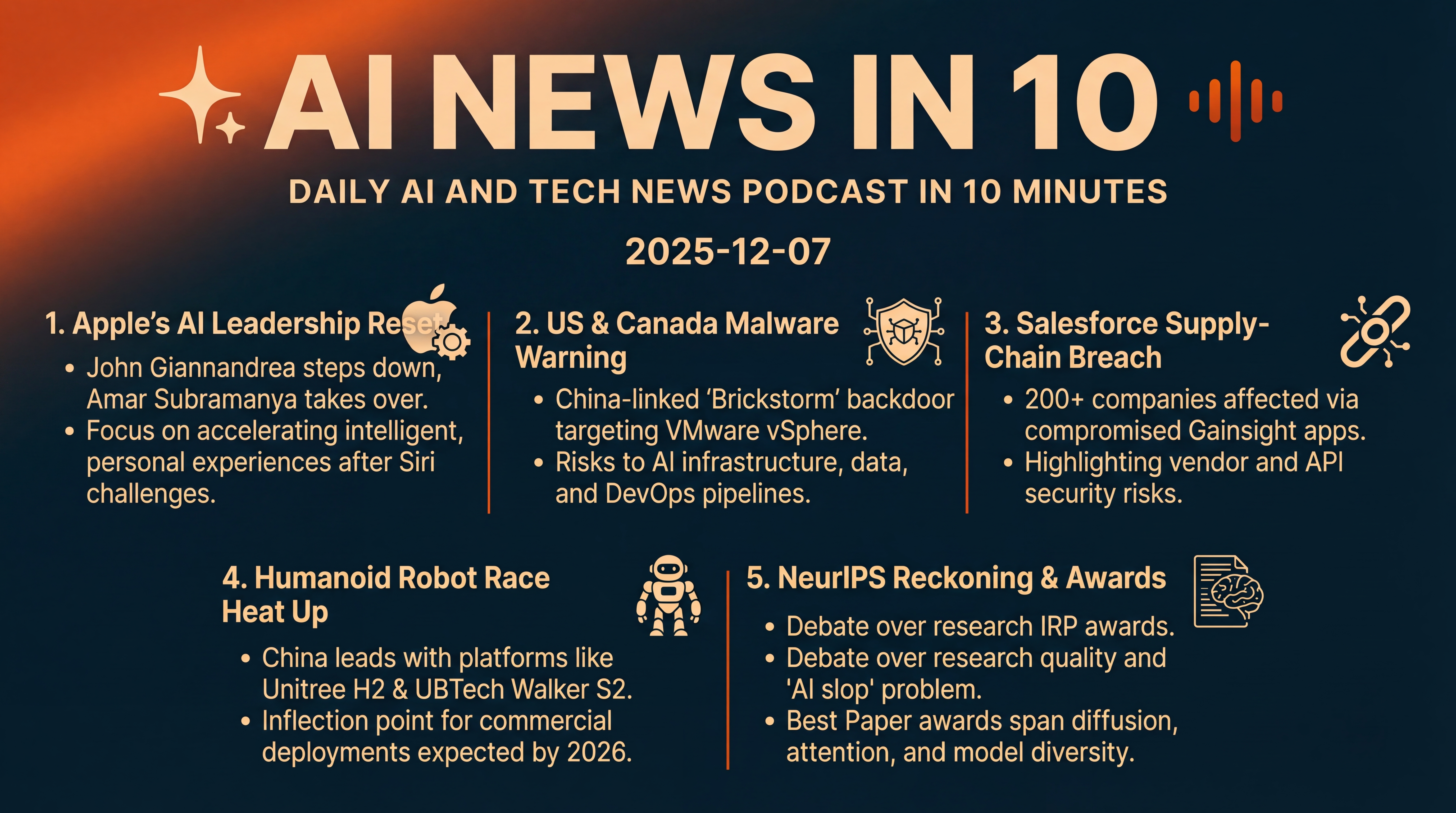
Episode Infographic
Show Notes
Welcome to AI News in 10, your top AI and tech news podcast in about 10 minutes. AI tech is amazing and is changing the world fast, for example this entire podcast is curated and generated by AI using my and my kids cloned voices...
It’s Sunday, December 7th, and we’ve got a brisk tour through the five biggest AI and tech developments you should know about today. Apple is reshuffling its AI leadership, the U.S. and Canada are warning about a state-linked malware campaign burrowing into enterprise infrastructure, and a sprawling supply-chain breach tied to Salesforce apps continues to ripple across industries. We’ll also look at why this week’s big robot show in Tokyo suggests the humanoid race is tilting toward China — and finish with a reality check from NeurIPS about research quality and what actually won Best Paper this year. Let’s jump in...
[BEGINNING_SPONSORS]
Story one — Apple’s AI shake-up.
Apple announced that longtime AI chief John Giannandrea is stepping down. He’ll advise the company before retiring in spring 2026.
Taking the helm is Amar Subramanya — a veteran of Microsoft and Google — who will serve as vice president of AI and report to Craig Federighi. Apple says Subramanya will lead Apple Foundation Models, machine learning research, and AI safety and evaluation, while parts of Giannandrea’s org shift to Sabih Khan and Eddy Cue to better align with operations and services. The company framed the move as positioning Apple to accelerate work on intelligent, trusted, personal experiences after a challenging year for Siri upgrades.
You can see the transition happening in real time. Apple removed Giannandrea from its leadership page on December 3, after confirming his retirement plan two days earlier. Reporting also notes that Subramanya isn’t yet listed, but is set to join Federighi’s team, while elements like AI Infrastructure and Search and Knowledge are being reassigned internally.
And there may be more movement to come. A fresh report today suggests Johny Srouji — Apple’s senior VP who led its chip renaissance from A-series to M-series — could be weighing an exit, amid a broader wave of senior departures this year. Apple hasn’t confirmed that, but if true, the optics would be significant — a hardware brain trust shift at the same time Apple is rewiring its AI leadership.
Big picture: this is Apple trying to reset its AI execution while the market demands faster progress. If Subramanya brings over the best of what he learned building consumer assistants and foundational models elsewhere, expect iPhone-first AI features to get more personal, more private, and — crucially — on time.
Story two — a cross-border cybersecurity alert with AI implications.
The U.S. Cybersecurity and Infrastructure Security Agency and Canada’s Centre for Cyber Security say China-linked hackers have been using a backdoor dubbed Brickstorm to burrow into government and IT networks — sometimes for more than a year — targeting VMware vSphere environments. The joint advisory details credential theft, persistent access, and potential sabotage pathways. Broadcom, which owns VMware, acknowledged customer responsibilities around patching, while China’s embassy dismissed the allegations as baseless. The campaign’s longevity — from April 2024 through September 2025 in one case — is a wake-up call on how state actors use living-off-the-land tactics to stay hidden.
Why this matters for AI — the same infrastructure that trains and runs models, like virtualized GPU clusters, management planes, and DevOps pipelines, often sits alongside or on top of vSphere. Compromised identity stores and hypervisor layers are a worst-case scenario — they give adversaries a perch to observe, and potentially tamper with, crown-jewel workloads, including model artifacts and data. If your organization is modernizing for AI, this is your reminder to modernize identity, segmentation, and patch hygiene in lockstep.
Story three — the Salesforce and Gainsight supply-chain breach keeps growing, and it’s not the only one.
Google’s Threat Intelligence Group says more than 200 companies had Salesforce-hosted data stolen through compromised apps from Gainsight, a popular customer-success vendor. The attackers — self-described as the Scattered Lapsus Hunters collective — allegedly piggybacked from an earlier campaign against another vendor to hop into linked Salesforce instances and exfiltrate data. Salesforce says its platform wasn’t the source of the vulnerability. Gainsight is working with Mandiant, and Salesforce has revoked access tokens during the probe.
And it isn’t just Salesforce-adjacent firms notifying customers. In a separate incident, banks and mortgage players have been assessing fallout after a November breach at fintech provider SitusAMC, which handles mountains of loan-related data — the FBI says it’s on the case. Meanwhile, marketing technology firm Marquis notified clients of an August ransomware intrusion in which a SonicWall vulnerability was exploited to access files containing personally identifiable information. The lesson is the same: your risk surface is also your vendors’ risk surface.
If your team is rolling out AI copilots and agents that tie into CRMs and data lakes, build vendor due diligence and token governance into the roadmap. The convenience of plugging models into business systems is exactly why attackers target the connective tissue.
[MIDPOINT_SPONSORS]
Story four — the humanoid race is getting real, and China’s momentum was on full display in Tokyo.
At the International Robot Exhibition — iREX — this week, reporters observed that Chinese players are now setting the pace in humanoids, with platforms like Unitree’s H2 and UBTech’s Walker S2 moving quickly toward commercial deployments. Analysts see a 2026 inflection point — tens of thousands of humanoids sold annually — scaling to more than a million by the early 2030s if costs drop and reliability climbs. That has big implications for AI, because skillful manipulation and robust locomotion depend on high-quality perception, world models, and policy learning — the same areas advancing in frontier AI labs.
And it’s not just bipedal heroes on stage. Hyundai showed a production-ready version of MobED, a compact, posture-controlling mobile platform that blends automotive-grade stability with AI-powered navigation. It’s aimed at logistics, research, and film crews — and it comes with open APIs to build on. Think of it as a developer kit for embodied AI in the field, with a Pro variant slated for the first half of 2026.
Why this matters: over the last 18 months, the conversation shifted from neat demos to supply chains, training data, and use-case fit. If China can translate its rapid iteration into reliable factory workers and warehouse runners, expect a race over standards, safety, and export controls — especially as U.S. automakers and logistics companies place their own bets. For teams building AI agents, note how quickly these robots are adopting modular APIs and simulation-to-real workflows — those same patterns make them natural targets, and natural partners, for enterprise AI platforms.
Story five — NeurIPS, a celebration and a reckoning.
The world’s biggest machine learning conference wrapped up in San Diego this weekend under a cloud of debate over research quality. A widely read piece highlighted what critics call an AI slop problem — a flood of superficially novel, poorly reviewed papers, and questionable authorship practices that strain conference workflows and make replication harder. One case that set off alarms involved an individual credited on astounding numbers of accepted papers, raising questions about mentorship versus meaningful contribution. The worry is simple — perverse incentives are rewarding volume over rigor.
But the science isn’t standing still. NeurIPS announced its 2025 Best Paper awards, spanning diffusion theory, attention mechanisms, online learning, neural scaling, and a new dataset effort probing whether large language models converge on homogenous, hive-mind outputs. That last one — Infinity-Chat — zeroed in on creativity, preference diversity, and how alignment might unintentionally collapse variety in model responses. It’s a useful counterpoint to the slop critique — the field is still pushing frontiers while grappling with its own growing pains.
What should you take from this if you’re shipping AI products? First, treat leaderboard bumps with skepticism — ask for ablations, compute budgets, and failure modes. Second, favor benchmarks that reflect your use case over general-purpose averages. And third, when your business depends on long-horizon agents and tool use, pilot with reproducible research and — where possible — evaluate with your own ground truth.
Quick coda before we go: the FBI just warned about a surge in AI-enabled virtual kidnapping scams using convincing cloned voices, photos, and videos to demand fast ransom payments. Their advice is simple and practical — set a family safe word, hang up and call back on a known number, and don’t let urgency override verification. It’s grim, but timely, as deepfake tooling gets ever easier.
That’s a wrap. Today we covered Apple’s AI leadership reset, a serious warning about state-linked intrusions into core infrastructure, the latest on a cascading supply-chain breach, how the humanoid robot race is accelerating — especially in China — and the NeurIPS split-screen of quality concerns and genuine breakthroughs. Keep your eyes on Apple’s next AI moves, refresh your vendor risk playbook, and remember — rigor beats hype every time.
Thanks for listening and a quick disclaimer, this podcast was generated and curated by AI using my and my kids' cloned voices, if you want to know how I do it or want to do something similar, reach out to me at emad at ai news in 10 dot com that's ai news in one zero dot com. See you all tomorrow.