
Ad-Light Experiments, Tougher AI Rules, Chip Winners
From Brussels to Washington, we unpack Meta’s EU ad-light gambit, the UK’s call for binding frontier AI rules, a Supreme Court case that could reshape agency independence, Gartner’s reset for automaker AI spend, and the chipmakers riding Amazon’s AWS build out. Fast context, clear takeaways, and what to watch next.
Episode Infographic
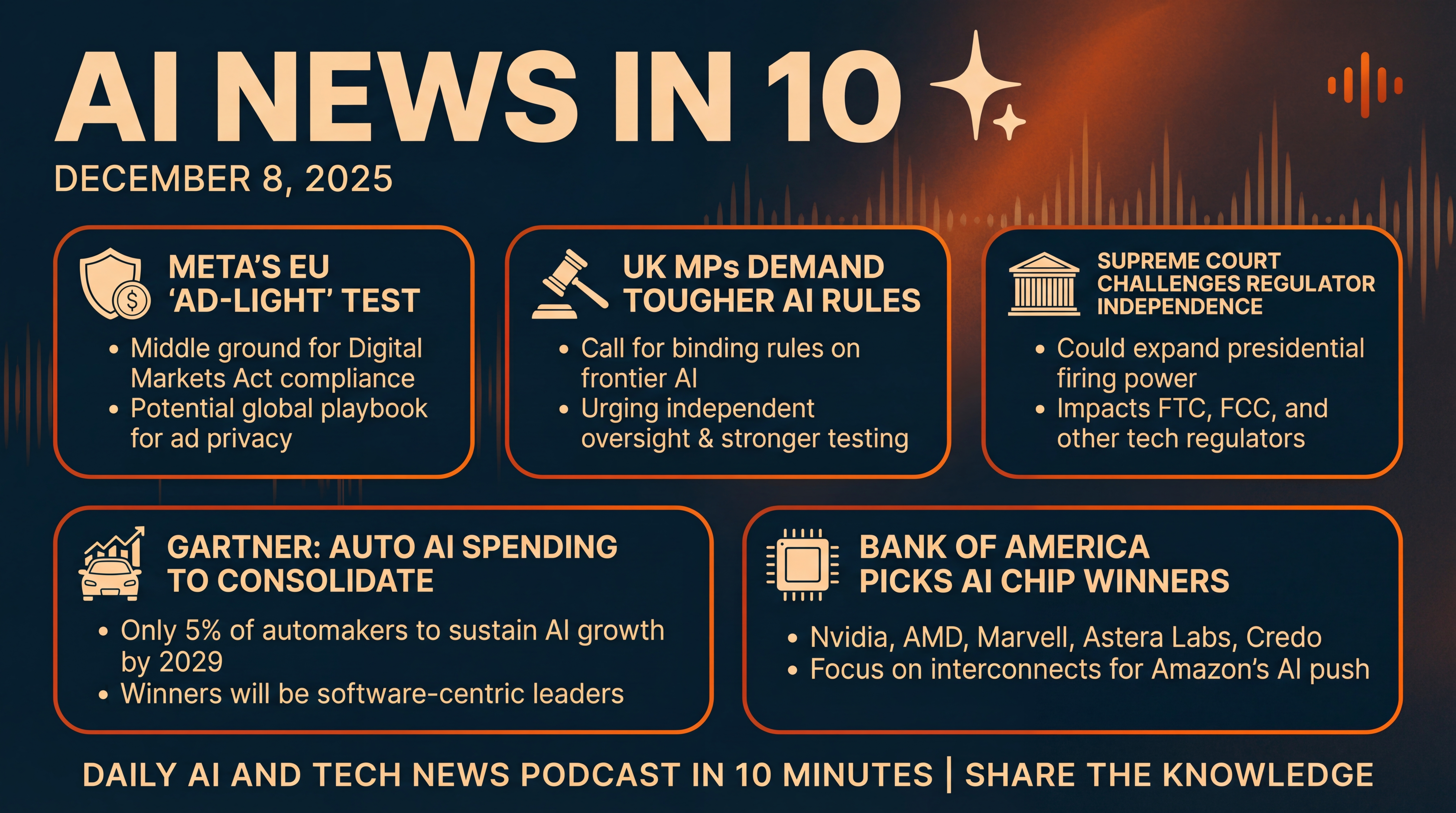
Show Notes
Welcome to AI News in 10, your top AI and tech news podcast in about 10 minutes. AI tech is amazing and is changing the world fast, for example this entire podcast is curated and generated by AI using my and my kids cloned voices...
It’s Monday, December eighth. Here’s what’s new in AI and tech today.
Fresh regulatory maneuvering from Meta in the European Union that could reshape ad models across big platforms... a coordinated push from UK lawmakers to lock in binding rules on the most powerful AI systems... a US Supreme Court case that could redefine how independent our tech regulators really are... a sobering forecast for automakers’ AI spending from Gartner... and a Wall Street note picking semiconductor winners from Amazon’s latest AI infrastructure strategy.
Let’s dive in.
[BEGINNING_SPONSORS]
We start in Brussels, where Meta is trying to thread the Digital Markets Act needle. The company is testing a new ad-light option for EU users — a middle ground between paying for ad-free Facebook and Instagram, or consenting to full tracking.
EU regulators had warned about escalating daily penalties under the DMA. Meta’s move is being treated as a positive step while the investigation stays open and compliance is monitored.
Why it matters... If Europe accepts a middle lane between pay-or-consent and fully personalized ads, other gatekeepers could borrow the playbook. It also shows how the DMA is already forcing product and business model choices at US tech giants. That said, the Commission will want to see real outcomes — lower data use for targeting, and clear user controls — before declaring victory. Reported by the Financial Times.
Across the Channel, a broad chorus inside the UK Parliament is asking the government to go further — and faster — on frontier AI. More than one hundred parliamentarians from different parties and devolved legislatures are calling for binding rules on the most powerful systems. The effort is coordinated by the nonprofit Control AI, backed by Skype co-founder Jaan Tallinn.
Their letter urges Prime Minister Keir Starmer to resist US pressure against tougher rules, and to push for independent oversight, stronger testing requirements, and global standards. Notable voices like Yoshua Bengio and Jared Kaplan are cited as warning that self-training AI could escalate risks if left unchecked. The UK hosted an AI Safety Summit and set up an AI Security Institute — but critics say progress toward enforceable rules has lagged the pace of capability leaps. Reported by The Guardian.
Now, over to Washington, where the Supreme Court has accepted a case that could reshape the ground under US tech regulation. The justices will hear a challenge testing whether President Trump can remove FTC commissioner Rebecca Slaughter before her term ends — potentially taking aim at a 1935 precedent that protects independent agency officials from being fired without cause.
A ruling that expands presidential removal power would reverberate through agencies that police tech and AI. Think the FTC on acquisitions, app stores, and data abuses. The FCC on spectrum and broadband. And even the Fed and the CFPB on fintech. It could also influence how aggressively the government scrutinizes AI mega-deals and partnerships going forward. A decision is expected by June 2026. Reported by Reuters.
Let’s shift gears — literally — to autos. Gartner has a reality check for the AI arms race in carmaking: by 2029, only around five percent of automakers will sustain strong growth in AI investment, down from over ninety-five percent today.
The firm argues that only companies with deep software talent, a long-term AI strategy, and leadership that elevates software to the top table will pull ahead. Legacy players like Volkswagen face cultural and structural hurdles as they chase software-centric rivals such as Tesla and BYD. The takeaway isn’t that AI fades from cars — it’s that the spending spree narrows to a few winners who can turn models and data pipelines into products and margin, while others retrench. If you’re in mobility or the supply chain, plan for a more concentrated customer base for advanced AI features by the late 2020s. Reported by Reuters.
[MIDPOINT_SPONSORS]
To chips — because all that AI needs silicon and interconnect. Bank of America highlights five likely winners from Amazon’s latest AI push at AWS: Nvidia, AMD, Marvell Technology, Astera Labs, and Credo Technology.
What’s behind the call? First, Amazon and Nvidia deepened their partnership, with AWS set to use Nvidia’s NVLink Fusion to link future AI accelerators — so Nvidia benefits not just from GPUs, but from an ecosystem increasingly standardizing around its interconnects. Second, Marvell and Credo have leverage in high-speed data center connectivity — vital when you’re moving petabytes across giant training clusters. Third, AMD remains a key supplier at AWS even if it wasn’t the marquee name on stage, while Astera Labs’ sell-off on fears of displacement looks premature, given the sheer scale of demand in the pipeline.
For context, AWS also introduced Trainium 3 servers — one hundred forty-four chips per box, with claims of more than four times the performance at forty percent less power — and previewed where the next Trainium could go with Nvidia tech. Put together, the message from Wall Street is clear: the AI build out is expanding beyond GPUs to networking, memory, and packaging — and the winners are the ones that ride the interconnect wave. Reported by Business Insider.
Let’s connect a few dots across today’s stories. If Meta’s ad-light path sticks in the EU, it could become a playbook for balancing privacy rules with ad-supported AI products — and it might even influence how chat assistants are monetized without turning into overt ad feeds.
But regulators are also debating structural power in AI. A former FTC official warns that consolidation — big clouds, big models, big infrastructure — could foreclose competition if enforcers move too slowly. That op-ed points to mega-partnerships across hyperscalers and frontier labs as the next antitrust front, reminiscent of mistakes around social media mergers a decade ago. It’s a theme that collides with the Supreme Court case: the closer the White House is to agencies, the more volatile enforcement becomes from cycle to cycle. Covered by the Financial Times.
Back to autos for a practical lens. Gartner’s five percent figure doesn’t mean the end of autonomy or software-defined vehicles — it suggests a sorting. If only a handful keep scaling AI investment through 2029, the supplier map tightens, with chipmakers and Tier-1s consolidating around those leaders. That could amplify the thesis on connectivity and accelerators: as winning automakers demand bigger on-vehicle and edge inference stacks, the value of standard-like interconnects and networking silicon rises.
And one more policy pulse check. Europe’s DMA pressure on Meta will shape how gatekeepers approach AI features that learn from user interactions. If Brussels backs an ad-light middle ground, expect renewed focus on transparency and consent in AI assistants — especially when models are trained or tuned on chat history. Meanwhile, in the UK, lawmakers are pushing for independent oversight and rigorous testing for the most powerful systems — an angle that aligns with today’s antitrust concerns about concentration at the top of the AI stack. Reported by the Financial Times.
Quick recap... Meta is offering EU users an ad-light path as it tries to close a DMA probe — watch for copycats from other platforms. In London, a cross-party bloc wants binding rules for frontier AI — pressure is on to move from summits to statutes. In Washington, the Supreme Court’s new case could redefine the independence of the very agencies that police Big Tech. In autos, Gartner says the AI spending party narrows fast — only five percent keep the pedal down by 2029. And on Wall Street, Bank of America circles five chip beneficiaries of Amazon’s Nvidia-aligned AI build out — Nvidia, AMD, Marvell, Astera Labs, and Credo.
That’s your AI News in ten for December eighth.
Thanks for listening and a quick disclaimer, this podcast was generated and curated by AI using my and my kids' cloned voices, if you want to know how I do it or want to do something similar, reach out to me at emad at ai news in 10 dot com that's ai news in one zero dot com. See you all tomorrow.