
Europe Probes Google, U.S. Centralizes AI Policy
From Brussels to Washington, we break down Europe’s new antitrust case against Google’s AI, a White House push for one national standard, a narrow China path for Nvidia’s H200, the FDA’s first qualified AI tool for MASH trials, and Microsoft’s multibillion-dollar Canada expansion. Clear takeaways for builders, enterprises, and policy watchers.
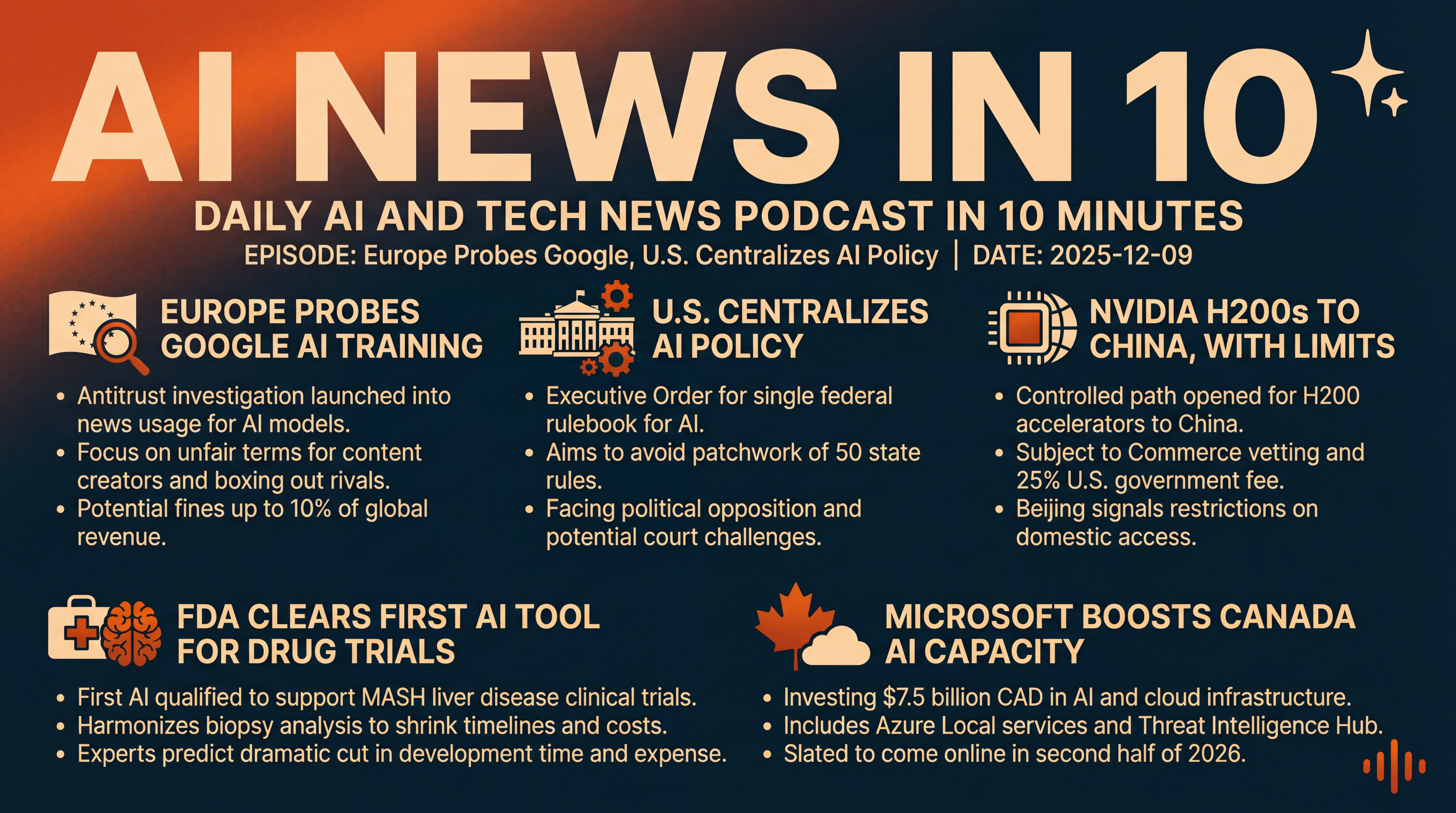
Episode Infographic
Show Notes
Welcome to AI News in 10, your top AI and tech news podcast in about 10 minutes. AI tech is amazing and is changing the world fast, for example this entire podcast is curated and generated by AI using my and my kids cloned voices...
Here’s what’s new in AI and tech today — Tuesday, December 9, 2025.
Europe fires a fresh shot at Google over how it trains and surfaces AI. The White House is readying an executive order to set a single federal rulebook for AI — setting up a clash with states. Washington opens a lane for Nvidia’s powerful H200 chips to ship to China, even as Beijing signals new limits. The FDA greenlights the first AI tool meant to accelerate drug trials for a serious liver disease. And Microsoft commits more than 7.5 billion Canadian dollars to bulk up AI and cloud capacity north of the border.
We’ll connect the dots on why each move matters — for builders, businesses, and policy watchers alike.
[BEGINNING_SPONSORS]
Let’s start in Brussels. The European Commission has opened a new antitrust investigation into Google, looking at whether the company unfairly used news publishers’ articles and YouTube videos to train and feed its AI — especially those AI Overviews that answer questions directly in search.
Regulators are asking two big questions... Did Google impose unfair terms on content creators? And did it leverage its dominance in search and video in ways that box out rivals building AI models?
If the Commission finds violations under EU competition law, fines can reach up to 10% of global revenue. Google says it’s cooperating, but warns that heavy-handed rules could chill innovation. The probe follows formal complaints from independent publishers and digital competition groups earlier this year, and it’s separate from ongoing Digital Markets Act — the DMA — proceedings focused on ranking and access.
Now to Washington. President Trump says he’ll issue an executive order this week to streamline AI approvals and effectively push for one national standard — aimed at avoiding what industry calls a patchwork of 50 state rules.
Supporters say a single playbook would keep the U.S. competitive with China. But the politics are jagged... Several prominent Republicans have publicly opposed a federal preemption push, and legal scholars note an executive order can’t simply override state law. Expect court challenges if the order tries to box states in by tying it to federal funding.
Bottom line... companies may get rhetorical clarity fast, but real regulatory certainty will still depend on Congress and the courts.
On to chips and geopolitics. The U.S. is opening a controlled path for Nvidia’s H200 accelerators to reach approved customers in China — paired with a 25% fee that goes to the U.S. government. Blackwell and Rubin, Nvidia’s bleeding-edge platforms, remain off-limits. Commerce will vet buyers, and the policy aims to balance national security guardrails with industry demand.
Almost immediately, reports suggested Beijing would limit domestic access to the H200 — softening the commercial upside, and signaling that China intends to steer buyers to homegrown silicon wherever possible. Markets whipsawed on the headlines... in tech, policy can change the weather in minutes.
[MIDPOINT_SPONSORS]
A big milestone for AI in medicine. The FDA just qualified the first AI-based tool to support clinical trials for metabolic dysfunction-associated steatohepatitis — MASH, a severe form of fatty liver disease. The cloud tool, called AIM-NASH, analyzes biopsy images to score fat, inflammation, and scarring using established criteria, then hands those standardized scores to physicians for final interpretation.
Today, multiple pathologists often read the same slides — slowly and sometimes inconsistently — so a validated AI that harmonizes assessments could shrink timelines and costs for drug makers trying to bring MASH therapies to market. Experts the agency cited believe AI methods like this could cut development time and expense dramatically over the next three to five years. For patients and sponsors, that’s real velocity.
And speaking of velocity... Microsoft is putting more than 7.5 billion Canadian dollars — about 5.4 billion U.S. dollars — to work in Canada over the next two years, to expand cloud and AI capacity. That includes boosting Azure Local services, and launching a Threat Intelligence Hub focused on cybersecurity and AI security research.
New infrastructure is slated to come online in the second half of 2026. It’s the latest sign that hyperscalers are racing to add capacity wherever power, permits, and proximity to customers line up — and it folds into a broader Microsoft buildout in North America and beyond.
If you’re a developer or enterprise leader in Canada, this likely means lower latency, more AI-ready compute, and closer collaboration between industry and public agencies on cyber defense.
Quick recap... Europe barrels ahead with a competition probe into how Google sources and serves content for AI. The White House is set to test the legal boundaries of a single federal AI rule. Washington’s green light for Nvidia’s H200s is already meeting Chinese headwinds. The FDA’s first qualified AI tool for MASH could make trials faster and cheaper. And Microsoft’s multibillion-dollar Canada push underscores just how hot the AI infrastructure race remains.
We’ll be back tomorrow with what’s moving next.
Thanks for listening and a quick disclaimer, this podcast was generated and curated by AI using my and my kids' cloned voices, if you want to know how I do it or want to do something similar, reach out to me at emad at ai news in 10 dot com that's ai news in one zero dot com. See you all tomorrow.