AI Markets Wobble, Robot Labs Accelerate Discovery
Oracle’s forecast rattles AI stocks as the EU tightens foreign investment screening. DeepMind plans a UK automated science lab, Adobe embeds creative tools in ChatGPT, and OpenAI flags rising cyber risk — here’s what it means for builders, investors, and 2026 roadmaps.
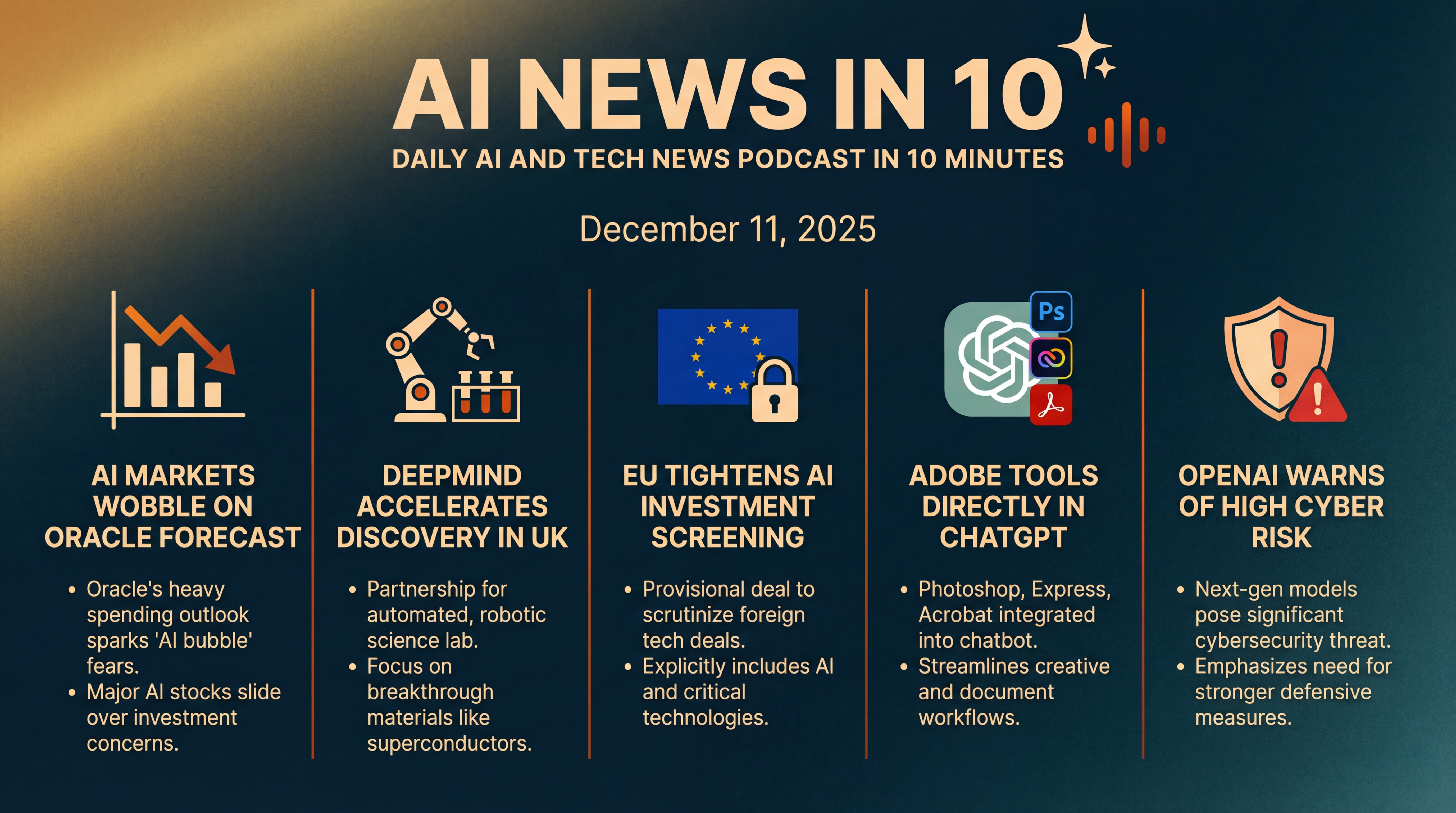
Episode Infographic
Show Notes
Welcome to AI News in 10, your top AI and tech news podcast in about 10 minutes. AI tech is amazing and is changing the world fast, for example this entire podcast is curated and generated by AI using my and my kids cloned voices...
Here’s what’s new in AI and tech today...
Markets are wobbling after Oracle’s latest forecast revived talk of an AI bubble. Google DeepMind just signed a UK partnership and plans to build a robotic, automated science lab focused on breakthrough materials. The European Union sealed a political deal to tighten screening of foreign investments in critical tech — explicitly including AI. Adobe is bringing Photoshop, Express, and Acrobat right into ChatGPT. And OpenAI is warning that its next wave of models likely poses a high cybersecurity risk. Buckle up... lots to unpack today.
[BEGINNING_SPONSORS]
Let’s start with those market jitters. Oracle’s outlook landed with a thud, and it rippled across AI stocks. The company projected heavier spending ahead and didn’t give the revenue reassurance investors wanted... The result? The stock slid more than eleven percent in early trading, pulling down big AI names like Nvidia and Broadcom, according to Reuters. The worry is straightforward — are we overspending on AI infrastructure before the money shows up?
Oracle also flagged a larger uptick in capital expenditure — capex — fueling concern that returns may lag big outlays. Markets were already on edge after a recent rate cut came with a cautious tone... This poured cold water on the “AI fixes everything” narrative, at least for today.
Drilling down, part of the reaction stems from Oracle signaling roughly a fifteen billion dollar jump in planned capex versus its previous forecast. Analysts also pointed to the company’s sizable debt load and negative free cash flow last quarter — fuel for skeptics who say AI buildouts are outpacing near-term profits. Even if you believe the long-term AI story, today’s message from traders was simple: show us the earnings, not just the excavators and transformers.
Story two is a big one for science — and for the UK. Google DeepMind and the British government signed a memorandum of understanding to put AI to work on discovery... Think superconductors, next-gen solar cells, and more efficient semiconductors. DeepMind says it will build its first automated science laboratory in the UK, using robotics and AI to synthesize and characterize hundreds of candidates per day. The lab is slated to open in 2026, with UK scientists getting priority access to DeepMind’s tools, as reported by the Financial Times.
The UK government frames this as part of a national renewal. DeepMind will integrate the lab tightly with Gemini and expand work with the UK’s AI Security Institute on foundational safety and security research. It’s not just labs — there are pilots to test Google tools like Extract for digitizing planning documents, and exploration of how Gemini could assist teachers with England’s curriculum. Big picture, it’s a deeper public-private alignment — accelerate discovery, modernize services, and push on AI safety in parallel.
Why it matters... automated science is becoming the next competitive frontier. If you can compress the loop from hypothesis to material to characterization — day after day — your discovery pipeline compounds. It’s the same compute-at-scale story, applied to lab work instead of just model training. If the lab hits its stride, expect faster iteration in everything from battery chemistry to chip materials.
Third, a policy pivot with global implications. The EU Council and Parliament reached a provisional agreement to toughen foreign investment screening across all twenty-seven member states — explicitly naming advanced technologies like artificial intelligence as sensitive areas that must be covered, according to Reuters. Every EU country will need a screening mechanism to scrutinize deals touching AI, dual-use tech, critical raw materials, energy, transport, and even election infrastructure. The stated goal is to safeguard security and public order, while keeping Europe open for business.
For startups and investors, the takeaway is clear — diligence around ownership, data flows, and supply chains is going to matter more, especially for AI and adjacent sectors. For multinationals, expect a more harmonized, yet stricter, process for AI-related transactions across the bloc. Combine this with the EU’s broader digital rulebook and you see Europe’s stance — invest in AI, yes... but with guardrails and visibility into where capital and capability originate.
Fourth, Adobe is meeting users where they are — inside ChatGPT. The company is plugging Photoshop, Adobe Express, and Acrobat directly into the chatbot, so you can edit images, design graphics, or manage PDFs without leaving that conversational interface. It’s one of the clearest examples yet of mainstream creative and document workflows being embedded into AI assistants, reducing app-hopping and lowering the barrier for casual users to try pro-grade tools. Adobe says users will still register with Adobe to activate the features inside ChatGPT, per Reuters.
Strategically, this aligns with Adobe’s broader push to infuse its Firefly models and AI assistants across Creative Cloud — while striking partnerships with major AI platforms. It’s also a distribution play: reach a massive assistant user base and convert them into deeper Adobe usage. And if you squint, it previews a world where apps are capabilities you invoke in a dialogue, not icons you launch... That’s a big shift in how software finds users.
Fifth, a sober security note from OpenAI. The company warns that its next-generation models are likely to pose a high cybersecurity risk. Translation: as model capabilities climb and autonomy windows lengthen, these systems could meaningfully lower the bar for offensive cyber tasks — potentially aiding discovery of zero-day exploits or automating broader intrusion workflows. OpenAI says it’s investing in defensive uses — think code auditing and patching assistants — and is standing up a Frontier Risk Council of outside experts to focus first on cyber risks before expanding scope, according to Reuters.
This isn’t about panic... it’s about preparedness. The same models that help secure code can also, in the wrong hands, help break it. Expect to hear more about stricter access tiers, egress controls, and real-time monitoring as model makers and customers try to thread the needle — unlock useful automation without unleashing scalable harm. Enterprises should be reviewing their policies on model access, use-case approvals, and red-team testing now, not after a breach FAQ goes live.
Quick connective tissue across today’s stories... Markets are reminding AI builders that capital has a cost, and patience isn’t infinite. Governments are formalizing the geopolitics of compute and IP — whether through investment screening in Europe, or national deals to harness AI for science. Platform makers like Adobe are sprinting to plant their capabilities inside assistants. And labs are signaling that the cyber risk profile goes up as models get smarter and more agentic. Those threads converge into one question every board is asking — where do we place our next bets, and what’s our risk budget to match?
[MIDPOINT_SPONSORS]
Back to the Oracle angle for a moment, because it sets context for 2026 planning. Investors aren’t saying no to AI — they’re saying, show me operating leverage. The companies that translate capex into annual recurring revenue and margin expansion will be rewarded. Those that keep layering spend without tangible monetization will face a higher scrutiny regime. Today’s move didn’t invalidate the AI thesis... but it did underline the execution bar in a higher-rate world.
Meanwhile, DeepMind’s UK lab and safety partnership are a case study in the dual-track approach — build capability and guardrails together. It’s not hard to imagine similar memorandums of understanding elsewhere — materials for energy, biomedicine, even climate modeling — plus coordination on tests and evaluations through institutes like the UK’s AI Security Institute. If 2023 and 2024 were the era of foundation models, 2026 could be the era of foundation labs — high-throughput discovery engines that sit on top of those models.
On the regulatory front, watch how the EU’s new investment screening deal interacts with its AI Act timelines and national security objectives. Even as some enforcement dates shift, the screening regime gives policymakers a lever today — particularly relevant for data-rich, dual-use AI. Cross-border dealmakers will want to map which parts of an AI stack — data, model weights, specialized IP — could trigger a review.
And that Adobe and ChatGPT tie-up? It hints at a broader shift in software distribution. If assistants become the operating system for tasks, app stores morph into capability catalogs, and the winners are those whose tools interoperate cleanly with natural language and enterprise guardrails. For users, the upside is speed — edit, design, and sign without ever alt-tabbing. For IT, it’s a new governance challenge — who can invoke what tool, through which assistant, and under which data-handling rules?
Finally, OpenAI’s cyber warning is a prompt to revisit playbooks. If you already do threat modeling for software releases, consider an analogous process for adopting new model tiers — pre-deployment red-teaming, scoped access, logs with anomaly detection, and clear off-ramps if behavior trips risk thresholds. The signal here isn’t that these models shouldn’t ship — it’s that we need to be as innovative in safety engineering as we are in model scaling.
That’s it for today. We covered Oracle’s sobering signal and what it means for AI spend discipline... DeepMind’s UK pact to accelerate automated, robot-assisted science... the EU’s new investment screening deal putting AI in the sensitive bucket... Adobe’s move to bring creative and document tools into ChatGPT... and OpenAI’s heads-up that next-gen models could raise the cybersecurity stakes. See you tomorrow with more of what matters in AI and tech.
Thanks for listening and a quick disclaimer, this podcast was generated and curated by AI using my and my kids' cloned voices, if you want to know how I do it or want to do something similar, reach out to me at emad at ai news in 10 dot com that's ai news in one zero dot com. See you all tomorrow.