Hollywood Backs GPT 5.2, Rivian’s Autonomy Chip
OpenAI rolls out GPT 5.2 as Disney invests and opens its IP for Sora, while Washington pushes political-bias checks for federal AI buyers. Plus, Taiwan’s sovereign AI cloud goes live, Rivian unveils a custom autonomy chip, and the EU readies DMA penalties for Google — with U.S.-China chip tensions simmering into 2026.
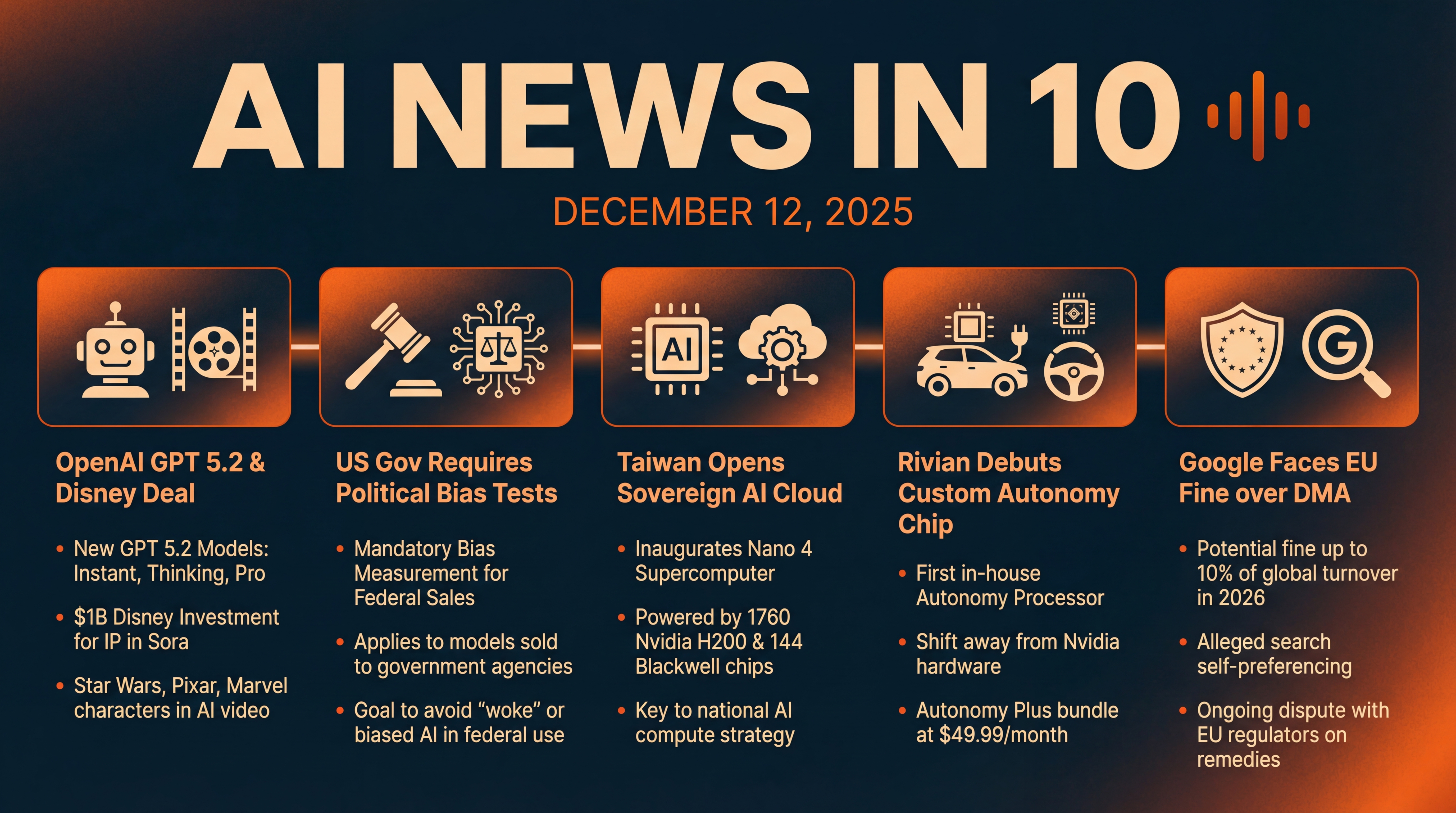
Episode Infographic
Show Notes
Welcome to AI News in 10, your top AI and tech news podcast in about 10 minutes. AI tech is amazing and is changing the world fast, for example this entire podcast is curated and generated by AI using my and my kids cloned voices...
Here’s what’s on deck for Friday, December 12, 2025.
OpenAI rolls out GPT 5.2 with a surprising Hollywood ally... Washington moves to measure political bias in AI systems selling to the government... Taiwan opens a sovereign AI cloud center anchored by a brand-new national supercomputer... Rivian shows off its first custom autonomy chip and a budget-friendly assist package... and Google’s tussle with the EU’s Digital Markets Act inches toward a possible fine next year. Let’s dive in.
[BEGINNING_SPONSORS]
First up, OpenAI’s latest.
On December 12, OpenAI began rolling out GPT 5.2 — a family of models called Instant, Thinking, and Pro — to paid ChatGPT users. The headline promises: better long context handling, stronger coding, and more agent-style, multi-step task execution — things like building spreadsheets, assembling slide decks, and managing complex projects end to end.
Earlier models — GPT 5.1, GPT 5, and GPT 4.1 — remain available through the API, which should help developers plan migrations instead of doing overnight rewrites. The launch followed a code red push inside OpenAI at the start of December to respond to Google’s Gemini 3 gains... though CEO Sam Altman says Gemini had less impact on their core metrics than expected.
Here’s the twist. Disney is investing one billion dollars in OpenAI and will allow OpenAI to use iconic characters — from Star Wars, Pixar, and Marvel — inside Sora, its AI video generator. That sets up a fascinating test: can licensed IP plus stronger generative models turn AI video from novelty into mainstream content production? It also signals that the big entertainment houses aren’t just lawyering up against AI — they’re negotiating their way in.
Second, a big U.S. procurement shift.
The White House is moving to require AI vendors to measure political bias in their large language models if they want to sell to federal agencies. The policy — announced December 11 and clarified today — exempts national security systems but otherwise applies broadly to models offered to the government.
It builds on a July directive aimed at avoiding what the administration called 'woke' AI in federal use. Practically, vendors will have to document and quantify how their systems behave across the political spectrum — not just on safety or toxicity benchmarks — before they can land agency contracts.
Microsoft and Meta, which have worked with the administration on low-cost AI offerings, declined immediate comment. Expect a compliance scramble... standardized tests for political bias are far from settled, and vendors will need to balance measurement with free speech and viewpoint discrimination risks.
There’s also rising state-level pressure. Two days ago, a coalition of state attorneys general warned Google, Meta, and OpenAI that their chatbots may be violating state laws — citing child safety concerns, allegations of harmful advice, and even claims that outputs could constitute unlicensed medical practice. They set a January 16, 2026 response deadline and called for stronger safeguards and third-party audits. The combined federal procurement bar and state enforcement posture suggest 2026 will be the year AI policy gets very specific — and very litigious.
Third, Taiwan just cut the ribbon on a key piece of its sovereign AI strategy.
President Lai Ching-te inaugurated a new cloud computing center in Tainan on December 12, anchored by Nano 4 — the island’s most powerful supercomputer. The facility draws about 15 megawatts and is packed with 1,760 Nvidia H200 accelerators, plus 144 next-gen Blackwell chips.
It’s part of a broader Ten Major AI Infrastructure Projects plan launched in July to push Taiwan from being the world’s hardware workshop into a leader in AI services and applications. If you’re mapping supply chains, note the symbolism: the world’s key semiconductor base — home to TSMC — now operating national AI compute at scale, not just exporting the parts. The move underscores how AI sovereignty increasingly means owning compute, data, and model training pipelines at home.
[MIDPOINT_SPONSORS]
Fourth, EV maker Rivian held its first Autonomy and AI Day yesterday, and the big reveal was a homegrown chip.
The Rivian Autonomy Processor is the company’s first custom silicon for self-driving — a shift away from Nvidia hardware. Rivian paired the chip with a new driver-assistance bundle called Autonomy Plus, priced at $2,500 upfront or $49.99 a month — far below the ticket for Tesla’s Full Self-Driving in the U.S.
The roadmap includes adding LiDAR sensors, debuting the stack in the upcoming R2 models, and targeting Level 4 capabilities — eyes-off driving under limited conditions — as soon as 2026. Rivian also showed a Large Driving Model to support perception and planning, and demoed an AI assistant for vehicle tasks and maintenance. Despite the tech splash, shares fell about eight percent — Wall Street wants execution proof and cost discipline. Still, if Rivian can vertically integrate compute and lower the price of advanced driver assist, it will pressure rivals on both performance and affordability.
Finally, Google’s DMA headache in Europe just got more tangible.
According to sources today, EU regulators are preparing a fine — potentially as high as ten percent of global turnover — in 2026 for alleged ongoing self-preferencing in search. The Commission charged Google in March 2025 and has since rejected multiple rounds of proposed remedies — including changes in October — arguing they still fall short of DMA requirements.
Google counters that the EU’s approach would mostly benefit intermediaries rather than European merchants selling directly. This is separate from other EU probes, like Google Play, and it’s unfolding as the U.S. government continues to criticize Europe’s digital laws for disproportionately targeting American tech firms. For product teams, the DMA pressure translates into more visible rivals in search slots and more constraints on how Google integrates Shopping, Hotels, and Flights into results — a test of how far platform neutrality will go in practice.
Quick notes to watch after we wrap.
The U.S.-China chip friction hasn’t cooled. Senator Elizabeth Warren is calling for Nvidia CEO Jensen Huang and the Commerce Secretary to testify after the administration’s move to allow licensed sales of H200 AI chips to China — even as the Justice Department cracks down on smuggling rings. Expect export policy — and hearings — to remain front-page AI news into early 2026.
That’s the lineup. OpenAI’s GPT 5.2 lands with Disney’s IP muscle... Washington pushes bias measurement for AI models sold to the feds... Taiwan powers up a sovereign AI cloud with thousands of Nvidia chips... Rivian brings autonomy in-house and undercuts rivals on price... and Google’s DMA standoff points to a potential fine next year. We’ll keep tracking the rollouts, the rulemaking, and the revenue impacts as they unfold.
Thanks for listening and a quick disclaimer, this podcast was generated and curated by AI using my and my kids' cloned voices, if you want to know how I do it or want to do something similar, reach out to me at emad at ai news in 10 dot com that's ai news in one zero dot com. See you all tomorrow.