SpaceX’s $800B Flex, Starlink Enters South Africa
SpaceX eyes a 2026 IPO amid an $800B valuation, as South Africa clears the way for Starlink. We also unpack U.S.–China chip tensions around Nvidia’s H200, Huawei’s seven-nanometer progress, and Germany’s response to AI-fueled hybrid attacks.
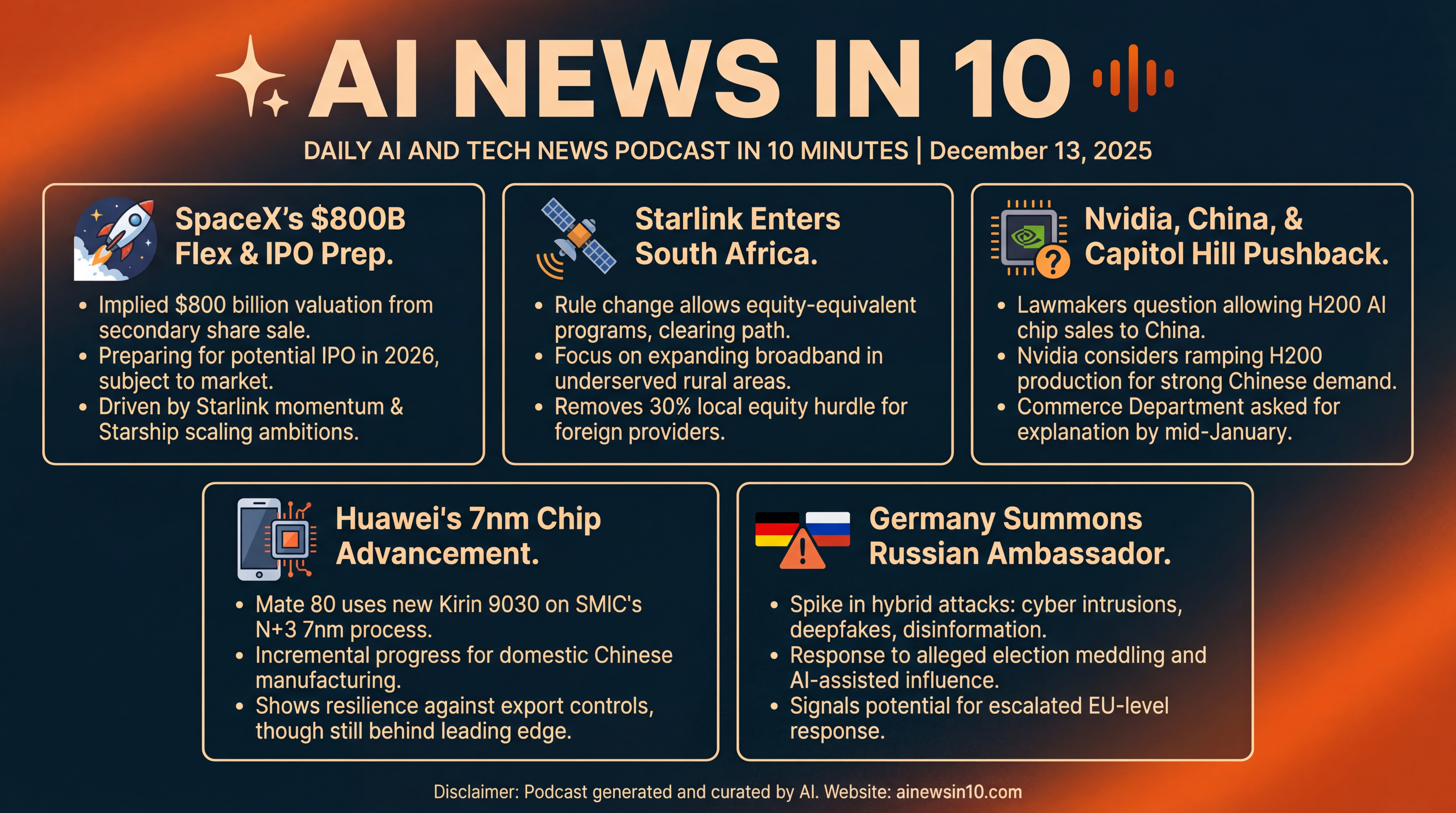
Episode Infographic
Show Notes
Welcome to AI News in 10, your top AI and tech news podcast in about 10 minutes. AI tech is amazing and is changing the world fast, for example this entire podcast is curated and generated by AI using my and my kids cloned voices...
Here’s what’s shaping the AI and tech world on Saturday, December 13, 2025... SpaceX has set an eye-popping 800 billion dollar valuation in a secondary share sale and is telling staff it’s preparing for a potential IPO in 2026. South Africa just changed the rules that kept Starlink out, clearing a path for satellite internet in underserved areas. In Washington, a key lawmaker is pressing the administration to justify allowing Nvidia’s H200 AI chips into China — while Nvidia weighs ramping output to meet Chinese demand. Over in hardware, TechInsights says Huawei’s latest flagship uses a more advanced, China-made seven nanometer chip... and Germany has summoned Russia’s ambassador over a spike in hybrid attacks, from cyber intrusions to deepfakes. Let’s dig in.
[BEGINNING_SPONSORS]
Story one—SpaceX’s 800 billion dollar flex
SpaceX told employees it’s preparing for a possible 2026 IPO and launched a secondary sale that lets eligible holders sell up to about 2.56 billion dollars in stock at 421 dollars per share — implying an 800 billion dollar valuation. That price — and the “we’re getting ready” message — came in a letter from CFO Bret Johnsen. The pitch behind that number is familiar: Starlink’s rapid subscriber growth, direct-to-mobile on the horizon, and a steady cadence of Starship development.
The company is stressing there’s no guarantee an IPO happens — market conditions and execution still matter — but the secondary gives liquidity now and signals confidence. Reuters and the Wall Street Journal report that the valuation is driven primarily by Starlink’s momentum and ambitions to scale Starship for lunar and Mars missions. Put it together, and you’ve got one of the world’s most valuable private startups... and a public-market “maybe” circled for 2026.
A quick reality check: even with that valuation, the capital needs are huge — lofting thousands more satellites, pushing direct-to-cell into commercial service, and funding an aggressive Starship flight schedule. But if Starlink revenue keeps compounding, and if Starship reusability keeps bending costs down, the math for a future listing starts to make more sense.
Story two—South Africa opens the door to Starlink
A big policy turn in South Africa: the government will allow foreign-owned satellite providers to meet empowerment requirements through equity-equivalent programs — training and other socio-economic initiatives — instead of selling 30 percent local equity. That was the hurdle keeping Starlink out. Elon Musk, who grew up in South Africa, had slammed the original rule as discriminatory.
The new directive, announced by Communications Minister Solly Malatsi, is framed as a way to expand broadband in rural and underserviced areas. Practically, it clears the regulatory path for Starlink to operate without ceding ownership — while still committing to local development. Expect a scramble by ISPs and municipalities to integrate satellite backhaul where fiber is slow or too costly... and watch how pricing lands relative to average household incomes.
Story three—Chips, China, and a Capitol Hill pushback
Washington’s China hawks want answers. House China Select Committee chair John Moolenaar has asked the Commerce Department to explain the decision to let Nvidia sell H200 AI accelerators to China — albeit with a 25 percent tariff — and he’s requested a detailed briefing by mid-January.
In the background, Reuters reports that Nvidia is considering boosting H200 production because Chinese buyers — from cloud giants to AI labs — are lining up orders. For context, H200 is significantly more capable than the constrained H20 designed to fit within export limits. Chinese officials are reportedly debating approvals and exploring bundled domestic chip purchases to support local industry.
The takeaway: policy, demand, and capacity are colliding — TSMC’s advanced packaging lines are finite — and the next few months will shape who gets how much compute. One side effect to watch... whether Chinese buyers lock into long-term commitments that reshape the global supply balance just as Nvidia’s Blackwell and Rubin generations ramp in 2026.
[MIDPOINT_SPONSORS]
Story four—Huawei’s latest phone shows China’s chip grind paying off
TechInsights’ teardown of Huawei’s Mate 80 indicates the new Kirin 9030 is fabbed on SMIC’s N-plus-3 process — an improved seven nanometer node. Still behind TSMC and Samsung’s five nanometer tech, yes... but a step forward for domestic Chinese manufacturing under export pressure.
The analysis points to incremental gains over earlier Huawei chips, with tighter design rules and yield improvements at SMIC. Beijing has had a fraught relationship with TechInsights — even placing the firm on its “unreliable entity” list in October — but the engineering facts stand: this is more advanced onshore silicon than a year ago.
For device makers, the question isn’t just performance — it’s volume. Can SMIC scale yields and output enough to make seven nanometer broadly available across product lines... or will these chips remain mostly halo parts in flagships?
Story five—Germany hauls in Russia’s ambassador over hybrid attacks
Berlin summoned Russia’s ambassador, citing a spike in hybrid threats — from cyber intrusions to disinformation and alleged deepfake meddling around recent elections. Officials referenced incidents like an air-traffic-control cyberattack and activity linked to well-known GRU-affiliated actors.
Europe’s security services have been warning all year about the uptick in AI-assisted influence operations — synthetic media that’s cheaper, more believable, and faster to deploy than the old methods. The summons signals Germany is ready to escalate its response, potentially with new defensive authorities or sanctions coordination at the EU level.
For companies, it’s another reminder that deepfake detection, content provenance, and employee phishing defenses are no longer nice-to-have — they’re table stakes.
Quick add-on: if you’re in comms or security, assume a higher baseline of synthetic content during any local political event or labor negotiation. Deepfakes and cloned-voice scams are getting better — and the time-to-detect window is shrinking.
Recap... SpaceX set an 800 billion dollar implied valuation and floated a 2026 IPO maybe. South Africa rewired its rules to let Starlink compete without local equity — in exchange for direct investment in communities. Washington is probing H200 sales into China as Nvidia weighs turning the spigot up. Huawei’s new flagship points to incremental but real progress in China’s chipmaking. And Germany is pushing back on hybrid attacks and deepfakes. We’ll keep watching how these five threads tug on the rest of the industry in the days ahead.
Thanks for listening and a quick disclaimer, this podcast was generated and curated by AI using my and my kids' cloned voices, if you want to know how I do it or want to do something similar, reach out to me at emad at ai news in 10 dot com that's ai news in one zero dot com. See you all tomorrow.