Robotaxis, Ad Labels, and the AI Power Squeeze
Waymo recalls thousands of robotaxis over a school-bus edge case, New York mandates AI performer labels in ads, Intel faces scrutiny over sanctioned chip tools, Microsoft resists nine-figure hiring wars, and hyperscalers lock in multi-gigawatt power as communities push back. A fast, clear briefing on the people, policy, and power shaping AI right now.
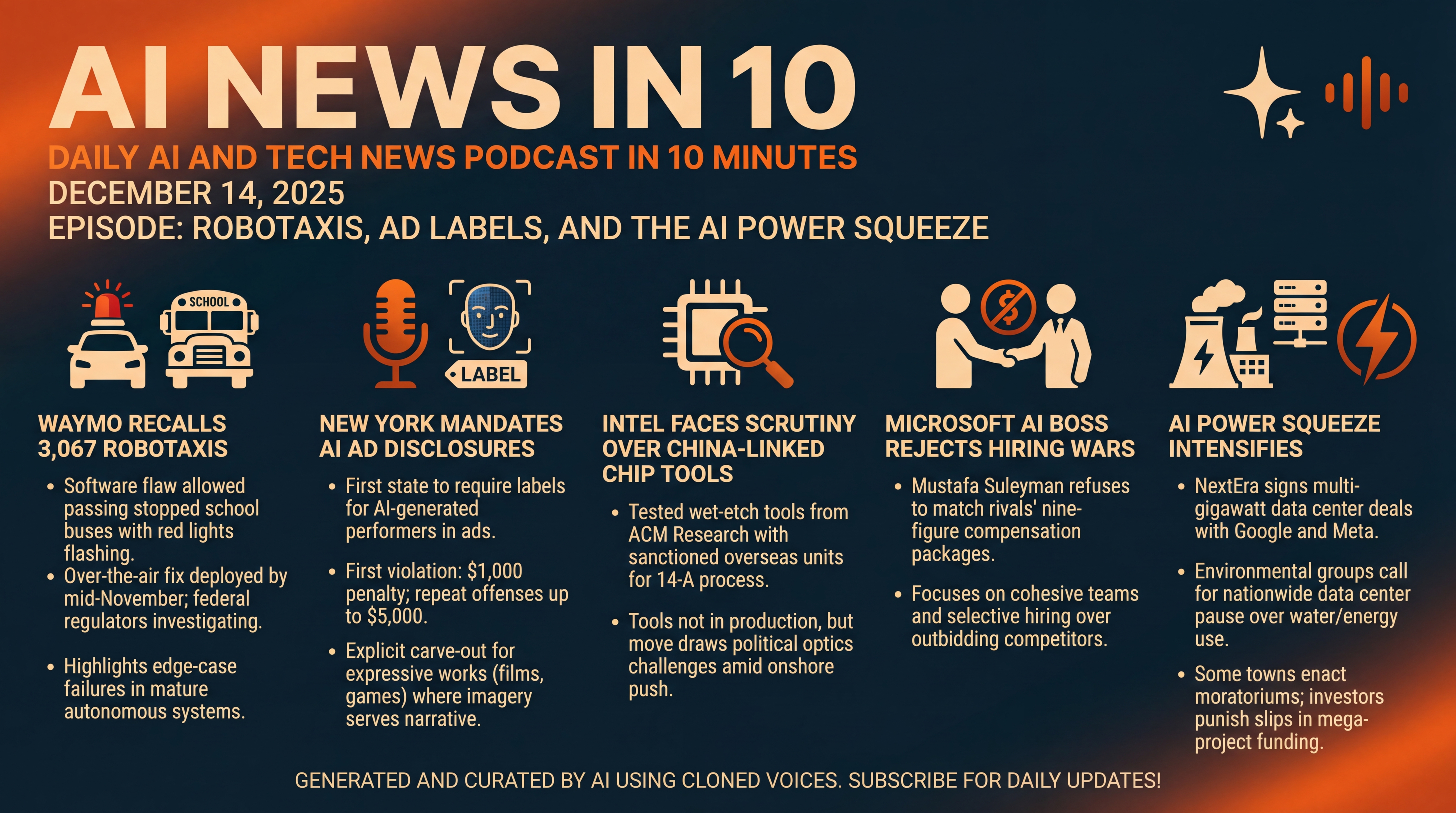
Episode Infographic
Show Notes
Welcome to AI News in 10, your top AI and tech news podcast in about 10 minutes. AI tech is amazing and is changing the world fast, for example this entire podcast is curated and generated by AI using my and my kids cloned voices...
Here's what's moving in AI and tech today.
Waymo quietly recalled more than three thousand robotaxis after discovering a software behavior that could improperly pass a stopped school bus — flashing red lights, stop arm out. New York just became the first state to require advertisers to disclose when they use AI-generated synthetic performers. Intel is in the hot seat for testing chip-fab tools from a firm with sanctioned China units. Microsoft's AI boss says he won't join the bidding war dangling nine-figure packages for elite researchers. And the AI power squeeze is intensifying — NextEra inked multi-gigawatt energy and data center deals with Google and Meta, even as local moratoriums spread and one buzzy AI-energy developer just stumbled.
[BEGINNING_SPONSORS]
Let's start with the robotaxis. Waymo issued a recall for 3,067 vehicles after its fifth-generation self-driving stack showed a corner-case behavior — proceeding past stopped school buses. The company pushed an over-the-air software fix, and says the affected vehicles were updated by mid-November.
Federal regulators — who had already been asking about Texas incidents where autonomous cars passed buses at least nineteen times this semester — now want Waymo to explain what went wrong and what changed. The big takeaway is that even mature autonomous systems can fail in high-stakes, low-frequency situations... but the fix can ship as quickly as a phone update. Watch whether NHTSA escalates its probe or considers broader rules for school-bus interactions in driverless fleets.
Policy shift next. New York's governor signed Senate bill 8420-A and Assembly bill 8887-B — the first law in the nation that requires ads to clearly disclose when AI-generated avatars or synthetic performers are used. First violations draw a one thousand dollar civil penalty, and repeat offenses can hit five thousand.
There's an explicit carve-out for expressive works — think films or games — when the synthetic imagery serves the narrative. A companion measure requires consent from a deceased person's heirs before using their name or likeness in ads. SAG-AFTRA backed the changes, arguing artists and consumers need clarity as generative tools flood feeds and billboards.
For marketers, the practical impact is simple — label it. For platforms and ad-tech, expect audits and questions about how disclosures are surfaced in small formats like Stories and Reels.
There's also a bigger New York AI bill in play — the RAISE Act on incident reporting and transparency — that's drawing last-minute edits and pressure from parents and advocacy groups. But the ad-disclosure rules are now law, and other states will likely borrow the language.
Over to chips and geopolitics. Reports say Intel tested wet-etch tools from ACM Research for its forthcoming 14-A process, targeted around 2027. The twist is that ACM has overseas units — in Shanghai and South Korea — that landed on U.S. sanctions lists last year for alleged ties to China's military-linked tech ambitions.
Intel says the tools aren't in production and that it complies with U.S. law, but the optics are rough — given Washington's push to onshore sensitive chipmaking under CHIPS Act funding. Why test them at all? Cost and performance pressure... especially as 14-A is expected to rely on pricey high numerical aperture EUV and deliver 15 to 20 percent better performance per watt versus 18-A. Expect congressional letters and due diligence questions about supply chains and tool provenance.
[MIDPOINT_SPONSORS]
Hiring wars. Microsoft AI chief Mustafa Suleyman says he won't match Meta-style mega packages — reportedly up to one hundred million dollars in signing bonuses, with total compensation in the hundreds of millions for top researchers. In a podcast interview, he emphasized building cohesive teams and hiring selectively rather than buying star talent at any cost.
It's a notable stance when even startups are offering three hundred to four hundred thousand dollar base salaries for leadership roles, and when Big Tech has been swapping top names all year. Whether this restraint sticks if rivals gain ground is an open question... but it does signal that culture, mission, and product velocity will have to carry more of the load at Microsoft than blank-check offers.
And finally, the AI power squeeze. Two dynamics collided this week — mega deals to feed AI's grid appetite, and pushback on where and how fast that buildout happens.
On the deal front, NextEra expanded its collaboration with Google Cloud to jointly develop multiple gigawatt-scale data center campuses across the U.S., pairing build-to-suit energy generation with the compute. The partners also plan to ship an AI-enhanced grid reliability product — think predictive maintenance and storm response optimization — into Google Cloud's marketplace by mid-2026. Separately, NextEra says it has now reached roughly two and a half gigawatts of clean energy contracts with Meta through eleven power purchase agreements and two storage deals slated for 2026 to 2028. Translation: hyperscalers are increasingly moving to bring-your-own-generation strategies — bundling land, load, interconnects, and long-term power at campus scale.
But the politics are heating up. More than two hundred thirty environmental groups are calling for a nationwide pause on new data centers over water and energy use. Towns are enacting short moratoriums — in Ohio, Waterville's city council hit pause for six months to study impacts — while utility commissions juggle reliability and rate pressures. The narrative is shifting from build faster to build smarter... closer to generation, with clearer community benefits.
There's also investor risk. Fermi, an AI-energy newcomer planning an eleven gigawatt campus in West Texas, just lost a 150 million dollar construction funding commitment from its first prospective tenant — and shares plunged roughly a third. Management says lease talks continue, but it's a reminder that mega projects hinge on early anchor customers... and that capital markets will punish slips.
Quick recap... Waymo's recall underscores how edge cases like school buses still trip up autonomous systems, even as over-the-air fixes get faster. New York's synthetic performer labels bring ad transparency rules into the AI era. Intel's test of ACM tools shows the geopolitical tightrope in chipmaking. Microsoft's AI boss is betting on team chemistry over nine-figure checks. And the AI power squeeze is here — hyperscalers are locking in multi-gigawatt campuses and clean energy deals even as communities and investors demand smarter, steadier buildouts. More tomorrow.
Thanks for listening and a quick disclaimer, this podcast was generated and curated by AI using my and my kids' cloned voices, if you want to know how I do it or want to do something similar, reach out to me at emad at ai news in 10 dot com that's ai news in one zero dot com. See you all tomorrow.