
Roomba Rescue, Apple Fees, and Space Compute
From iRobot's Chapter 11 and a pivotal Apple–Epic ruling to Google's real-time Translate, OpenAI's equity changes, and Blue Origin's push for orbital data centers — here's a fast, thoughtful breakdown of what matters. Get the context, the stakes, and why these moves could shape the next wave of AI.
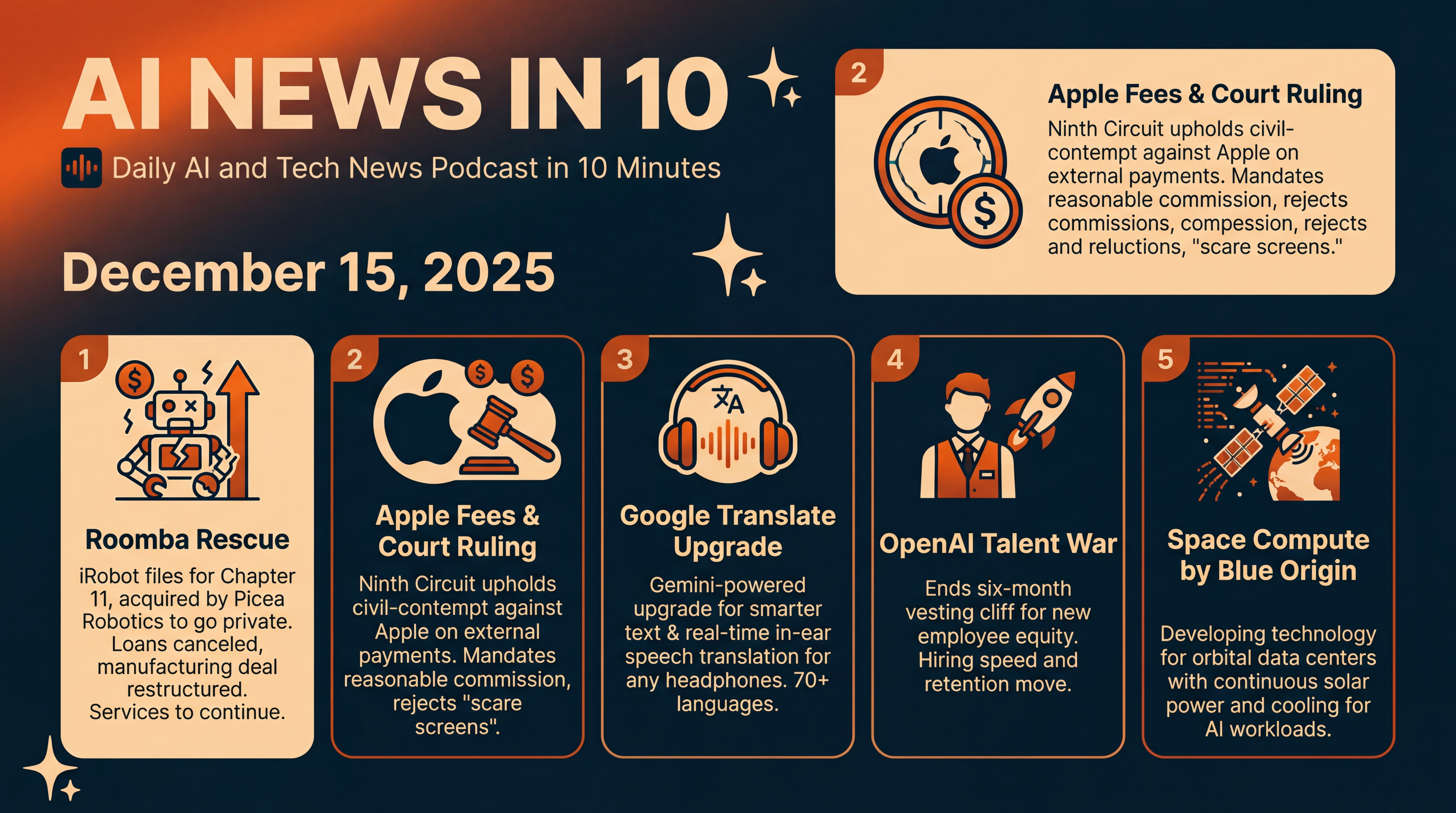
Episode Infographic
Show Notes
Welcome to AI News in 10, your top AI and tech news podcast in about 10 minutes. AI tech is amazing and is changing the world fast, for example this entire podcast is curated and generated by AI using my and my kids cloned voices...
It's Monday, December 15th. Here's your quick tour through the biggest AI and tech stories shaping the week... We've got a bankruptcy and buyout for the company behind Roomba... a pivotal appeals court ruling that could reshape how Apple charges for purchases outside the App Store... a very cool Google Translate upgrade that turns any headphones into a real-time interpreter... a compensation shake-up at OpenAI aimed at winning the AI talent war... and a wild card from space — Jeff Bezos' Blue Origin working on orbital data centers for AI. Let's get into it.
[BEGINNING_SPONSORS]
Story one. Roomba's parent, iRobot, has filed for Chapter 11 and plans to go private under an acquisition by its primary manufacturer, Picea Robotics. The plan hands Picea full ownership by canceling roughly 190 million dollars in loans, plus other obligations tied to their manufacturing deal. iRobot says your robot, the app, and support should keep working during restructuring.
This move follows years of margin pressure from cheaper rivals and tariffs — including a reported 46 percent levy on Vietnamese imports that added about 23 million dollars in costs this year — and the collapse of its proposed Amazon buyout in 2024. Reporting says iRobot still has meaningful market share in the United States and Japan, but pricing pressure and debt left the company with limited options. The company also tried to calm fears about devices bricking if the cloud went dark — and again, iRobot says services will continue during the process.
Why this matters. iRobot was an early consumer AI pioneer. Its fate is a case study in what happens when incumbents face lower-cost competitors, supply chain shocks, and thwarted mergers — all while customers rely on cloud-connected features that raise tough questions during bankruptcy.
Story two. A consequential legal update in the Apple–Epic saga. A three-judge panel at the Ninth Circuit largely upheld a civil-contempt finding against Apple for how it implemented a 2021 injunction that allows developers to link to payment options outside the App Store. The court criticized Apple's approach — think the 27 percent fee on external purchases and design restrictions that discouraged off-platform payments — but it also said an outright ban on any commission goes too far.
The case now heads back to the district court to set a reasonable commission tied to Apple's costs and IP — without letting security and privacy become a back-door surcharge. In short, Apple still has to open the door, but it can likely charge something for purchases it doesn't process. Multiple outlets also note the court's rejection of 'scare screens' and design limits that made outside payments less attractive.
Why this matters. Developers get clarity that external links are here to stay, but they'll need to budget for a court-blessed fee. Apple avoids a precedent of zero commissions and gains a path to monetize off-platform transactions — subject to judicial guardrails.
Story three. Google Translate just got a Gemini-powered glow-up. Two big parts here. First, smarter text translations that better handle nuance, idioms, and slang — 'stealing my thunder' is less likely to turn into a literal word salad. Second, a live speech-to-speech translation beta that works with any headphones, not just Pixel Buds.
The beta is rolling out on Android in the United States, Mexico, and India, covering more than 70 languages, with iOS expected next year. Early hands-on reports say the feature retains tone and cadence, so conversations feel more natural. Google also says the upgrade is now live for English with nearly 20 languages for improved text quality, and it expands the app's Practice feature to help you sharpen skills. Smart distribution — Translate has massive daily use, making it a runway for Gemini in the real world.
Why this matters. Real-time, in-ear translation is inching from sci-fi to standard. For travelers, students, frontline workers, and globally distributed teams, it's a quality-of-life upgrade that shows how AI will quietly embed into everyday tools.
[MIDPOINT_SPONSORS]
Story four. OpenAI has ended its six-month vesting cliff for employee equity — meaning new hires start vesting immediately. The change, shared internally by applications chief Fidji Simo, follows an earlier move that shortened the vesting period from the traditional 12 months to six. OpenAI sees this as a way to de-risk early tenure for recruits and stay competitive in a talent market where rivals, including xAI, have loosened equity rules.
Why this matters. With model launches, safety research, and infrastructure build-outs accelerating, hiring speed and retention are strategic weapons. Policy tweaks like removing cliffs might sound HR-ish, but they ripple across recruiting funnels and can shape where top talent lands — and what gets built next.
Story five. From the cloud... to orbit. Blue Origin has been developing technology for space-based data centers aimed at AI workloads. Think continuous solar power, abundant cooling via radiative heat rejection, and the ability to offload energy-hungry inference from Earth's strained grids. Jeff Bezos has mused that orbital data centers could beat land-based ones in the next ten to twenty years.
SpaceX is reportedly upgrading Starlink satellites to accommodate AI computing payloads — setting up a fascinating race over who brings compute to space first. And in academia, researchers have floated a tethered-chain architecture for sun-synchronous, solar-powered orbital AI clusters, arguing for multi-megawatt compute with manageable latency back to Earth. We're early, but the pieces are moving.
Why this matters. As AI demand runs headlong into power and cooling bottlenecks, space offers persistent sunlight and different thermal trade-offs. If launch costs keep falling and satellite servicing matures, orbital compute could complement terrestrial data centers — especially for inference-heavy workloads that benefit from stable, scalable power.
Quick recap... iRobot is heading through Chapter 11 with its manufacturer stepping in to take control... Apple lost big parts of its appeal in the Epic case but won a chance to charge a reasonable fee on external links... Google Translate's Gemini upgrade makes real-time, in-ear translation practical for more people... OpenAI's vesting-cliff change turns the talent dial another notch... and Blue Origin's space data-center work hints at a future where AI compute orbits above the grid. We'll keep watching how these threads evolve through the week.
Thanks for listening and a quick disclaimer, this podcast was generated and curated by AI using my and my kids' cloned voices, if you want to know how I do it or want to do something similar, reach out to me at emad at ai news in 10 dot com that's ai news in one zero dot com. See you all tomorrow.