Pact Paused, Meta Taps Chats, Nvidia Buys Slurm
Washington freezes a U.K. tech pact as Meta starts personalizing ads with your AI assistant chats, while the AI boom squeezes smartphones and reshapes energy and compute. We break down the stakes behind Google’s 21-year power deal in Malaysia and Nvidia’s Slurm acquisition — and what to watch next.
Episode Infographic
Show Notes
Welcome to AI News in 10, your top AI and tech news podcast in about 10 minutes. AI tech is amazing and is changing the world fast, for example this entire podcast is curated and generated by AI using my and my kids cloned voices...
Here's what's on deck today. Washington pauses a high-profile tech pact with the U.K... Meta starts using your AI chats to personalize ads... the AI boom quietly squeezes next year's smartphones... Google locks in long-term clean power for data centers in Malaysia... and Nvidia buys the company behind Slurm — the job scheduler that keeps AI training runs humming. Let's get into it...
[BEGINNING_SPONSORS]
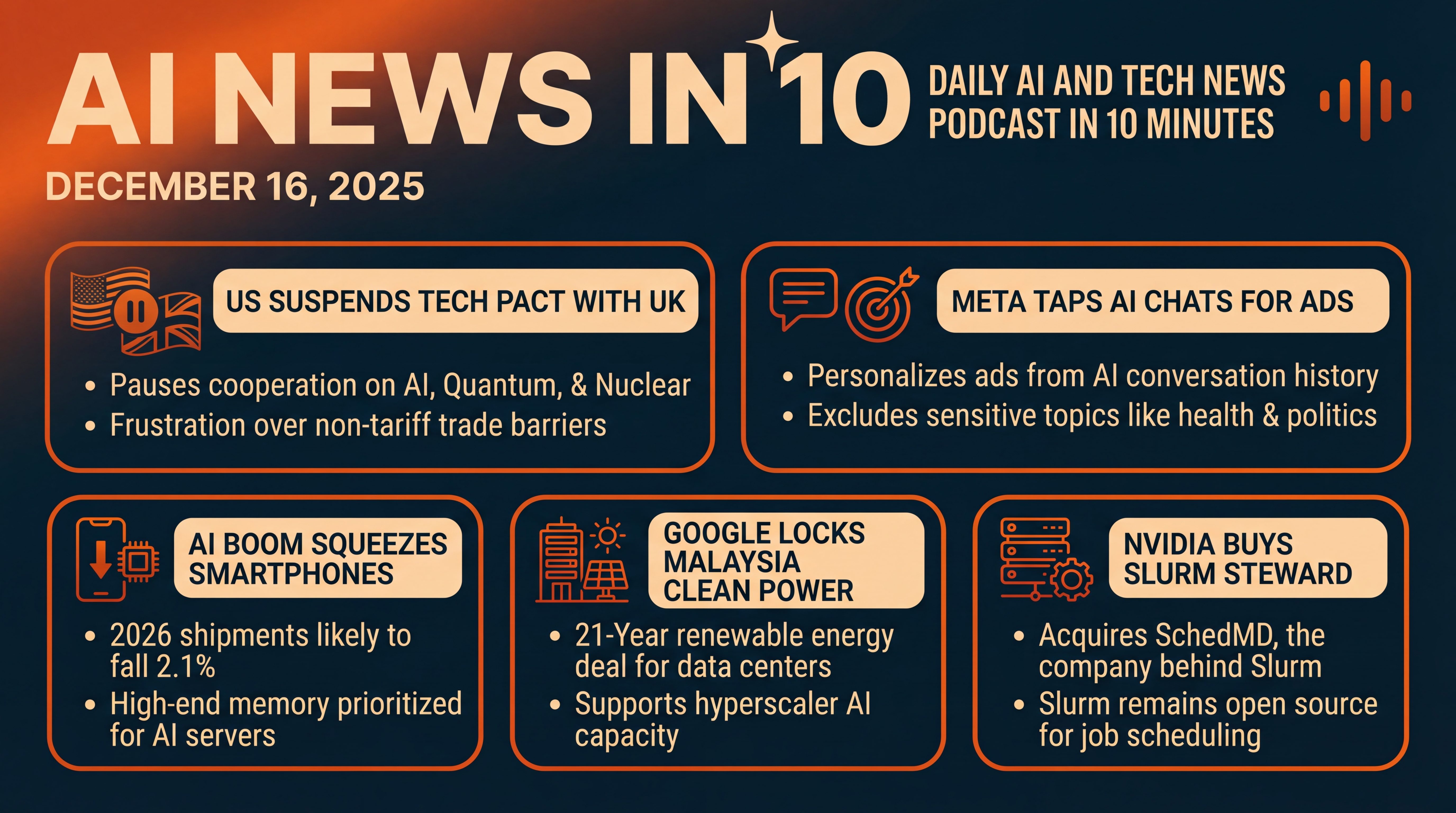
We'll start where geopolitics meets tech. Reuters reports the United States has suspended its Tech Prosperity Deal with the United Kingdom — a framework agreed in September to deepen cooperation across artificial intelligence, quantum computing, and civil nuclear energy. British officials say the suspension happened last week. Reports point to frustration inside the Trump administration with non-tariff barriers — things like food and industrial rules — stalling broader trade concessions. A U.K. spokesperson says the relationship remains strong, and Britain is still committed to making the deal deliver for both sides. The White House hasn’t publicly commented. Why it matters — joint standards and government-to-government funding often flow from these pacts. A pause could slow cross-border AI and quantum research — and complicate how labs share sensitive hardware and data.
Second, a big shift you may feel in your feed starting today — December 16, 2025. Reuters reports Meta is now using what you talk about with its assistant, Meta AI, to personalize what you see across Facebook and Instagram — including ads. There’s no opt-out if you choose to use Meta AI, though this change doesn’t apply in the U.K., the European Union, or South Korea. Meta says it will exclude sensitive topics — health, religion, sexual orientation, and political views — from ad targeting based on those chats. The company also says Meta AI reaches about a billion monthly users. Expect intense privacy debates as this rolls out. Ask Meta AI for hiking tips today, and you might see more hiking groups, friends’ trail posts, or boot ads tomorrow.
Quick analysis — this is a watershed moment in monetizing consumer chatbots. Unlike search queries or likes, conversational history is rich and nuanced — great for relevance, sensitive for privacy. Regulators in the U.S. and elsewhere will watch how Meta enforces the exclusions and disclosures here... and whether rivals follow.
Story three — the AI frenzy’s hidden ripple effect. Counterpoint Research, as reported by Reuters, says global smartphone shipments are likely to fall 2.1 percent in 2026 as chip costs keep climbing. Why? Memory makers are prioritizing high-end memory for AI servers, creating shortages in the legacy memory that low-end phones rely on. Bill-of-materials costs for sub-200-dollar handsets have jumped 20 to 30 percent since early 2025, pressuring brands like Honor and Oppo that run on thin margins. Apple and Samsung — with more pricing power and tighter vertical control — are better positioned to ride it out. One notable driver — Nvidia’s move to use smartphone-style memory chips in AI servers. That could help double server-memory prices by late 2026, because AI servers consume far more memory per box than phones do. IDC also sees a 2026 dip — though smaller, at about 0.9 percent. For consumers, that could mean fewer true budget phones and more upsell pressure. For chipmakers, tighter supply may keep margins fat.
[MIDPOINT_SPONSORS]
Fourth, power for the AI age — literally. According to Reuters, Google just inked a 21-year renewable energy deal with TotalEnergies to power its data centers in Malaysia. The agreement covers one terawatt hour of electricity from the planned Citra Energies solar plant, slated to start construction in early 2026, with supply beginning in the first quarter afterward. It follows a separate November deal to supply Google’s Ohio data centers. As hyperscalers build AI capacity, these long-dated power purchase agreements are becoming the new normal — locking in cleaner electrons and predictable pricing while local grids race to keep up. Malaysia, meanwhile, is positioning itself as a regional data-center hub, with multinationals pouring billions into facilities, water systems, and dedicated renewables.
Why this is strategic — AI servers guzzle power, far more than traditional data-center racks. Clean supply and grid interconnections are becoming competitive advantages, shaping where the next wave of AI capacity lands. Today’s deal is another sign the energy transition and the AI boom are tightly coupled.
Fifth and finally, a behind-the-scenes acquisition with outsized impact on the AI stack. Reuters reports Nvidia has acquired SchedMD — the company behind Slurm, the open-source workload manager used across supercomputing and AI training clusters to schedule massive jobs. Nvidia says Slurm will remain open source, and the company will keep supporting it. SchedMD, founded in 2010 and employing about 40 people, counts CoreWeave and the Barcelona Supercomputing Center among its customers. The move deepens Nvidia’s hold on the software that orchestrates where and how AI jobs run — complementing its CUDA moat and its growing catalog of open-source AI models. It’s also a practical bet — when your GPUs are booked solid, smarter scheduling translates directly into throughput and revenue.
What to watch next — will cloud rivals or open-source groups push alternative schedulers more aggressively to avoid vendor lock-in? And does Nvidia lean into tighter integrations — say, telemetry from its GPUs feeding back into Slurm — to eke out more performance per watt? Those incremental gains matter when training runs span weeks and millions of dollars.
Quick recap before we go. The U.S. put its U.K. tech pact on ice, injecting uncertainty into cross-border AI cooperation... Meta’s ad engine gets a new fuel source — your AI chats — rolling out today outside parts of Europe and South Korea... Counterpoint sees 2026 smartphone shipments shrinking as memory gets pulled into AI servers... Google secured 21 years of clean power in Malaysia to feed its data-center buildout... and Nvidia bought the steward of Slurm, tightening its grip on the AI compute pipeline while keeping a crucial tool open source. See you tomorrow with more AI and tech in ten.
Thanks for listening and a quick disclaimer, this podcast was generated and curated by AI using my and my kids' cloned voices, if you want to know how I do it or want to do something similar, reach out to me at emad at ai news in 10 dot com that's ai news in one zero dot com. See you all tomorrow.