Amazon OpenAI Talks, India Credit, Agentic AI
Inside Amazon’s reported ten billion dollar talks with OpenAI, George Osborne’s mandate to court governments for Stargate, Google’s UPI credit card push in India, the FCA’s approach to agentic AI, and China’s MetaX IPO surge. What it signals about chips, clouds, and the next phase of consumer finance and regulation.
Episode Infographic
Show Notes
Welcome to AI News in 10, your top AI and tech news podcast in about 10 minutes. AI tech is amazing and is changing the world fast, for example this entire podcast is curated and generated by AI using my and my kids cloned voices...
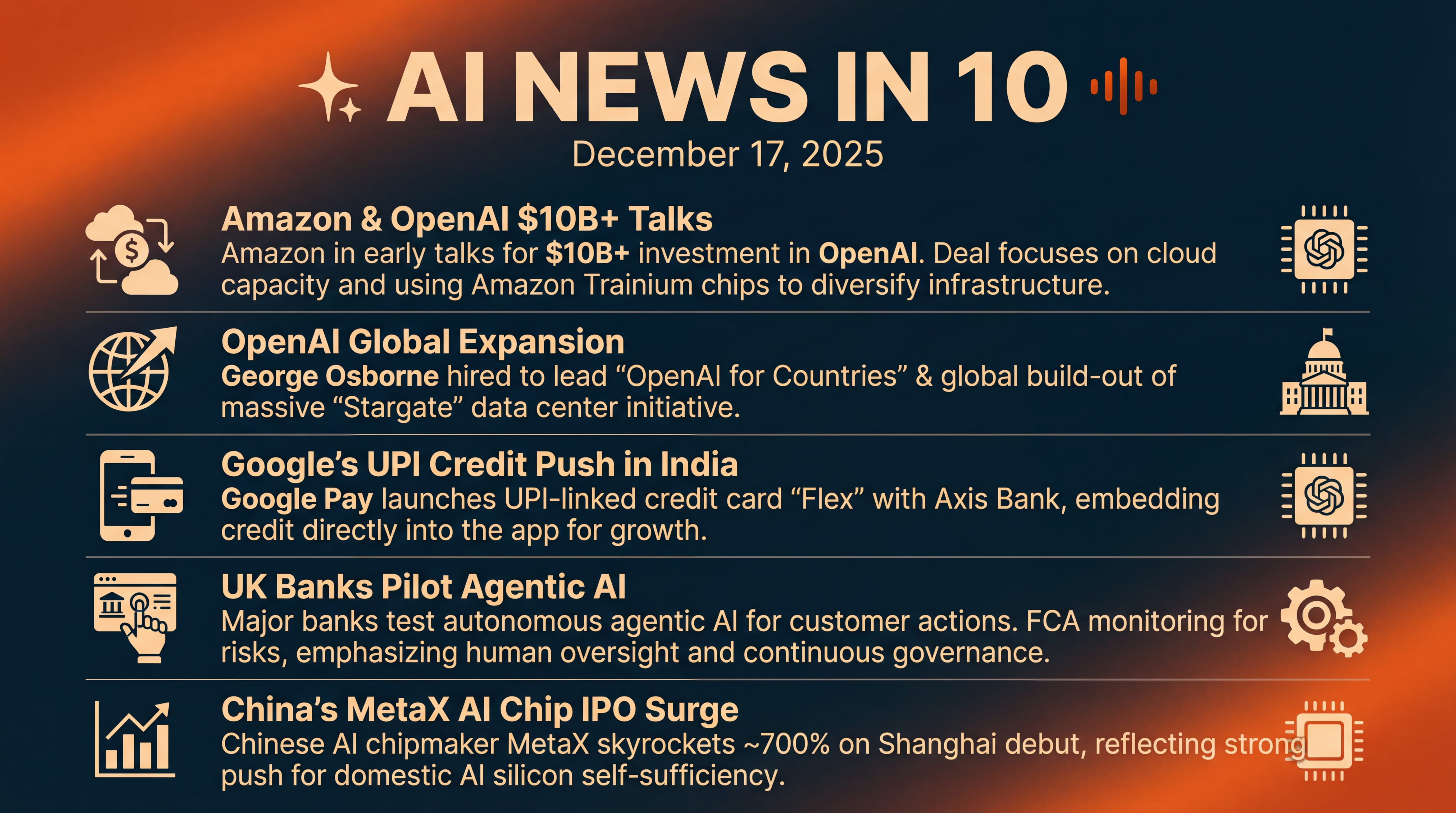
Here’s what’s on deck today... a potential mega deal that could reshape AI’s compute map. Amazon is reportedly in talks to invest more than ten billion dollars in OpenAI, and to supply chips and cloud capacity. OpenAI, meanwhile, just tapped former UK chancellor George Osborne to lead a new program called OpenAI for Countries, and to help expand the massive Stargate data center initiative globally. Over in fintech, Google is pushing deeper into India with a new UPI-linked credit card built into Google Pay. In banking, Britain’s regulator is watching closely as major banks pilot agentic AI — autonomous software that can plan and act on customers’ behalf. And in chip land, a Chinese AI chipmaker called MetaX had a blockbuster IPO in Shanghai, rocketing roughly seven hundred percent on day one.
[BEGINNING_SPONSORS]
Let’s start with Amazon and OpenAI. Multiple outlets report Amazon is in early-stage talks to invest more than ten billion dollars in OpenAI, potentially valuing the ChatGPT maker north of five hundred billion dollars. The strategic piece is as important as the cash — OpenAI would expand its use of Amazon’s Trainium chips and AWS data centers, diversifying away from a single vendor GPU stack.
There’s one wrinkle. Microsoft still holds exclusive rights to sell OpenAI’s most advanced models through its cloud, so Amazon’s role would be infrastructure and capacity — not model resale. The talks are fluid, but they’d build on OpenAI’s seven year, thirty eight billion dollar cloud commitment to Amazon announced earlier this fall. If it lands, the deal would echo the industry’s circular funding loop... clouds invest in model companies that then buy even more cloud.
A quick reality check on why this matters... Compute is the oxygen of modern AI, and the top model labs are racing to secure everything from Nvidia accelerators to custom silicon. Broadening to Trainium and other vendors — plus multiple clouds — spreads risk, taps additional energy footprints, and may lower the effective cost of training as workloads scale. Investors love the total addressable market story, but they worry about sustainability. A big ticket Amazon and OpenAI tie-up would signal that hyperscalers still believe the demand curve justifies multi billion dollar capacity bets.
Next up, OpenAI’s government playbook just got a high profile operator. The company named former UK finance minister George Osborne as managing director to lead OpenAI for Countries — overseeing partnerships with national governments and the international build out of Stargate, its umbrella for next generation AI data centers, now described as a five hundred billion dollar program over the coming years. Osborne starts in January and is slated to represent OpenAI at the World Economic Forum in Davos — a reminder that the model race is increasingly about infrastructure, energy, education, and geopolitics... not just algorithms.
Two takeaways here. First, OpenAI is formalizing a go-to-market motion that treats AI as critical national infrastructure — inviting governments into long horizon partnerships around workforce, research ecosystems, and grid planning. Second, bringing in a former chancellor signals the company expects heavy political navigation — from permitting large data center sites to aligning with national AI strategies and safety regimes. Expect similar public-private roadshows from rivals as governments compete to host compute and talent.
Story three: Google is deepening its push into consumer finance in India with a UPI-linked, co-branded credit card called Flex by Google Pay, issued with Axis Bank and running on the domestic RuPay network. It lives right inside Google Pay — for sign up, spend tracking, and bill pay — and it offers a transparent rewards scheme: Stars credited per transaction, with each Star worth one rupee. Google is also rolling out Pocket Money, letting parents grant kids limited, approval-based UPI spending capped monthly, and giving small merchants AI-assisted ad tools inside Google Pay for Business. The backdrop: India’s payments rails are world class, but credit penetration is still relatively low... so embedding credit into dominant UPI apps is a logical next wave for growth.
This is consequential for three reasons. One, it puts a Big Tech front end on India’s credit distribution — competing not only with banks but also with e-commerce platforms that already run co-branded cards. Two, it uses the UPI super rail to keep the experience familiar and low friction, which matters for first-time credit users. And three, it’s a fresh proving ground for AI in consumer finance — risk models, nudges to pay on time, and merchant-side ad creation — inside an app used by hundreds of millions. If Google can scale responsibly here, expect copycats across emerging markets.
[MIDPOINT_SPONSORS]
Fourth, the UK’s Financial Conduct Authority is sounding both open-minded and cautious as British banks race to roll out agentic AI — systems that can plan, decide, and execute tasks for customers, like sweeping idle cash into higher-yield accounts or dynamically adjusting savings goals. NatWest, Lloyds, and Starling say they’re working with the FCA as they prep customer-facing trials that could arrive in earnest in early twenty twenty six. The regulator isn’t writing new AI rules right now — it plans to lean on existing regimes like the Senior Managers regime and the Consumer Duty — while warning about fast-moving, interacting agents amplifying risks, from misinformation to the velocity of behavior similar to a bank run if agents all react to the same signal.
You can feel the pivot from chatbots that answer questions to software that takes action. That’s a step change in accountability. Who’s on the hook if an agent moves money at the wrong moment, misreads a disclosure, or triggers fees? Banks will need human-in-the-loop designs, audit trails, and circuit breakers. And because agentic AI learns and adapts, model governance can’t be a once-a-year checklist — it has to be continuous oversight, testing, and stress scenarios that include many agents interacting across firms. The FCA’s stance — sandbox first, enforcement via existing duties — could make the UK a bellwether for how banking regulators everywhere approach AI that does more than chat.
Finally, to the chip front and China’s capital markets. Shanghai saw a flash of AI chip euphoria as MetaX Integrated Circuits — founded by a former AMD executive — surged roughly seven hundred percent on its trading debut after raising around six hundred million dollars. The pop follows big first-day moves by domestic rivals and spotlights Beijing’s push for AI chip self-sufficiency amid U.S. export controls. MetaX still holds a tiny share of China’s AI accelerator market, and analysts warn valuations look frothy — yet the message is clear: local investors are betting heavily that homegrown silicon can close the gap with Nvidia and AMD.
If you zoom out, this ties back to the Amazon and OpenAI news. Globally, the AI stack is fragmenting and expanding — more chips, more clouds, more regions trying to anchor compute close to demand. China’s IPO heat reflects industrial policy and investor appetite; in the West, hyperscalers and model labs are knitting together multi-vendor, multi-cloud strategies to secure capacity. Everyone’s chasing the same scarce inputs: power, land, cooling, and the specialized supply chains to manufacture and package advanced accelerators. That scarcity will continue to shape pricing, product roadmaps, and where AI workloads live.
Quick recap... Amazon and OpenAI are in talks on a ten billion plus tie-up centered on chips and cloud. OpenAI hired former UK chancellor George Osborne to steer government partnerships and the globe-spanning Stargate build-out. Google launched a UPI-linked credit card with Axis Bank inside Google Pay, aiming to widen access to credit in India. The UK’s FCA is giving the green light to live tests while warning about systemic risks in agentic AI for banking. And China’s MetaX IPO — up about seven hundred percent — shows just how hot the domestic AI chip race has become.
Thanks for listening and a quick disclaimer, this podcast was generated and curated by AI using my and my kids' cloned voices, if you want to know how I do it or want to do something similar, reach out to me at emad at ai news in 10 dot com that's ai news in one zero dot com. See you all tomorrow.