Guardrails and Gigawatts: This Week in AI
New York advances a sweeping AI safety law as Palo Alto Networks and Google Cloud deepen their security pact. Plus, California pressures Tesla on Autopilot claims, Cerebras readies an IPO, and Japan plans a 3.1-gigawatt data center hub.
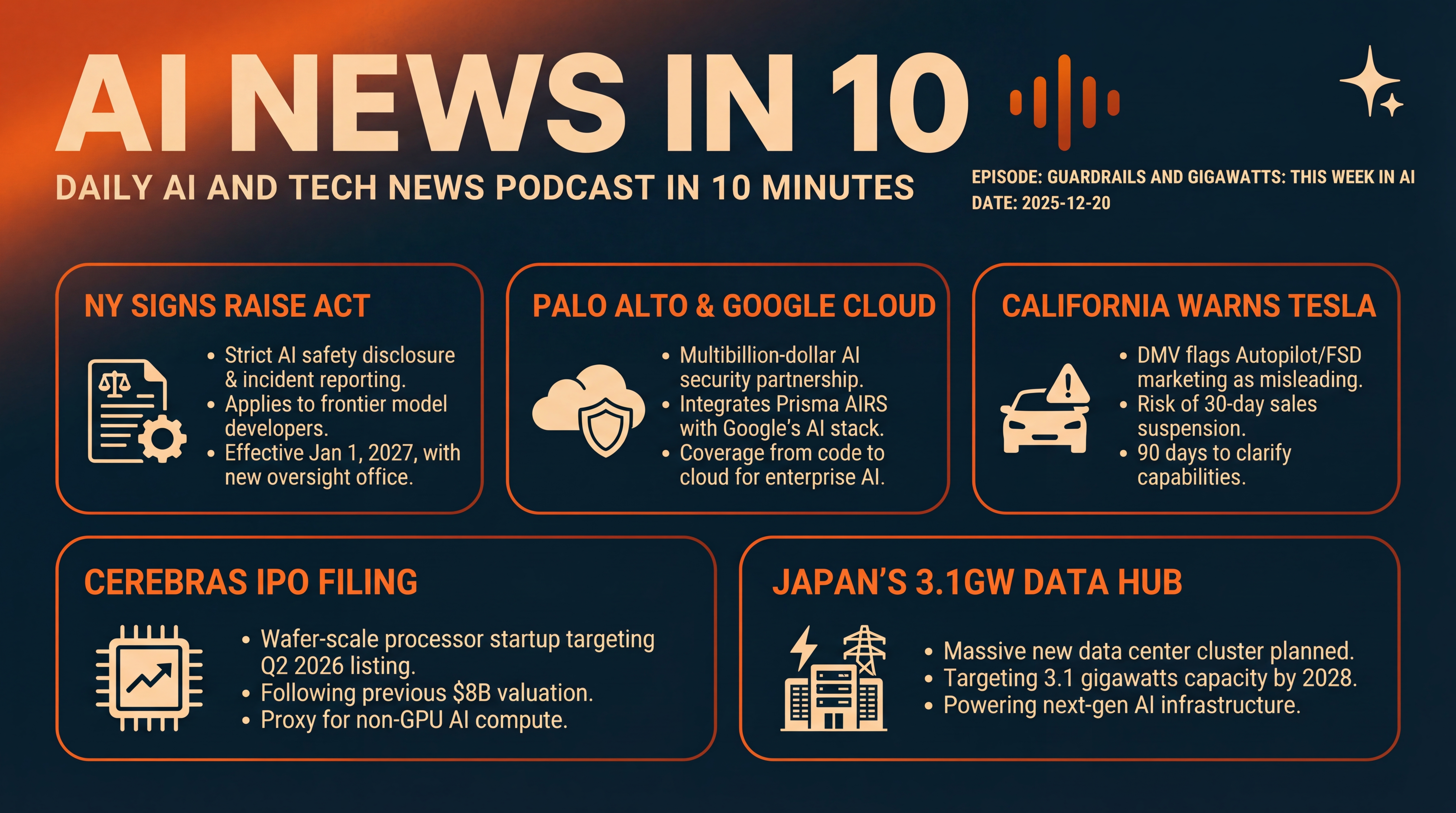
Episode Infographic
Show Notes
Welcome to AI News in 10, your top AI and tech news podcast in about 10 minutes. AI tech is amazing and is changing the world fast, for example this entire podcast is curated and generated by AI using my and my kids cloned voices...
Here's what's new in AI and tech for Saturday, December 20, 2025.
New York just signed one of the most aggressive state AI safety laws in the U.S. It sets disclosure and incident-reporting rules for frontier model developers. In the enterprise world, Palo Alto Networks and Google Cloud announced a multibillion-dollar security partnership to protect AI workloads. On the auto front, California regulators warned Tesla to clean up its Autopilot and Full Self-Driving marketing or risk a temporary sales suspension. In chips, Cerebras is getting ready to file for an IPO after a previous delay. And globally, Japan is planning a massive new data center hub to power the next wave of AI.
[BEGINNING_SPONSORS]
Let's start in New York. Governor Kathy Hochul signed the RAISE Act — Responsible AI Safety and Education — yesterday, December 19. The law requires developers of powerful frontier AI models to publish their safety frameworks and report serious safety incidents within 72 hours, starting January 1, 2027. It also creates a new oversight office inside New York's Department of Financial Services to enforce the rules and issue annual reports.
Supporters say the bill aims to set a consistent standard alongside California's SB-53 — but with stricter disclosure on safety incidents. That's a big swing at state-level AI governance, as federal legislation has stalled. According to the Governor's office and reporting from Axios, backers explicitly pitched it as a companion to California's framework while going further on incident transparency.
The politics matter here. The move comes despite a recent White House push to curb state AI rules. New York lawmakers framed RAISE as filling an urgent gap now, rather than waiting on Washington. The Wall Street Journal notes the bill targets companies with large revenues and puts real teeth behind safety plans through fines and oversight. If you're a developer or an enterprise deploying large models, the message is clear — state rules with real reporting clocks are landing.
Over to enterprise security. Palo Alto Networks and Google Cloud unveiled what they're calling a landmark expansion of their partnership to secure AI initiatives. Under a new multibillion-dollar agreement, Palo Alto will migrate key internal platforms to Google Cloud and tightly integrate its Prisma AIRS platform with Google's AI stack. Think coverage from code to cloud — AI runtime security, model scanning, agent security, red-team tooling — plus deeper hooks into Vertex AI and Gemini. Google, for its part, is adding Palo Alto to its Unified Security Recommended program, with pre-validated integrations for customers building and running AI at scale.
Why this matters: the practical bottleneck for rolling out agentic AI in big companies is trust — who can see what data, how models are governed, and how incidents are contained. Palo Alto is betting that a unified view — policy, detection, response — mapped to Google's AI services can speed rollouts without inviting risk. Expect more vendors to certify deep, native AI security stacks with the major clouds.
Now to California — and Tesla. The state's Department of Motor Vehicles warned that unless Tesla adjusts how it markets Autopilot and Full Self-Driving — also labeled Supervised — the company could face a 30-day suspension of its vehicle sales license. An administrative law judge found the marketing misleading. The DMV isn't moving to suspend manufacturing, but Tesla has 90 days to clarify what the systems can and cannot do.
California has long argued that terms like Autopilot and Full Self-Driving overstate capability and can encourage misuse. Tesla calls the action regulatory overreach, but the clock is ticking. If Tesla doesn't satisfy the DMV, sales in its largest U.S. market could briefly halt — an extraordinary step that would ripple across driver-assist messaging industry-wide.
[MIDPOINT_SPONSORS]
On the chip front, a notable filing is coming. Reuters reports that Cerebras Systems — the startup known for its dinner-plate-sized wafer-scale processors — plans to file for a U.S. IPO as soon as next week, targeting a listing in the second quarter of 2026. Cerebras previously withdrew an IPO in October after raising north of one billion dollars at an eight billion dollar valuation. People familiar with the matter say a national security review tied to a minority investment by UAE-based G42 has been resolved, clearing a path forward.
If it lists into a resilient AI hardware market, Cerebras could become a liquid public proxy for non-GPU AI compute — and a barometer for investor appetite beyond Nvidia's ecosystem.
Zooming out globally, Japan is laying groundwork for the next wave of compute-hungry AI. A government-backed plan would build the country's largest data center hub in Nanto City, Toyama Prefecture, ultimately targeting about 3.1 gigawatts of capacity — among the largest clusters anywhere. The first 400 megawatts are slated for late 2028. The site aims to attract hyperscalers like Amazon, Google, and Microsoft, while diversifying beyond Tokyo and Osaka into a region seen as more resilient to natural hazards. With Japan's data center market expected to nearly double by 2028, the Toyama plan is both a regional growth play and a compute-supply hedge for the AI era.
Stepping back, these stories tell a consistent tale. States aren't waiting for Congress on AI safety. Cloud and security leaders are racing to make AI deployment safer by design. Regulators are forcing clearer consumer messaging around automation. Capital markets still want exposure to alternative AI compute. And countries are sprinting to build the power and floor space AI will consume. Put differently... the scaffolding of the AI economy — laws, chips, grids, and rules — is going up fast.
Quick recap: New York's RAISE Act adds strict disclosure and incident-reporting obligations for top model developers. Palo Alto Networks and Google Cloud doubled down on AI security with a multibillion-dollar collaboration. California told Tesla to fix Autopilot marketing or risk a 30-day sales suspension. Cerebras is prepping an IPO to bring wafer-scale AI compute to the public markets. And Japan green-lit plans for a 3.1-gigawatt data center hub to feed AI's power appetite. We'll keep tracking the policy, infrastructure, and silicon that determine who actually benefits from this AI boom.
Thanks for listening and a quick disclaimer, this podcast was generated and curated by AI using my and my kids' cloned voices, if you want to know how I do it or want to do something similar, reach out to me at emad at ai news in 10 dot com that's ai news in one zero dot com. See you all tomorrow.