Nvidia–Intel, New Grid Rules, and AI Skills
Washington clears Nvidia’s stake in Intel as FERC moves to rewrite grid rules for AI megaprojects. We also cover Starship debris near airliners, South Korea’s push for mass breach restitution, and the Coursera–Udemy merger reshaping enterprise upskilling.
Episode Infographic
Show Notes
Welcome to AI News in 10, your top AI and tech news podcast in about 10 minutes. AI tech is amazing and is changing the world fast, for example this entire podcast is curated and generated by AI using my and my kids cloned voices...
It’s Sunday, December 21, 2025, and today’s tech rundown is a snapshot of how AI is reshaping everything — chips and grids, cybersecurity accountability, and even airspace safety. We’ll start with Washington’s green light for a landmark Nvidia–Intel tie-up... shift to a new federal order that could change where and how AI data centers plug into the grid... dig into a Wall Street Journal investigation about Starship debris and commercial flights... cover South Korea’s consumer watchdog forcing payouts after a massive telecom breach... and wrap with the Coursera–Udemy merger — a bet that AI skills training is going enterprise first.
[BEGINNING_SPONSORS]
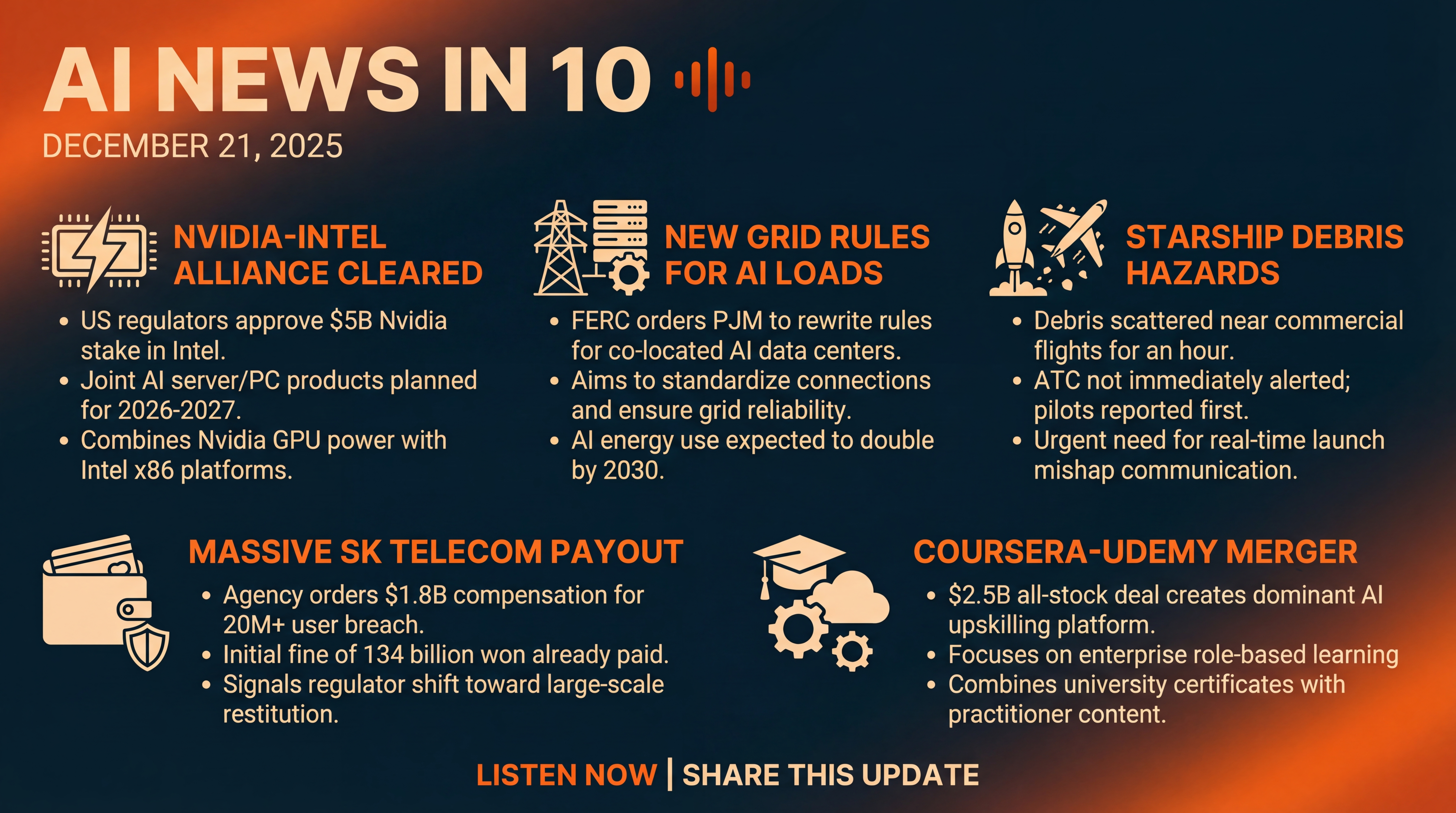
Story one. The U.S. has cleared Nvidia’s investment in Intel, removing an antitrust cloud over one of the most unusual chip alliances.
Here’s the headline — regulators okayed Nvidia’s equity stake in Intel worth five billion dollars, paving the way for collaboration on custom data center and PC products that knit Nvidia’s accelerated computing with Intel’s x86 platforms.
Why it matters — Nvidia needs more CPU horsepower tightly coupled to its GPUs, and Intel needs growth catalysts beyond its foundry comeback.
The framework, first announced in September, has Intel building Nvidia‑custom x86 CPUs for AI infrastructure, plus x86 system-on-chips that integrate RTX GPU chiplets for PCs — connected over NVLink.
If it lands, expect reference platforms for AI servers and AI PCs in 2026 and 2027 — plus a broader software and interconnect ecosystem that stretches beyond CUDA into the x86 PC base.
The clearance signals Washington isn’t viewing this as anti-competitive, at least on its face. And the market noticed when it was unveiled — Intel had its best day in decades.
Now, with approval in hand, the real work starts: product roadmaps, OEM wins, and — crucially — power and supply.
Source: Reuters.
Let’s pivot to the power behind all those chips.
On Thursday, December 18, the Federal Energy Regulatory Commission directed PJM — America’s largest grid operator, serving 13 states and D.C. — to rewrite its rules for connecting massive, AI-hungry loads sited next to power plants.
The aim — clarify how co-located data centers tap nearby generation without distorting wholesale markets or destabilizing local reliability.
Backstory — developers have been racing to build multi-hundred-megawatt AI campuses right beside gas or nuclear plants to skip long interconnection queues and transmission upgrades. Supporters say it’s efficient; critics warn it can push up local rates and complicate grid operations.
FERC said PJM’s current tariff is unclear, unjust, and unreasonable — and ordered clearer interconnection provisions for facilities serving these co-located loads.
This is a big precedent — the first formal federal push to standardize how AI megaprojects wire into the grid in a way that won’t leave everyone else holding the bill.
For context on why regulators are moving now — Gartner estimates global data center electricity use could roughly double from 2025 to 2030, with AI-optimized servers driving a huge chunk of that growth.
Expect similar filings in other regions next.
Source: Reuters.
Story three heads to the skies.
The Wall Street Journal reports that the January Starship test explosion scattered debris over the Caribbean for nearly an hour — so much so that three commercial planes encountered hazards, with two reportedly declaring fuel-related emergencies while deciding whether to divert or punch through a spreading no-fly zone.
According to the Journal, air traffic controllers weren’t immediately alerted through the FAA’s emergency hotline and initially learned about debris from pilots themselves. That’s hair-raising... and a warning shot for an era of far more frequent heavy-lift tests.
The FAA, per the report, implemented some recommendations and suspended a broader review later in the year — but left the door open to take more action.
The takeaway — commercial space and commercial aviation are increasingly sharing airspace, and real-time mishap communication — down to automated debris-hazard alerts — has to be table stakes before launch cadence scales again.
Source: The Wall Street Journal.
[MIDPOINT_SPONSORS]
Story four — in Seoul, a landmark consumer-protection move after a colossal telecom breach.
South Korea’s consumer agency says it will order SK Telecom to compensate 58 plaintiffs — 100,000 won apiece via credits and bill discounts — after personal data from more than 20 million users was leaked earlier this year.
That alone isn’t the headline. It’s the agency’s next step that’s the bombshell — pushing the carrier to fully compensate all affected customers, a liability that could approach 2.3 trillion won, roughly 1.8 billion dollars.
The company already took a 134 billion won fine in August. Now it faces whether to negotiate or fight broader payouts under pressure from the state.
For global operators, the message is clear — regulators are moving from fines to restitution at population scale, especially where critical infrastructure is involved. Expect insurers, boards, and CISOs to run new breach-cost models on Monday.
Source: Reuters.
And story five — consolidation in the skills economy.
Coursera and Udemy plan to merge in an all-stock deal worth 2.5 billion dollars — creating what could be the dominant enterprise learning platform for AI upskilling.
Terms — Udemy holders receive 0.8 Coursera shares per Udemy share. The combined company keeps the Coursera name and targets more than 1.5 billion dollars in pro forma annual revenue, with 115 million dollars in run-rate cost synergies within two years.
Why now? Enterprises are standardizing on AI tools and workflows, and training budgets are shifting from one-off courses to measurable, role-based learning paths that map to software licenses and outcomes.
Coursera brings universities and brand-name certificates. Udemy brings a vast, fast-refreshing marketplace of practitioner-led content.
If regulators sign off, this pair can bundle assessments, certification, and on-the-job labs into one enterprise catalog — an attractive proposition for CIOs trying to make new AI investments productive, fast.
Watch how they integrate content quality controls and align catalogs to vendors’ AI platforms in 2026.
Source: Reuters.
Quick recap...
The U.S. just cleared a rare alliance between Nvidia and Intel — expect new AI server and AI PC blueprints out of that partnership.
FERC told PJM to tighten the rules for plant-adjacent AI loads — a template others may copy as data center power demand soars.
The Journal’s report on Starship debris near airliners raises urgent questions about launch mishap protocols.
South Korea is pushing SK Telecom toward large-scale restitution after a record breach.
And Coursera plus Udemy is the clearest signal yet that AI skills are going enterprise by default.
Thanks for listening and a quick disclaimer, this podcast was generated and curated by AI using my and my kids' cloned voices, if you want to know how I do it or want to do something similar, reach out to me at emad at ai news in 10 dot com that's ai news in one zero dot com. See you all tomorrow.