
GPUs, Grids, and Gatekeepers Collide
Apple faces an Italian privacy–antitrust fine, Georgia greenlights a massive power build for AI, Washington reviews Nvidia H200 exports to China, data center dealmaking hits records, and Mexico reins in Android tying. A fast, clear briefing on how regulation, infrastructure, and capital are shaping AI's next phase.
Episode Infographic
Show Notes
Welcome to AI News in 10, your top AI and tech news podcast in about 10 minutes. AI tech is amazing and is changing the world fast, for example this entire podcast is curated and generated by AI using my and my kids cloned voices...
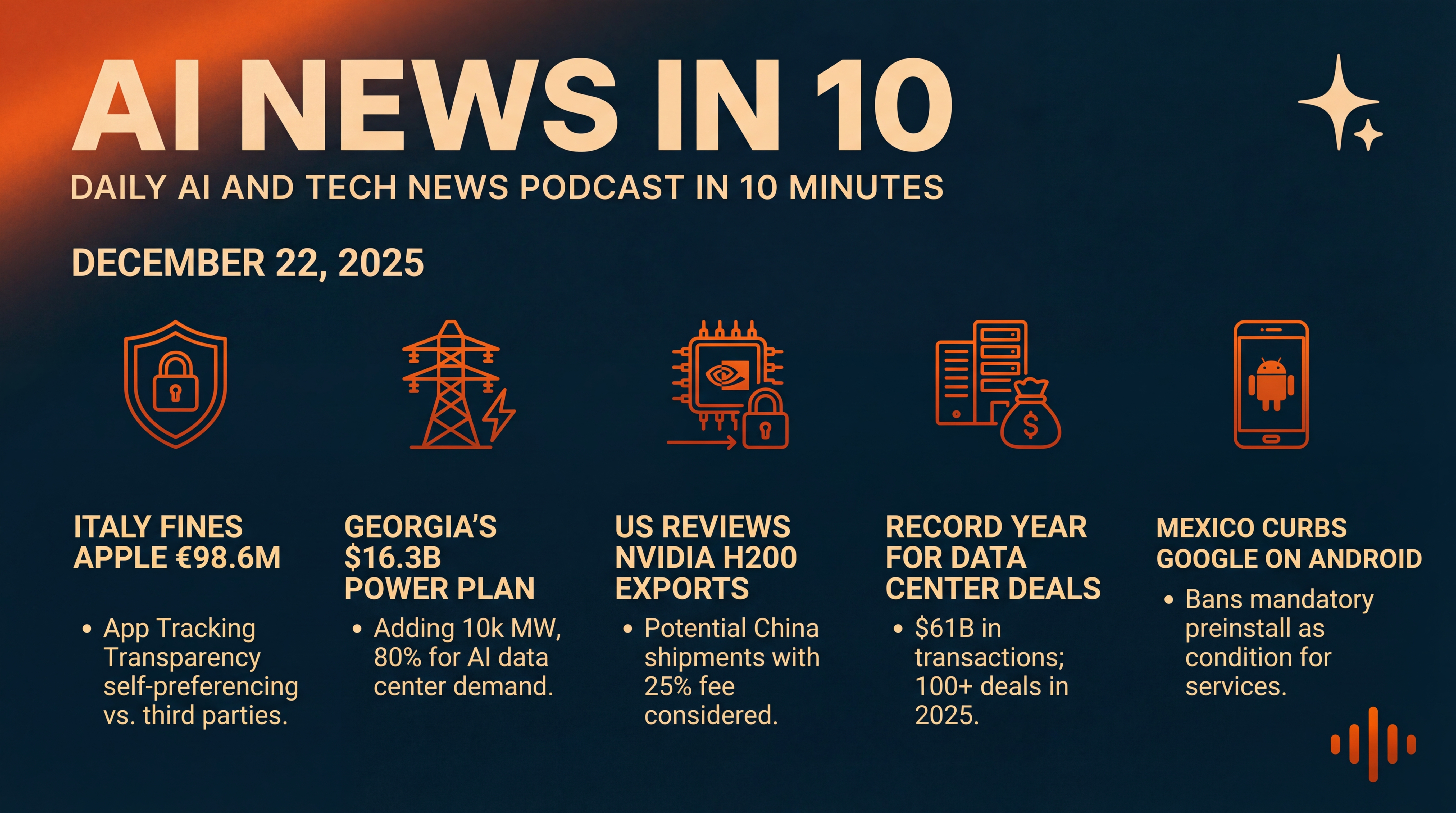
Here's what's new in AI and tech for Monday, December 22, 2025... A fresh antitrust sting for Apple out of Italy, a massive U.S. power plan to feed AI data centers, a Washington review that could reopen Nvidia's chip pipeline to China, a record year for data center dealmaking, and a competition ruling in Mexico reining in how Google ties Android to device makers. Let's get into it.
[BEGINNING_SPONSORS]
First up, Apple was hit with a 98.6 million euro fine from Italy's competition authority over how App Tracking Transparency — the privacy prompt Apple rolled out in 2021 — was applied to others versus Apple itself. Regulators say third-party developers faced stricter consent hoops while Apple's own services benefited — which they view as an abuse of dominance in the app market.
Apple is appealing, saying ATT protects user privacy equally. But the takeaway... European enforcers are probing whether privacy frameworks can morph into competitive advantage — and Italy's watchdog effectively said yes.
For developers betting on ad-supported apps, the precedent matters. Duplicative prompts and asymmetric consent rules can tank opt-in rates — and revenue. That's why this isn't just a fine, it's a signal about how 'privacy by design' is judged when a platform is also a competitor. The case involved coordination across European regulators and lands on top of the EU's Digital Markets Act, which is already pushing Apple to open up more of its ecosystem. Reuters has the details.
Zooming out from platforms to power... Georgia's Public Service Commission just approved a 16.3 billion dollar plan to boost electricity generation by roughly 50 percent — about 10,000 megawatts — with regulators saying the surge is primarily to meet data center demand driven by AI. Eighty percent of that capacity is earmarked for data centers.
Supporters say large users will shoulder most costs, and spreading fixed expenses could lower typical bills later in the decade. Critics warn of environmental risks, gas dependence, and the possibility that ratepayers are left holding the bag if demand forecasts overshoot. Either way, it's a vivid snapshot of 2025's underlying AI story — compute hunger rippling into utility planning, grid financing, and state politics. The Associated Press reports it's one of the largest generation expansions in the U.S.
Staying in the engine room of AI — chips — Washington has kicked off an interagency review that could allow shipments of Nvidia's H200 accelerators to China, a notable shift from the hard stop under earlier export controls. Commerce is leading the process with input from State, Energy, and Defense, weighing national security concerns against industry pressure to sell.
President Trump has publicly floated permitting H200 exports with a 25 percent fee attached — a controversial compromise, because even if H200 isn't Nvidia's latest Blackwell silicon, it's still plenty capable for advanced model training. National security hawks worry about military end use or indirect transfers; industry argues that calibrated allowances preserve U.S. leadership while tamping down incentives for gray-market workarounds. Either way, the review sends a market signal: policy around mid-tier AI accelerators is becoming more granular — and more negotiable — than one-size-fits-all bans. Reuters broke the story.
[MIDPOINT_SPONSORS]
On to the real estate of AI — the buildings and balance sheets behind it. A new S&P Global Market Intelligence analysis shows 2025 set a record for data center dealmaking: more than 100 transactions totaling nearly 61 billion dollars through November. Private equity loves the predictable cash flows, while hyperscalers and GPU clouds are racing to lock in acreage, power, and water.
Since 2019, the U.S. and Canada have seen around 160 billion dollars in data center deals, with Asia-Pacific near 40 billion and Europe over 24 billion. The caveat... debt-financed valuations are lofty, and the risk is that overbuild meets softer-than-expected demand or delayed utility hookups. For now, though, the flywheel of AI — models, chips, capacity — keeps pulling in capital. Reuters has the numbers.
And we'll close with competition news from Mexico that could ripple across Android licensing. Mexico's antitrust commission concluded a long-running case by telling Google it can't require phone makers to preinstall Android as a condition for accessing Google services.
The finding speaks to the subtle levers of platform power — bundles, defaults, and certification programs that can steer OEM choices without headline-grabbing acquisitions. While Google notes it holds no ownership in most partners and often frames these deals as pro-consumer interoperability, regulators worldwide are increasingly scrutinizing how choice works in practice when the app store, services, and the OS are tied together. With the EU pressing interoperability via the DMA, and multiple DOJ and FTC probes alive in the U.S., Mexico's decision adds a non-U.S., non-EU datapoint that device makers — and regulators across Latin America — can cite. Reuters reported the ruling last week.
Quick hits before we wrap... A U.S. judge rejected LinkedIn's proposed antitrust settlement, calling the terms inadequate — another sign courts are skeptical of injunctive-only fixes in digital markets. And in Taiwan, the government's sovereign-AI buildout includes a new cloud facility with H200s and Blackwells under the hood — another marker on the global map of AI capacity. Both developments underline how governance, capital, and geopolitics are converging on the same bottlenecks: compute, power, and rules.
That's your rundown: Italy fines Apple over ATT and self-preferencing... Georgia ramps up power for AI data centers... Washington reviews Nvidia's H200 exports to China... S&P says 2025 was a record year for data center mergers and acquisitions... and Mexico curbs Google's Android preinstall conditions. The through line is scale — of regulation, of infrastructure, and of the investments needed to keep AI moving. We'll keep watching as those forces collide as the year winds down — and the next one gears up.
Thanks for listening and a quick disclaimer, this podcast was generated and curated by AI using my and my kids' cloned voices, if you want to know how I do it or want to do something similar, reach out to me at emad at ai news in 10 dot com that's ai news in one zero dot com. See you all tomorrow.