Big Bets, New Rules, and Safer Agents
Two major acquisitions reshape AI's power and security stack, while Washington signals new chip tariffs. States roll out the first rules for AI companions, and OpenAI hardens its browser agent against prompt injection.
Episode Infographic
Show Notes
Welcome to AI News in 10, your top AI and tech news podcast in about 10 minutes. AI tech is amazing and is changing the world fast, for example this entire podcast is curated and generated by AI using my and my kids cloned voices...
Here’s what’s new in AI and tech today — Tuesday, December 23, 2025. We’ve got two big-money deals reshaping AI infrastructure and cybersecurity. Alphabet is buying energy and data center developer Intersect to feed Google’s AI compute appetite... and ServiceNow is snapping up Armis in a multibillion-dollar bet that proactive, AI-driven security becomes the enterprise control tower. On the policy front, the U.S. will impose tariffs on Chinese semiconductors — but not until mid-2027. New York and California just drew the first legal lines around AI companions. And to cap it off, OpenAI says browser-based agents face a prompt-injection problem that may never be fully solved, even as new defenses ship.
[BEGINNING_SPONSORS]
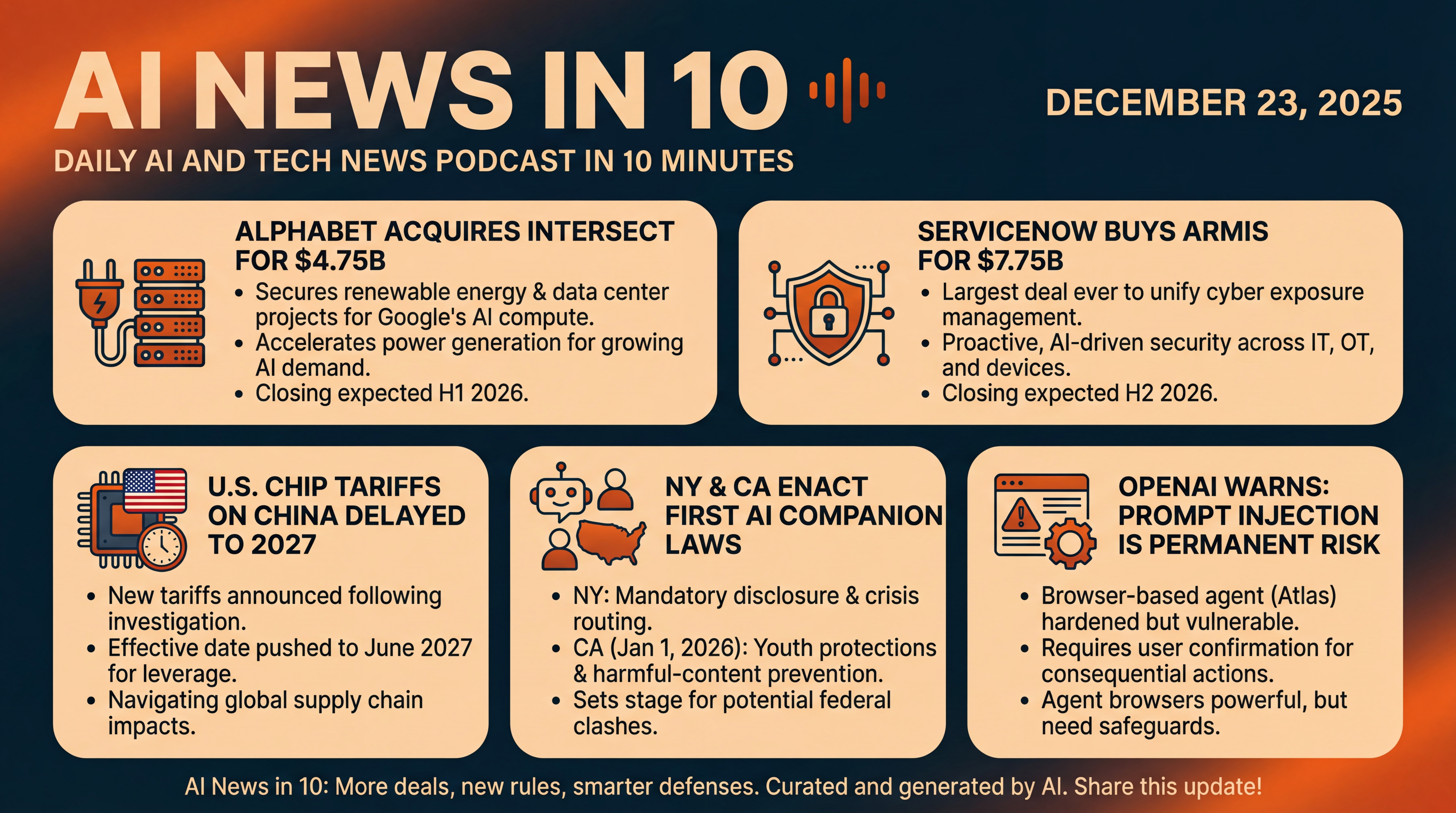
Let’s start with the energy and infrastructure behind AI. Alphabet — Google’s parent — announced a definitive agreement to acquire Intersect for 4.75 billion dollars in cash, plus assumed debt. The deal brings Intersect’s team and multiple gigawatts of in-development power and co-located data center projects under Alphabet’s umbrella, while keeping Intersect operating as a separate brand led by CEO Sheldon Kimber. The first co-located site is already under construction in Haskell County, Texas. Alphabet says the acquisition will let Google add data center capacity and power generation in lockstep as AI demand grows. Closing is expected in the first half of 2026, pending approvals.
This is part of a bigger trend: tech companies moving upstream into energy to secure reliable, lower-cost power for compute-heavy AI. Alphabet says Intersect’s existing operating assets in Texas, and its operating and in-development assets in California, are excluded from the deal — those remain with prior investors. The rest of Intersect’s development pipeline will support Google’s U.S. data center build-out. And the why is simple... AI factories are power-hungry, and communities are watching reliability and utility bills as deployments scale.
Deal number two is in cybersecurity. ServiceNow is acquiring Armis for 7.75 billion dollars in cash — its largest deal ever — aimed at unifying cyber exposure management with automated response across IT, operational technology, medical devices, and more. Together, they’re pitching an end-to-end stack that can see, decide, and act across the enterprise — tying Armis’ agentless asset discovery and risk prioritization to ServiceNow workflows. The transaction is slated to close in the second half of 2026, subject to approvals.
A few details: Armis says it has surpassed 340 million dollars in annual recurring revenue, with year-over-year growth above 50 percent, and is trusted by over a third of the Fortune 100. ServiceNow, which crossed 1 billion dollars in security and risk annual contract value earlier this year, argues that AI adoption is expanding the attack surface — and that enterprises need governance and remediation loops that span any cloud, any asset, any AI system. Some investors are wary of ServiceNow’s acquisition pace... but the strategic fit strengthens its pitch as an AI-native security platform.
Story three: the U.S. is preparing new tariffs on Chinese semiconductor imports — but will wait to swing that hammer. The administration says it will impose tariffs following a Section 301 investigation into China’s chip practices, yet the effective date is pushed out to June 2027. The exact rate will be disclosed at least 30 days before enforcement. The delay preserves leverage while Washington navigates broader tech and trade tensions with Beijing — and weighs potential spillovers across global supply chains.
[MIDPOINT_SPONSORS]
On to AI policy at the state level. New York and California just became the first two U.S. states to regulate AI companions — those chatbots designed for ongoing, quasi-social relationships that have surged in popularity among teens. New York’s law, now in effect, requires AI companions to regularly disclose they’re not human, and to detect and route users expressing suicidal ideation to crisis services — with penalties of up to 15,000 dollars per day for violations. California’s SB 243 takes effect January 1, 2026, and adds broader safeguards: youth protections, harmful-content prevention, mandated transparency reports, and even a private right of action.
These first-in-the-nation rules arrive amid federal uncertainty. A December 11 executive order set a national AI policy posture that may clash with some state mandates. That tension sets up likely court tests next year over where the line sits between federal direction and state police powers — especially when minors’ safety and mental-health concerns are in play. For developers, the signal is clear: build compliant identity disclosure, crisis routing, and audit trails now... if your product even resembles an AI companion.
And finally, an unusually frank security update from OpenAI. The company detailed how it’s hardening ChatGPT Atlas — its browser-based agent — against prompt-injection attacks, while acknowledging a hard truth: prompt injection, like phishing and social engineering on the web, may never be fully solved. The latest Atlas update includes an adversarially trained model and tighter safeguards informed by automated red-teaming that uncovers long-horizon attack chains. OpenAI recommends limiting logged-in access, requiring user confirmation for consequential actions, and scoping tasks more narrowly to reduce exposure.
The broader takeaway for agentic systems is straightforward: as autonomy and access rise, so does risk. OpenAI says these attacks may always be a risk, even as detection improves. Security researchers note that many current best practices deliberately trade some autonomy for safety — for example, forcing explicit confirmations before sending messages or making payments. In short, agent browsers are powerful... but today, they still need seatbelts.
Quick recap... Alphabet is buying Intersect to bring power and data center capacity online faster for AI workloads. ServiceNow is acquiring Armis to fuse exposure management with automated response. Washington’s new chip tariffs on China are real — but the bite won’t come until 2027. New York and California just wrote the first U.S. rules for AI companions. And OpenAI says prompt injection is a permanent risk, even as Atlas gets tougher. More deal-making, more rules, and smarter defenses — that’s today’s AI News in 10.
Thanks for listening and a quick disclaimer, this podcast was generated and curated by AI using my and my kids' cloned voices, if you want to know how I do it or want to do something similar, reach out to me at emad at ai news in 10 dot com that's ai news in one zero dot com. See you all tomorrow.