WhatsApp Walls, iOS Openings, and Reusable Dreams
EU regulators challenge Meta’s AI gatekeeping on WhatsApp, Brazil compels Apple to open iOS, and two rocket milestones in Brazil and China show how close reusability is. Plus, South Korea passes a sweeping speech-liability law with major implications for platforms and AI.
Episode Infographic
Show Notes
Welcome to AI News in 10, your top AI and tech news podcast in about 10 minutes. AI tech is amazing and is changing the world fast, for example this entire podcast is curated and generated by AI using my and my kids cloned voices...
Here’s your quick run-through for Wednesday, December 24th.
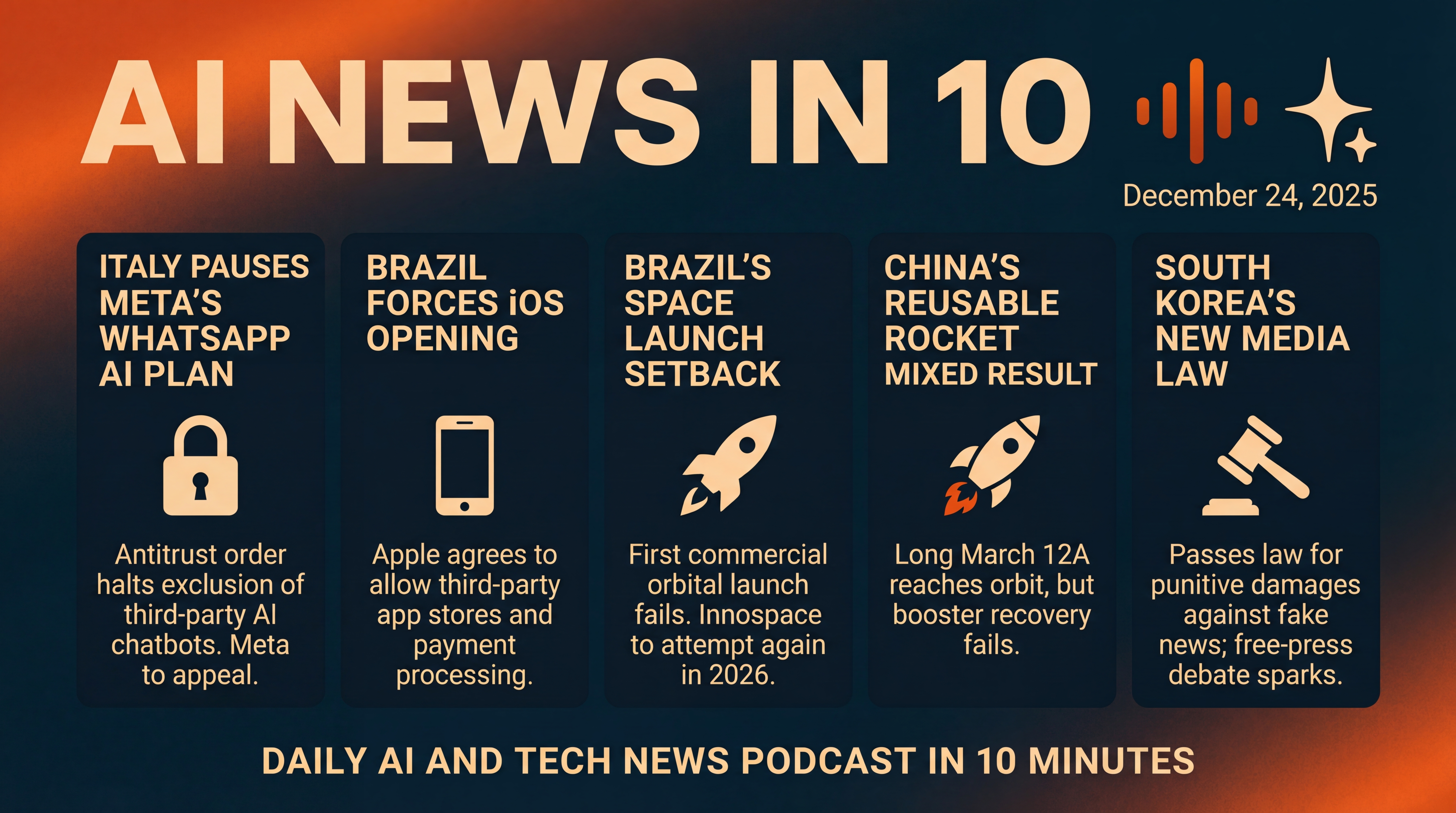
Europe just moved against Meta’s AI strategy on WhatsApp, Brazil forced a meaningful opening in Apple’s iOS ecosystem, and we’ve got two big space stories — one setback in Brazil, one mixed result in China’s reusability race. We’ll also touch on a powerful new media law in South Korea that could reshape content moderation and liability online. Let’s dive in.
[BEGINNING_SPONSORS]
Story one. Italy just put the brakes on Meta’s plan to keep rival AI chatbots off WhatsApp.
Italy’s antitrust authority ordered Meta to suspend contract terms that — according to regulators — effectively barred third-party AI chatbots from WhatsApp’s business platform. Meta says the decision is fundamentally flawed... arguing chatbots strain systems not designed for that load. It plans to appeal.
The probe started in July and widened in November. In parallel, Brussels opened its own antitrust review. What’s at stake is access — WhatsApp is a gateway to hundreds of millions of users — and regulators are asking whether Meta is unlawfully favoring its own Meta AI over competitors.
Reuters reports Italy is coordinating with the European Commission on next steps. Recent reporting says the EU is examining whether WhatsApp’s policy change blocked third-party AI providers while leaving Meta’s bot in place.
Expect months of legal jockeying... but the signal is clear: EU enforcers don’t want a single gatekeeper deciding which AI assistants can talk to consumers inside the world’s most popular messengers.
Zooming out — if Brussels ultimately concludes WhatsApp’s rules harm competition, it could push for broad remedies quickly, not just fines. That matters far beyond Italy. As chatbots move from standalone apps into platforms and operating systems, the question of who controls distribution — platform owner or open market — will be a recurring flashpoint in 2026.
Story two. A major shift for Apple in a key market.
To settle a long-running antitrust case with Brazil’s competition watchdog, Apple agreed to allow third-party app stores and alternative payment processing on iOS in Brazil. The company has 105 days to implement the changes, and the settlement runs for three years. If it fails to comply, Apple faces potential fines of up to 150 million reais — around 27 million dollars.
The case began with a 2022 complaint from MercadoLibre, which argued Apple unfairly restricted distribution and payments for digital goods. Apple still says these changes raise privacy and security risks, but it plans to mitigate them.
Two takeaways. First, this is a negotiated opening — not a global policy pivot — but it’s concrete. Second, regulators outside the EU are willing to push on mobile distribution rules, which could create pressure for similar arrangements in Latin America and beyond.
If you build for iOS, Brazil’s move is worth watching. It could create a template for compliant sideloading — strict security conditions, but real access to alternative stores and payment choice. The question for 2026 is whether developers embrace it... and whether users follow.
Story three. We head to the Alcântara Space Center in Brazil, where the country’s first commercial orbital launch ended in failure.
South Korea’s Innospace launched its small HANBIT-Nano rocket on December 22nd. About 30 seconds after liftoff, it crashed within the designated safety zone. No injuries were reported, but it’s a blow to Brazil’s aspirations for Alcântara — a site prized for its equatorial location — and to Innospace, whose shares dropped almost 29 percent after the incident.
The mission carried eight payloads, including five small satellites. The company says it gathered valuable data and plans a new attempt in the first half of 2026. The failure inevitably recalls Alcântara’s tragic 2003 pad explosion that killed 21 engineers — though this flight was unmanned and designed with safety corridors.
Why this matters for the AI and data economy: the growth of Earth-observation and communications constellations depends on frequent, affordable launches from multiple regions. Every new launcher that reaches reliability helps diversify access to orbit... and every setback prolongs bottlenecks that ripple to downstream services — from mapping and agriculture analytics, to disaster response and IoT backhaul.
[MIDPOINT_SPONSORS]
Story four. China’s reusability push scored a half-win.
The new methane-fueled Long March 12A reached orbit on its maiden flight — but booster recovery failed. State media said the first stage was not recovered, while the second stage hit its target orbit.
This follows a recent private-sector attempt, when LandSpace’s stainless-steel Zhuque-3 also reached orbit but lost its first stage in a dramatic landing fireball. The throughline is clear: China is closing the performance gap to the Falcon 9 class with methane engines and precision guidance — but reliable booster recovery remains the missing piece.
If you’re thinking about 2026 launch capacity for AI-related constellations, watch these programs closely. Frequent, reusable medium-lift flights are the difference between sporadic batch deployments and a true high-cadence pipeline for satellites that feed AI models with fresh Earth imagery and deliver broadband for edge workloads.
And story five. A sweeping new speech-liability law in South Korea is already sparking free-press debates — with big tech implications.
The National Assembly passed a bill allowing heavy punitive damages — up to five times proven losses — against news and internet media that publish false or fabricated information, with additional fines up to one billion won for repeat offenders. It passed by a vote of 170 to 3, following a filibuster. Critics warn the bill’s vague definitions could chill investigative reporting and push platforms to over-remove content, especially AI-generated or AI-amplified posts. Civil society groups are urging President Lee Jae Myung to veto. If it’s signed, platforms and publishers may need more aggressive fact-checking, provenance labeling, and appeals workflows for takedowns to manage legal exposure.
Remember, South Korea is also moving forward on broader AI governance — finalizing decrees for its AI Basic Act — and has already signaled tighter labeling rules for AI-generated ads. Taken together, you’re seeing a regulatory posture that aims to curb AI-assisted deception while promoting industrial growth. For developers and platforms operating in Korea, expect more mandatory labeling, more auditability, and sharper penalties when content harms are alleged.
Quick recap: Italy told Meta to stop locking rivals out of WhatsApp’s AI channel. Brazil forced a serious iOS opening from Apple. Brazil’s first commercial launch stumbled, while China’s reusable-rocket effort delivered a mixed result. And South Korea passed a tough false-information law that could reshape platform risk.
We’ll keep tracking how these moves shape where AI lives — inside messengers, app stores, constellations... and the rulebooks that govern them. See you tomorrow.
Thanks for listening and a quick disclaimer, this podcast was generated and curated by AI using my and my kids' cloned voices, if you want to know how I do it or want to do something similar, reach out to me at emad at ai news in 10 dot com that's ai news in one zero dot com. See you all tomorrow.
