AI’s Growth Meets the Power Ceiling
Big Tech pours 67.5 billion dollars into India as the U.S. grid’s unused capacity offers a surprising AI release valve. We recap 2025’s AI infrastructure surge, India’s 100 homegrown apps, and a holiday DDoS that hit France’s postal service.
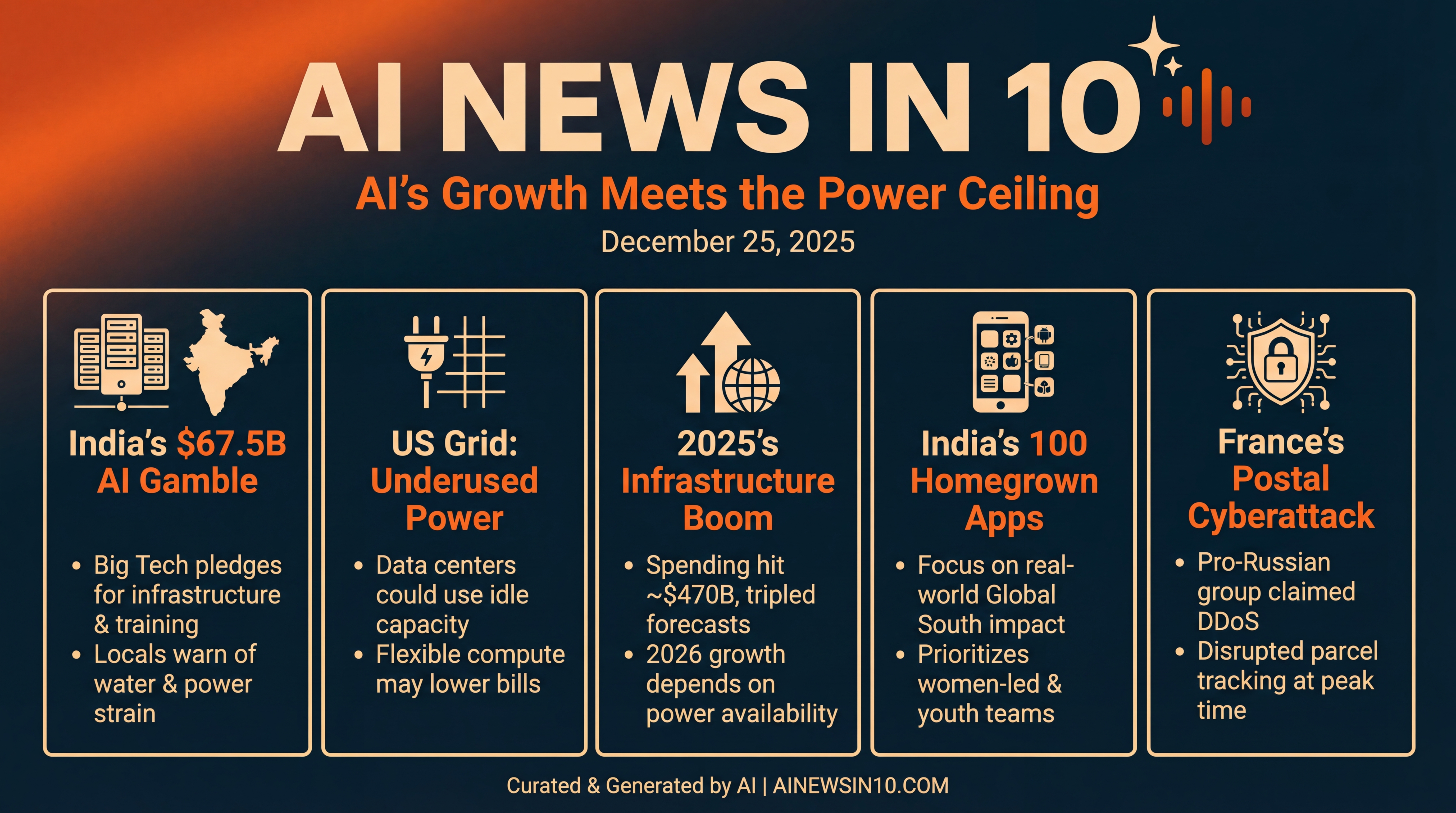
Episode Infographic
Show Notes
Welcome to AI News in 10, your top AI and tech news podcast in about 10 minutes. AI tech is amazing and is changing the world fast, for example this entire podcast is curated and generated by AI using my and my kids cloned voices...
Today we’ve got a holiday handful of stories that all orbit the same gravity well — AI scale, power, and policy.
We’ll start in India, where Amazon, Microsoft, and Google have pledged a combined 67.5 billion dollars for AI infrastructure and programs... even as locals warn about water and power strain.
Then we zoom back to the United States, where researchers say the grid is used at roughly half capacity most of the year — and flexible data centers could actually help lower rates.
We’ll widen the lens with the Financial Times’ year-end take: AI infrastructure spending smashed expectations in 2025 and could grow again in 2026 — if power doesn’t bottleneck.
After the break, India’s tech ministry plans a showcase of 100 homegrown AI apps aimed at the Global South.
And we’ll close in Europe, where a pro-Russian group claimed a DDoS attack against France’s postal service, snarling deliveries at the worst possible moment.
[BEGINNING_SPONSORS]
Let’s begin in India, because the scale is eye-popping. Since October, Amazon, Microsoft, and Google have pledged 67.5 billion dollars in India — about 80 percent announced in December — with money aimed at massive AI data centers, workforce training, and small-business adoption.
Microsoft is building a sprawling data center complex in Hyderabad, slated to go live in mid-2026. Google is planning a one-gigawatt-scale facility in Visakhapatnam, with state records pointing to roughly 2.4 billion dollars in subsidies and about 480 acres of land.
Analysts describe India as a must-win market. OpenAI and Anthropic both opened offices there this year, and executives from Satya Nadella to Intel’s Lip-Bu Tan met with Prime Minister Narendra Modi to talk AI and semiconductors.
But there’s growing resistance on the ground. Data centers need huge amounts of power and water, and activists warn about resource stress and subsidy misallocation. Economists worry that AI could displace entry-level roles in India’s 283 billion dollar IT outsourcing sector.
The bottom line: the money is real, the market is massive... and the social license to operate isn’t guaranteed.
Zooming to the U.S. electric grid — here’s a counterintuitive one, and it’s good news if we use it. The grid is built for peak demand that hits only a handful of days a year, so most of the time it’s underused... often around 50 percent, with ranges from roughly 30 to 70 percent depending on location.
Researchers say that slack could be a pressure valve for the AI boom. If data centers agree to power down or shift compute during those few peak days, they could absorb off-peak capacity the rest of the year and help spread fixed grid costs across more customers.
One Duke University study estimates as much as 100 gigawatts of idle capacity could be tapped under curtailment agreements. Google has announced pilots in Indiana and Tennessee to reduce usage during peaks, and a startup called GridCARE helped a utility identify tens of megawatts of flexible capacity tied to incoming data centers.
Skeptics note that only strict contracts will make hyperscalers reliably curtail. Still — with peak demand projected to rise about 24 percent over the next five years, driven in part by AI — this is one of the few levers that could lower bills, reduce new fossil buildout, and keep reliability intact.
Now, the year-end big picture. The Financial Times says 2025’s defining winners weren’t the flashiest consumer apps — it was the companies building the AI backbone.
Morgan Stanley’s forecast was blown away: global AI-related data center spending for 2025 jumped to roughly 470 billion dollars — nearly triple some early-year expectations — and could rise to around 620 billion in 2026. Token prices collapsed more than fiftyfold in two years, fueling adoption but compressing some business models. Power scarcity has — so far — kept the worst overbuild risks in check.
Valuations soared across frontier model labs, and eight U.S. tech giants crossed the one trillion dollar mark on chip, cloud, and AI demand. But the caution flag is clear: 2026’s growth now depends as much on electrons as on algorithms — the next constraint isn’t investors, it’s power.
[MIDPOINT_SPONSORS]
Fourth story, and we’re staying in India — but with a different angle: applications. India’s Ministry of Electronics and Information Technology, MeitY, plans to showcase 100 homegrown AI apps at the upcoming IndiaAI Impact Summit, with a deliberate focus on the Global South.
Officials say the shortlist tilts toward solutions with real-world impact: AI for agriculture and financial inclusion, language tech for clinical records, fraud detection, assistive tools, and factory uptime. There’s also a push for inclusion — 30 apps by women-led teams and 20 by young entrepreneurs are being prioritized, with cash awards and investor showcases lined up.
It’s a pragmatic complement to the infrastructure spree — less about building the world’s biggest models, more about deploying AI that’s affordable, deployable, and locally useful.
And fifth, a cybersecurity reality check from France. Just ahead of Christmas, a distributed denial-of-service campaign knocked La Poste’s central systems offline, disrupting parcel tracking and even impacting online functions at La Banque Postale.
By midweek, a pro-Russian hacking group known as NoName zero five seven sixteen had claimed responsibility, and France’s domestic intelligence agency — the DGSI — took over the investigation. Authorities said letters still moved, but tracked parcels and some online services were hit during the peak season.
It’s part of a broader pattern European officials call hybrid warfare — where cyberattacks and disinformation aim to sap resources and public confidence. For operators of critical services, and for the rest of us who depend on them, the lesson is familiar: DDoS mitigation, redundant channels, and crisp crisis comms are now table stakes.
Quick recap before you head back to your holiday. In India, Big Tech’s 67.5 billion dollar bet is colliding with real concerns over resources and jobs. In the U.S., flexible data centers could help turn our underused grid into cheaper electricity. Globally, AI’s infrastructure boom defined 2025 but may slam into the power ceiling in 2026. India’s government wants to spotlight 100 homegrown AI apps for the Global South. And Europe closes the year reminded that critical infrastructure is squarely in hackers’ crosshairs.
We’ll keep tracking the power, policy, and people stories shaping AI’s next act.
Thanks for listening and a quick disclaimer, this podcast was generated and curated by AI using my and my kids' cloned voices, if you want to know how I do it or want to do something similar, reach out to me at emad at ai news in 10 dot com that's ai news in one zero dot com. See you all tomorrow.
