Nvidia’s Groq Gambit, Waymo’s Storm Test
Nvidia licenses Groq’s inference tech and hires key leaders as Waymo pauses Bay Area rides during storms and ships an outage-aware update. Plus, Microsoft’s new Texas data center, Boston Dynamics’ Atlas at CES, and Coupang’s breach faces a U.S. class action.
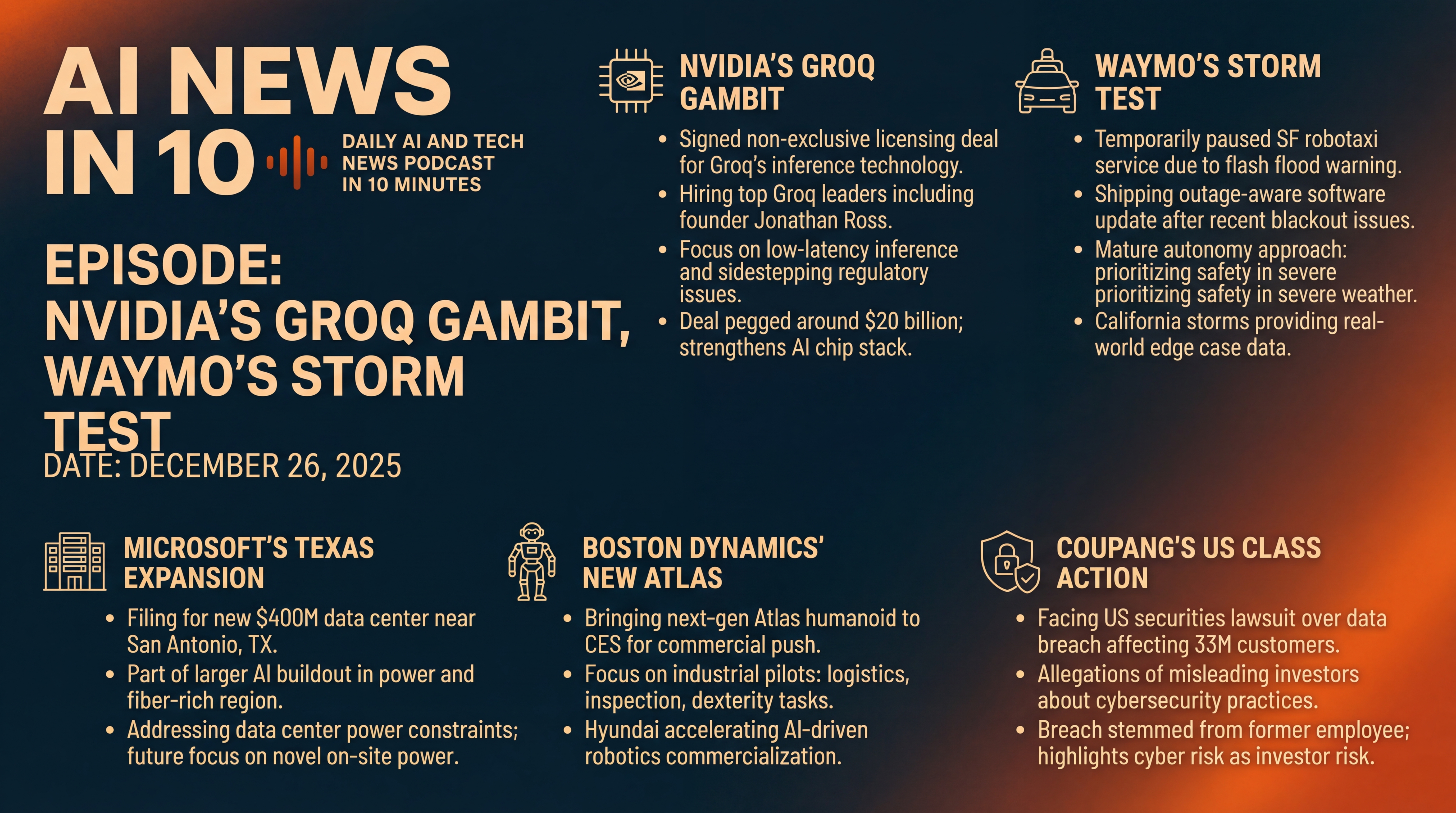
Episode Infographic
Show Notes
Welcome to AI News in 10, your top AI and tech news podcast in about 10 minutes. AI tech is amazing and is changing the world fast, for example this entire podcast is curated and generated by AI using my and my kids cloned voices...
Here’s what’s new in AI and tech for Friday, December 26, 2025... Nvidia makes a bold play to bring in Groq’s inference tech and key leaders. Waymo taps the brakes in San Francisco as storms drench the Bay Area — and it’s shipping an outage-aware software update. Microsoft quietly files plans for another big data center just outside San Antonio. Boston Dynamics is set to bring a new Atlas humanoid to CES. And Coupang gets hit with a United States securities class action after disclosing a breach affecting 33 million customers. Let’s get into it.
[BEGINNING_SPONSORS]
First up, Nvidia just took a very Nvidia move to stay ahead in AI chips — without doing a straight acquisition.
The company has signed a non-exclusive licensing deal for Groq’s inference chip technology, and it’s hiring top Groq leaders, including founder and CEO Jonathan Ross and president Sunny Madra, according to Reuters. Groq says it will continue as an independent company under new CEO Simon Edwards. This structure lets Nvidia bring Groq’s SRAM-heavy, on-chip memory approach in house — while sidestepping the regulatory headaches a full buyout might invite.
Some outlets have pegged the transaction around 20 billion dollars. The parties didn’t disclose terms — and again, the license is non-exclusive.
The strategic read: inference demand is exploding, and Groq’s low latency architecture has been a favorite for real time AI agents. This move helps Nvidia shore up its stack for an era when running models cheaply and fast matters as much as training the biggest ones.
What to watch... talent absorption and ecosystem fallout. If Nvidia lands Ross and core Groq engineers, expect quick cross-pollination with Blackwell era inference parts — and tighter software integrations for developers chasing ultra low latency. Also, keep an eye on regulators. Even a license, plus key person hires, can draw scrutiny if it looks like consolidation in disguise.
Next, Waymo temporarily paused robotaxi service around San Francisco on Thursday because of a National Weather Service flash flood warning. Users saw a banner in the app saying exactly that. Local reports confirmed the pause, and service restarted as conditions allowed.
It’s a timely stress test. Just days ago, a massive citywide blackout snarled traffic and left some Waymo vehicles stalled at dark intersections. The company now says it will ship a fleet-wide software update to better handle power outage scenarios — and to reduce unnecessary so-called confirmation requests that caused cars to stop and wait. Taken together, this is what maturing autonomy looks like... tightening emergency protocols while proving you’ll slow down or stop when conditions turn dangerous.
The broader context: California’s storms this week have been serious — with widespread flooding risks, high surf, and power outages. For autonomous vehicles, that means new data for edge cases in heavy rain, debris, and sensor noise. If Waymo’s update performs under real-world stress, it could help rebuild confidence after the blackout hiccups.
On to Microsoft. The company keeps adding concrete to the great AI buildout — this time in Medina County, just outside Castroville, west of San Antonio.
Public filings point to a one story, roughly 195,670 square foot data center with a project cost around 400 million dollars, targeted for completion by July 2028. The facility is described as colocation — space Microsoft can lease to other companies — on land where it already owns more than 1,400 acres. It’s part of a larger patchwork of builds nearby that collectively represent billions in investment. Why it matters: Texas keeps emerging as a power and fiber sweet spot, and San Antonio has quietly become a serious data center hub.
Zooming out for a second... power is the constraint everyone’s watching. Gartner estimates data centers will draw about 448 terawatt-hours this year, and roughly double to about 980 terawatt-hours by 2030 — with AI optimized servers accounting for an ever larger share. That’s why you’re hearing so much about novel on-site power — hydrogen, geothermal, even small modular reactors — coming into the mix before decade’s end. Microsoft’s footprint growth in power-friendly regions fits that trajectory.
[MIDPOINT_SPONSORS]
Now to robotics. Boston Dynamics is bringing next generation Atlas humanoids to CES, parent company Hyundai says, as part of a push to accelerate commercialization of AI-driven robotics.
Details are under wraps until the Las Vegas reveal, but the message is clear: humanoids are moving from flashy YouTube stunts to industrial pilots — think logistics, inspection, and last 50 feet tasks where dexterity matters. If Boston Dynamics shows real improvements in manipulation, battery life, or cost curves, it could mark a shift from lab demos to purchase orders. Keep an eye on how Hyundai frames the use cases — and any announcements about developer tooling, safety envelopes, and service models.
Humanoids aren’t alone — automation is surging across form factors — but Atlas remains the highest profile platform. Putting it on the CES stage places robotics front and center in a year when factories are under pressure to do more with constrained labor, and when AI agents are getting better at planning and control.
Finally, Coupang — South Korea’s e-commerce giant — is facing a United States securities class action over a major data breach that exposed data on more than 33 million customers. Plaintiffs allege the company and its executives misled investors about cybersecurity practices and failed to disclose the incident promptly. Coupang has said payment data and login credentials weren’t affected. Investigators in Korea are still digging into the breach, which the company says stemmed from a former employee accessing internal systems.
Why this matters for U.S. investors: disclosures around security posture and incident timelines are increasingly material. If the court finds omissions or misstatements, the case could raise the bar for how cross listed tech firms report cyber risk.
One more thought on security... the wave of high profile ransomware and supply chain incidents this year has kept regulators and boards on alert. As AI proliferates, so do attack surfaces — identity, cloud configurations, model endpoints. Expect more suits testing where the line sits between best effort security and the obligation under securities law to disclose evolving risk.
Quick recap... Nvidia’s Groq move doubles down on ultra low latency inference — without a messy takeover. Waymo paused Bay Area rides for flash flood safety — and is shipping an outage aware update after last weekend’s blackout. Microsoft’s latest 400 million dollar Texas project shows the AI buildout rolling on — even as the industry stares down a power crunch. Boston Dynamics is set to put a new Atlas on the CES stage. And Coupang’s breach fallout lands in U.S. court — underscoring how cyber risk has become investor risk.
We’ll keep tracking what moves from headline to bottom line as we close out 2025.
Thanks for listening and a quick disclaimer, this podcast was generated and curated by AI using my and my kids' cloned voices, if you want to know how I do it or want to do something similar, reach out to me at emad at ai news in 10 dot com that's ai news in one zero dot com. See you all tomorrow.
