Chatty AI Guardrails, Rocket IPOs, Stormy Skies
China drafts safety rules for human-like AI and fast-tracks reusable-rocket listings. In the U.S., AI helps airlines amid a brutal winter storm, Goldman flags a vendor breach, and a U.S.–EU tech policy rift deepens.
Episode Infographic
Show Notes
Welcome to AI News in 10, your top AI and tech news podcast in about 10 minutes. AI tech is amazing and is changing the world fast, for example this entire podcast is curated and generated by AI using my and my kids cloned voices...
Here’s what’s new and noteworthy in AI and tech for Saturday, December 27, 2025.
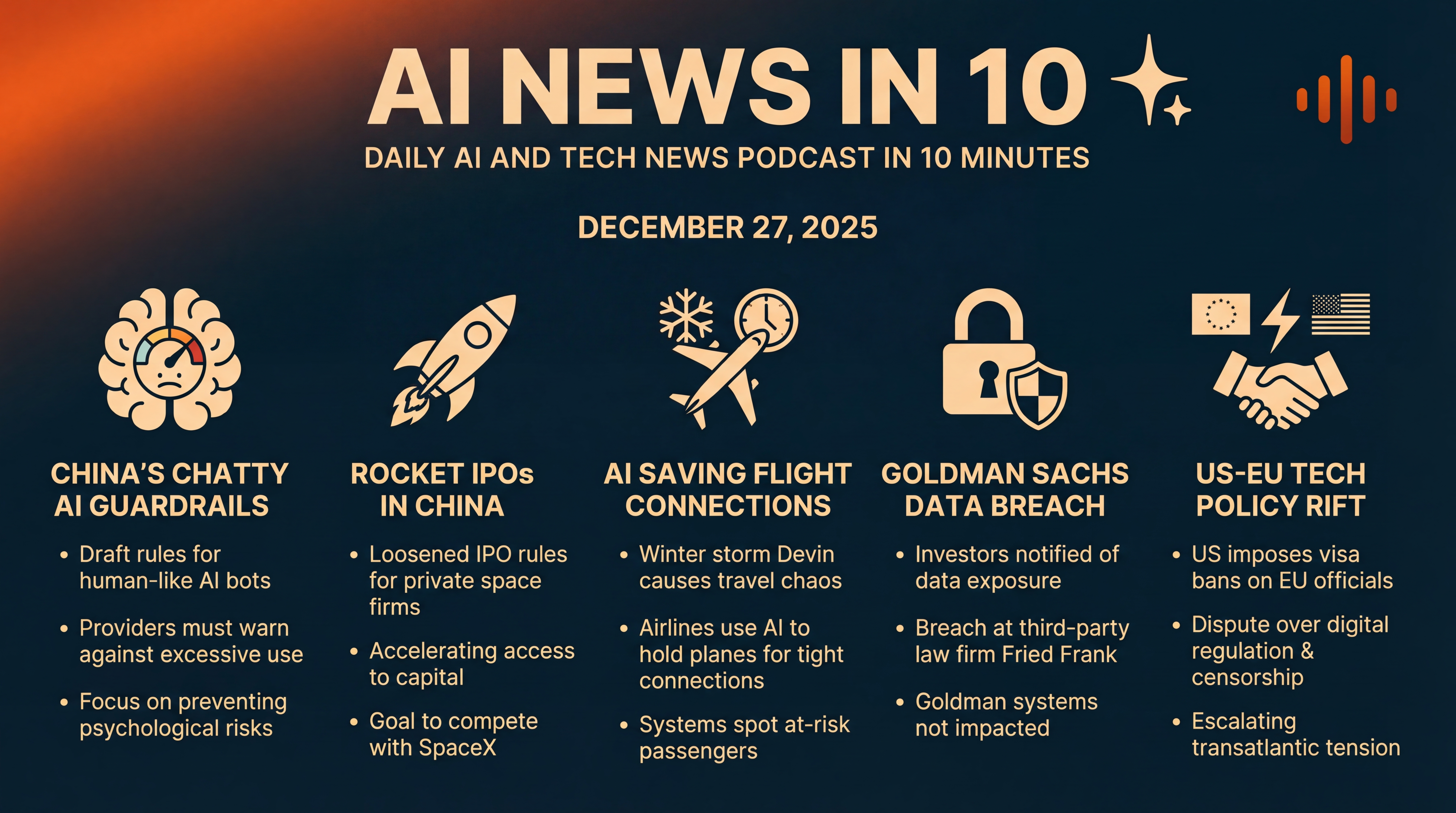
China has proposed strict new rules for chatty, human-like AI. Beijing also moved to boost its private space sector by loosening IPO rules for reusable-rocket companies. In the U.S., a winter storm is hammering holiday travel — and airlines are deploying AI to help salvage tight connections. Goldman Sachs notified some fund investors about a third-party data breach at a law firm. And across the Atlantic, a diplomatic dust-up over digital regulation is widening between Washington and Brussels.
[BEGINNING_SPONSORS]
Let’s start in China, where regulators proposed the most detailed guardrails yet for AI products designed to feel... human. The country’s cyberspace watchdog released draft rules aimed at services that simulate personality and engage emotionally — across text, images, audio, and video. Providers would need to warn users against excessive use, detect signs of extreme dependence or distress, and step in when needed. It’s an explicit attempt to curb psychological risks from companion-style bots.
The draft also calls for algorithm reviews, data-security and privacy controls throughout a product’s lifecycle, and content red lines against threats to national security or the spread of misinformation, violence, or obscenity. Public comment is open, but the direction is clear — consumer AI that “acts human” will face human-centric safety obligations, according to Reuters.
Zooming out, the move fits Beijing’s broader posture: green-light innovation, keep a tight leash. The rules echo earlier measures on generative AI and watermarking, and they’ll likely shape how domestic platforms build the next wave of assistants and companions. For global developers selling into China, the compliance playbook just got more prescriptive.
Story two is also from China — but it’s about space hardware. Regulators introduced new listing rules to help reusable-rocket startups tap Shanghai’s tech-focused STAR Market even if they’re not yet profitable. Companies that hit key milestones — like flying an orbital launcher with reusable components — could bypass traditional revenue and profit thresholds. The goal is straightforward: close the gap with SpaceX by accelerating capital access for private firms, Reuters reports.
Momentum is building. LandSpace recently finished a pre-IPO tutoring phase and says a Shanghai listing could come in 2026. After an initial flight that fell short on booster recovery, the company is targeting a successful retrieval by mid-2026 — and reuse by its fourth launch. Put it together and you see a concerted push: scale up reusability, cut launch costs, expand satellite constellations... fast.
Story three: winter storm Devin is battering U.S. holiday travel — and AI is quietly helping travelers make their connections. As of Friday evening, airlines canceled more than eighteen hundred flights and delayed over twenty-two thousand, with major hubs in New York and New Jersey among the hardest hit. JetBlue saw the most cancellations, followed by Delta, Republic, American, and United — each offering fee waivers. Officials urged people to stay off the roads while crews work, according to Reuters.
Behind the scenes, carriers are testing AI-assisted tools that decide when it’s smarter to hold a plane a few minutes so late inbound passengers can make it onboard — without wrecking the day’s schedule. American Airlines says its in-house system spots at-risk connections, suggests short holds at hubs like Dallas Fort Worth and Charlotte, and coordinates rebooking through a new generative-AI chat assistant during weather events. United runs a similar concept, Connection Saver, which alerts customers when a gate hold is in effect. On a day like today, those extra five to ten minutes can be the difference between making dinner — or sleeping on the concourse.
[MIDPOINT_SPONSORS]
On to cybersecurity. Goldman Sachs notified investors in some of its alternative investment funds that their data may have been exposed after an incident at outside law firm Fried Frank — formally, Fried Frank Harris Shriver and Jacobson. In a letter dated December 19, Goldman said its own systems weren’t impacted, cited the firm’s statement that vulnerabilities were remediated, and noted that any exposed data is unlikely to be distributed or misused. The bank says it’s assessing the firm’s controls and will provide client-specific updates if needed. For the industry, it’s another reminder that third-party legal and consulting vendors can be the weakest link, per PYMNTS.
And finally, the U.S.–EU tech policy rift just escalated. The U.S. imposed visa bans on former EU commissioner Thierry Breton and others it accuses of pushing “censorship” through the Digital Services Act and related enforcement against social platforms — a move reported by the Financial Times. European leaders condemned the step as coercive and an attack on EU sovereignty. This comes amid broader tensions: earlier this month, the White House moved to centralize U.S. AI oversight and signaled it could withhold federal broadband funds from states with what it sees as onerous AI laws — more fuel for a transatlantic fight over who sets the rules for online speech and algorithmic systems. Expect more courtroom and diplomatic drama in 2026.
Quick recap before we go. China unveiled draft rules to police emotionally interactive AI, setting a new marker for safety and user-protection requirements. Beijing also made it easier for reusable-rocket startups to list, putting capital behind its SpaceX ambitions. In the U.S., a major winter storm snarled thousands of flights — but AI-driven connection-saving tools softened some of the blow. Goldman Sachs warned some fund investors after a third-party law firm breach. And Washington’s visa bans on EU digital officials sparked fresh transatlantic friction over tech governance.
That’s your wrap for December 27, 2025. Stay safe, stay warm... and I’ll see you tomorrow.
Thanks for listening and a quick disclaimer, this podcast was generated and curated by AI using my and my kids' cloned voices, if you want to know how I do it or want to do something similar, reach out to me at emad at ai news in 10 dot com that's ai news in one zero dot com. See you all tomorrow.
