
Patch Now, AI Ads, and Space Milestones
Microsoft ships an actively exploited fix, Meta starts using your AI chats to target ads, Samsung tees up Gemini-powered appliances, the UK sets Online Safety Act fees, and Rocket Lab ends the year on a high. Practical takeaways for updates, privacy settings, and your CES game plan.
Episode Infographic
Show Notes
Welcome to AI News in 10, your top AI and tech news podcast in about 10 minutes. AI tech is amazing and is changing the world fast, for example this entire podcast is curated and generated by AI using my and my kids cloned voices...
It’s Sunday, December 28, 2025... and we’ve got a tight lineup to close out the holiday week.
First—Microsoft’s final Patch Tuesday of the year shipped with an actively exploited zero-day, plus fixes touching Copilot and PowerShell... so yes, it’s update-now territory.
Then, Meta quietly flipped on a new setting that uses your AI chats to personalize ads across Facebook and Instagram—outside Europe and South Korea.
We’ll also peek at Samsung’s CES teasers, including Gemini-powered AI features coming to refrigerators and more.
In policy, Ofcom lays out fees and timelines under the UK’s Online Safety Act that will bite big platforms in 2026.
And we’ll end in space—Rocket Lab closes 2025 with a radar-imaging satellite for Japan... and a new annual launch record.
[BEGINNING_SPONSORS]
Story one—Microsoft’s December security drop.
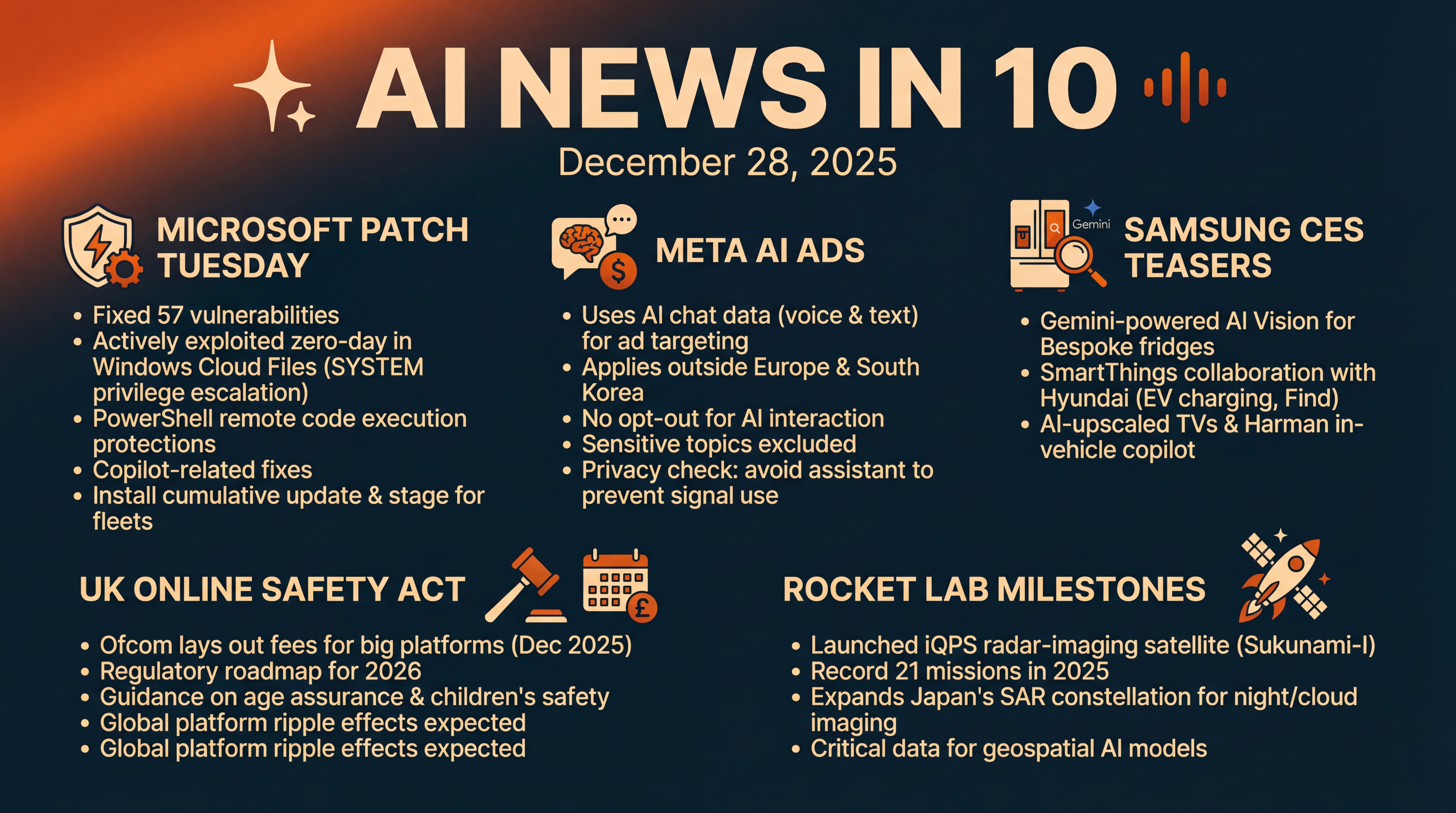
If you’ve been putting off updates... don’t. This Patch Tuesday, Microsoft fixed 57 vulnerabilities, including an in-the-wild zero-day in the Windows Cloud Files Mini Filter Driver. Attackers have been using it to escalate privileges to SYSTEM—which is why CISA added it to the Known Exploited Vulnerabilities list.
Microsoft also hardened developer-adjacent tools—new PowerShell remote code execution protections, plus a Copilot-related pathway researchers warned could enable cross-prompt injection in certain workflows.
Bottom line—install the cumulative update, then confirm your PowerShell and developer environments inherit the mitigations.
Across the year, Microsoft has patched over eleven hundred vulnerabilities—second only to 2020—with this release stacking more elevation-of-privilege and remote code execution fixes on top.
A couple of practical tips. If you manage fleets, stage the update to a pilot ring today, but don’t wait until the workweek to push broadly—especially for systems exposed to untrusted code. For endpoints with third-party file sync or virtualized storage filters, test for driver conflicts. And if you’re experimenting with local agent tools that automate shell commands, revisit any auto-approve settings—some vendor defaults are lenient.
Story two—Meta starts using AI chat data to personalize your feed and ads.
Beginning December 16, Meta enabled a change that allows conversations with Meta AI—by voice or text—to inform content ranking and advertising signals across Facebook, Instagram, and more. There’s no opt out if you choose to interact with Meta AI, though the company says sensitive topics like health, religion, and politics won’t be used for ads. The rollout excludes the UK, the EU, and South Korea.
Meta says its assistant has about one billion monthly actives, so this is a meaningful shift in how AI interactions feed the ad machine. For users, expect ads and recommended content tied to things you asked the bot—like hiking boots after you chatted about trails. For marketers, this is effectively a first-party intent channel... with all the privacy scrutiny that implies. The change is now live.
A quick privacy hygiene check—if you don’t want your conversations used as signals, the surest route is simply not to engage the assistant. Also review your off-Meta activity settings and ad preferences—they don’t directly control this AI chat signal, but tightening them still reduces other tracking vectors.
Story three—a CES sneak peek. Samsung’s AI Vision, powered by Google’s Gemini, is coming to the kitchen and beyond.
Samsung says its next Bespoke AI refrigerators will recognize more foods, suggest recipes, and support richer multimodal queries right on the door display. The company is also expanding SmartThings—a new collaboration with Hyundai Motor Group will let SmartThings recommend EV charge windows, automatically switch to battery-backup modes during outages, and even help you find your car with SmartThings Find.
Samsung’s broader AI for All push includes AI-upscaled TV features, a Harman in-vehicle copilot avatar, and a B2B SmartThings Pro for buildings and hotels. Expect more details as CES week kicks off next month in Las Vegas.
[MIDPOINT_SPONSORS]
Story four—the UK’s Online Safety Act moves into the money and timelines phase.
Ofcom’s December industry bulletin spells out how it will recover operating costs—annual fees from platforms with more than 250 million pounds in qualifying worldwide revenue—and it updates the regulatory roadmap for 2026. The fees regulations take effect December 11, 2025, with a four-month window for platforms to submit revenue data for the 2026–27 charging year.
Ofcom also previewed key guidance for 2026—final super-complaints guidance in February, and statutory reports on age assurance and children’s app-store use later in the year. For U.S. listeners—while this is UK-specific, compliance shifts by global platforms often ripple into product changes you’ll see everywhere, especially around age assurance and recommendation safety.
One tactical note for trust-and-safety teams—Ofcom’s timelines suggest a busy mid-2026 for transparency reporting, categorization registers, and additional safety measures. If your product operates in the UK and touches minors, align your labeling and age-assurance roadmaps early to avoid rushed, brittle implementations later.
Story five—Rocket Lab caps 2025 with a radar-imaging satellite for Japan... and a record year.
On December 21, Rocket Lab launched iQPS’s QPS-SAR-15, nicknamed Sukunami-I, aboard Electron from New Zealand, placing it into a 575-kilometer orbit. It’s the company’s 21st mission of 2025—a new annual record—extending Electron’s cadence and adding to Japan’s growing commercial SAR constellation that images through clouds and at night. The mission nickname—The Wisdom God Guides—underscores small-launch resilience as the market gets more crowded and rideshares scale up.
Quick take—set aside the launch count... this mission matters for data. SAR is what governments and insurers want during storms, fires, and night operations. Each new node improves revisit rates—the lifeblood of geospatial AI models that do change detection and logistics.
That’s the feed for December 28. Patch if you haven’t, watch those AI chat privacy settings on Meta, and get ready for a CES that’s about to make AI in everything feel very literal—from your living room, to your fridge, to your car. We’ll be back tomorrow—same time, same feed—with the latest on AI and the tech powering the start of 2026.
Thanks for listening and a quick disclaimer, this podcast was generated and curated by AI using my and my kids' cloned voices, if you want to know how I do it or want to do something similar, reach out to me at emad at ai news in 10 dot com that's ai news in one zero dot com. See you all tomorrow.
