
SoftBank, H200 to China, and Drone Ban
SoftBank reportedly circles DigitalBridge as Nvidia targets H200 shipments to China and the FCC’s drone import ban reshapes the skies. We break down Zoox’s recall, new NHTSA research on autonomy, and Senator Sanders’ call to pause AI data centers.
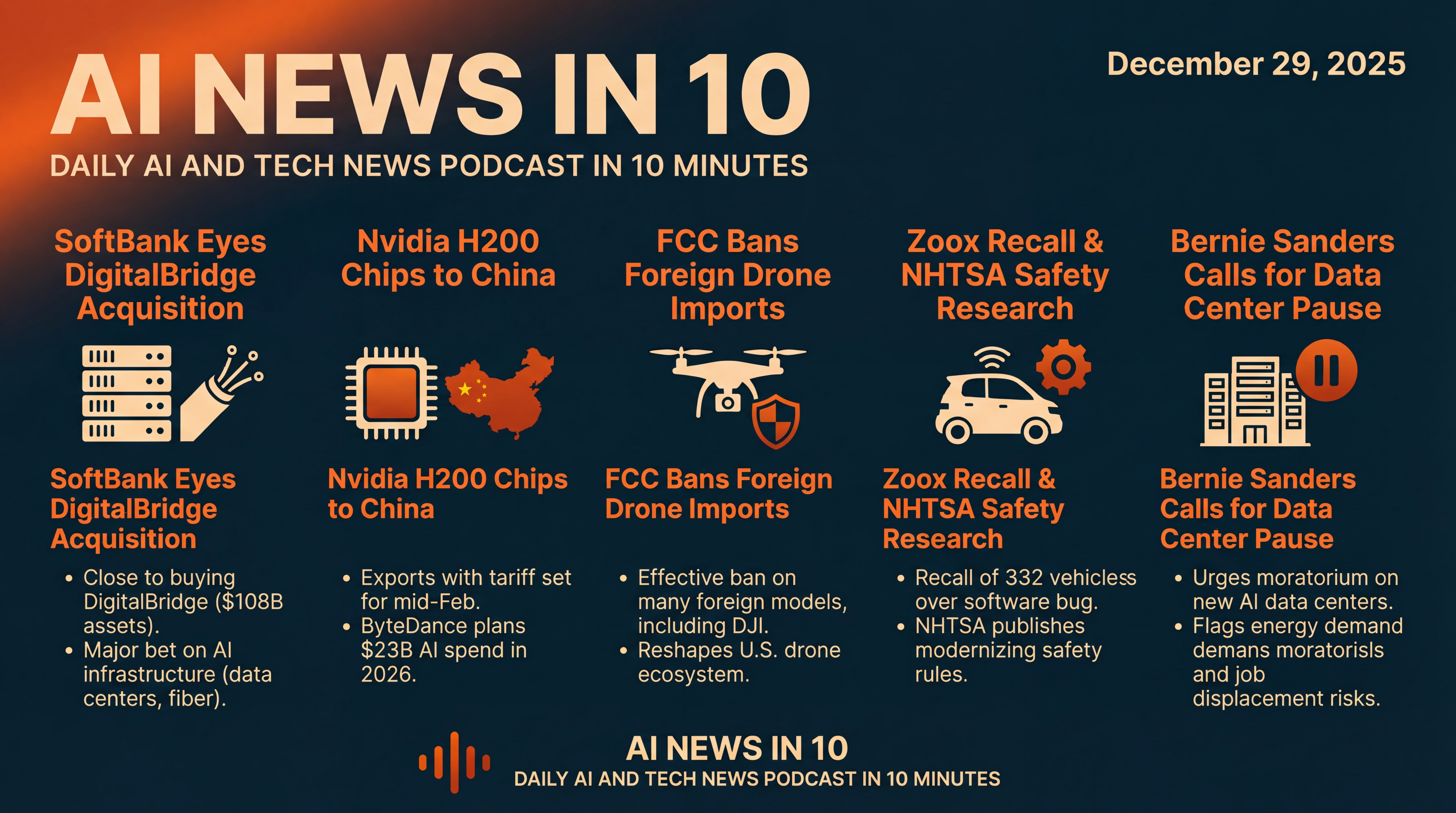
Episode Infographic
Show Notes
Welcome to AI News in 10, your top AI and tech news podcast in about 10 minutes. AI tech is amazing and is changing the world fast, for example this entire podcast is curated and generated by AI using my and my kids cloned voices...
It’s Monday, December 29th, and we’ve got a power-packed lineup to close out the year.
Today: SoftBank is reportedly on the verge of buying DigitalBridge — the data center investor behind Vantage, Zayo, Switch, and AtlasEdge — signaling an even bigger bet on AI infrastructure. Nvidia is aiming to send H200 chips to China by mid-February, as ByteDance lines up a reported 23 billion dollars of AI infrastructure spending for 2026. In the U.S., the FCC’s new ban on importing many foreign-made drones — including DJI — kicks in, reshaping the drone and inspection ecosystem. We’ll also talk about Zoox’s latest recall over an automated-driving software bug and fresh federal research on modernizing safety rules. And we’ll wrap with Senator Bernie Sanders’ call to pause new AI data centers, which could set the tone for 2026’s policy fights. Sources include Reuters, Bloomberg, The Verge, the National Highway Traffic Safety Administration, and The Guardian.
Let’s get into it.
[BEGINNING_SPONSORS]
Let’s start with the money and the metal — SoftBank and the data center gold rush.
Bloomberg — relayed by Reuters — says SoftBank is close to acquiring DigitalBridge Group, a major investor and operator across data centers, cell towers, fiber, and edge networks. DigitalBridge manages about 108 billion dollars in assets. Before today’s chatter, its market cap was roughly 2.5 billion dollars... and shares reportedly jumped around 40 percent on the news.
Masayoshi Son has been clear: AI infrastructure is SoftBank’s next-decade play — everything from chips to compute campuses. Pair that with Stargate, the mega-compute vision discussed with partners like OpenAI and Oracle, and you see the thread. Own not just the models or apps, but the scaffolding that makes AI possible — power, racks, connectivity, cooling. If this deal lands, SoftBank wouldn’t just be investing in AI... it would be buying a toll road the entire AI economy has to drive on.
Why it matters... two reasons.
First, scarcity. All through 2025, the gating factor for AI wasn’t imagination — it was watts and warehouse space. Owning a scaled platform of facilities and development pipelines lets you prioritize power, speed permitting, and lock in hyperscale tenants.
Second, convergence. Compute, networking, and energy are fusing. Whoever coordinates those three — at the right cost and latency — gets to set standards. If SoftBank marries DigitalBridge’s footprint with aggressive new buildouts, expect faster time to capacity for customers, and more long-term take or pay contracts that smooth revenue. That’s the picture from Reuters and Bloomberg.
Story two — chip diplomacy meets corporate spending.
Reuters reports Nvidia is targeting mid-February to begin shipments of its H200 AI accelerators to China — pending Beijing’s approval — after the U.S. allowed H200 exports with a 25 percent fee while still blocking the very latest Blackwell parts. Initial volumes could be five to ten thousand modules — equating to tens of thousands of chips — mainly from existing stock. That’s significant for Chinese tech firms that have been stuck on lower-spec parts. Around the same time horizon, the Financial Times — via Reuters — says ByteDance plans to spend roughly 160 billion yuan — about 23 billion dollars — on AI infrastructure in 2026.
Strategically, H200 access — even with a tariff — helps U.S. chipmakers maintain a presence in the world’s second-largest AI market without handing over their very top-end IP. For Chinese buyers, H200 is a clear step up from constrained alternatives, potentially enabling larger model training runs and faster inference for consumer apps. Keep an eye on conditions: Reuters notes China may link approvals to bundled purchases of domestic chips. Net-net... it’s a carefully calibrated detente that keeps the AI flywheel spinning, with strings attached on price and volume.
Story three is about the skies above us.
On December 22nd, the FCC added many foreign-made drones and components to its Covered List and effectively banned the import of new units unless the Department of Defense or the Department of Homeland Security recommends otherwise. DJI — the dominant global player — is squarely in scope. The FCC frames the move as a national security precaution, warning of surveillance and data exfiltration risks. DJI pushed back, saying existing U.S. products still function and criticizing the process. Practically speaking, your current DJI drone isn’t suddenly grounded — but replenishing fleets just got much harder. The Verge has those details.
Implications... they’re big. Public safety agencies, utility inspectors, construction surveyors, film crews, and farmers have spent years standardizing on DJI for price to performance and software ecosystems. A supply squeeze could nudge the market toward U.S. and allied alternatives, raising costs in the short term but potentially opening domestic manufacturing opportunities. For AI specifically, drones are flying sensors that feed computer vision pipelines — mapping roads, spotting defects in power lines, monitoring crops. Control the edge hardware, and you influence whose models — and which countries — get that data first.
[MIDPOINT_SPONSORS]
On to autonomy and safety.
Amazon’s Zoox is recalling 332 vehicles over an automated-driving software issue that, in certain situations near intersections, could misjudge the yellow center line and stop in the path of oncoming traffic — obviously a bad combination. Zoox pushed a software fix over the air, similar to a May recall affecting 270 vehicles tied to pedestrian tracking behavior after a crash in San Francisco. The National Highway Traffic Safety Administration — NHTSA — says the earlier probe was closed. Together, these updates show how quickly both regulators and developers now iterate, according to Reuters.
Zooming out, earlier this month NHTSA published the fourth and final volume of a multi-year research set on how to modernize Federal Motor Vehicle Safety Standards for vehicles with automated driving systems — basically, how to fit twentieth century rules to twenty-first century robotics. The research digs into dozens of standards — from braking and stability control to crashworthiness in unconventional seating configurations — and flags where testing methods or definitions don’t map cleanly to vehicles with no human driver. The subtext is clear: expect more rulemaking in 2026, and a continued shift away from blanket reporting orders toward risk-based, tech-specific oversight. Translation: progress... with a hard emphasis on measurable safety.
Finally, the politics of power — literally.
On Sunday, Senator Bernie Sanders told CNN that AI is the most consequential technology in the history of humanity, and said he wants a moratorium on building new data centers while the country weighs the economic, social, and environmental costs. He flagged job displacement risks and called out rising electricity demand from AI campuses. From a different angle, Republican Senator Katie Britt has pushed legislation aimed at protecting minors from harmful interactions with AI companions. Two very different worldviews... converging on the idea that the status quo needs guardrails, as reported by The Guardian.
You’re going to hear a lot more of this in January. Communities will wrestle with whether the tax base and jobs from a three hundred megawatt campus offset higher local power prices, water use for cooling, and grid upgrades. Nationwide, studies and industry trackers say data center electricity demand surged in 2025 and is on pace to keep growing sharply into the decade, with AI optimized servers taking a larger slice each year. Expect 2026 to bring more state-level bills on siting, water, and worker protections; more federal debates about preempting a patchwork of AI rules; and more utilities proposing new generation or microgrids dedicated to compute parks. The stakes aren’t abstract — your bill, your job, and your town’s zoning are on the table.
Quick recap before we go.
SoftBank is reportedly circling DigitalBridge — a move that would put one of the world’s boldest tech investors at the heart of AI’s physical buildout. Nvidia aims to ship H200s to China by mid-February, while ByteDance plans a massive 2026 infrastructure push — evidence that the AI compute race is global, nuanced, and relentless. The FCC’s foreign drone import ban reshapes a key edge AI market overnight. Zoox’s software recall, paired with new NHTSA research, shows how fast autonomy is maturing — and how closely it’s being watched. And Senator Sanders is calling for a pause on new data centers, teeing up a 2026 battle over how — and how fast — we scale AI.
Sources: Reuters and Bloomberg on SoftBank, DigitalBridge, and the China chip picture; The Verge on the drone import ban; the National Highway Traffic Safety Administration on ADS research; and The Guardian on Sanders’ remarks.
Thanks for listening and a quick disclaimer, this podcast was generated and curated by AI using my and my kids' cloned voices, if you want to know how I do it or want to do something similar, reach out to me at emad at ai news in 10 dot com that's ai news in one zero dot com. See you all tomorrow.
