Chips, State Rules, and AI's 2026 Pivot
Chip policy shifts in the U.S., China, and Japan redraw the compute map as New York sets a tough AI safety clock. We unpack supply chains, governance, and why Satya Nadella says 2026 is when AI moves from pilots to pervasive deployment.
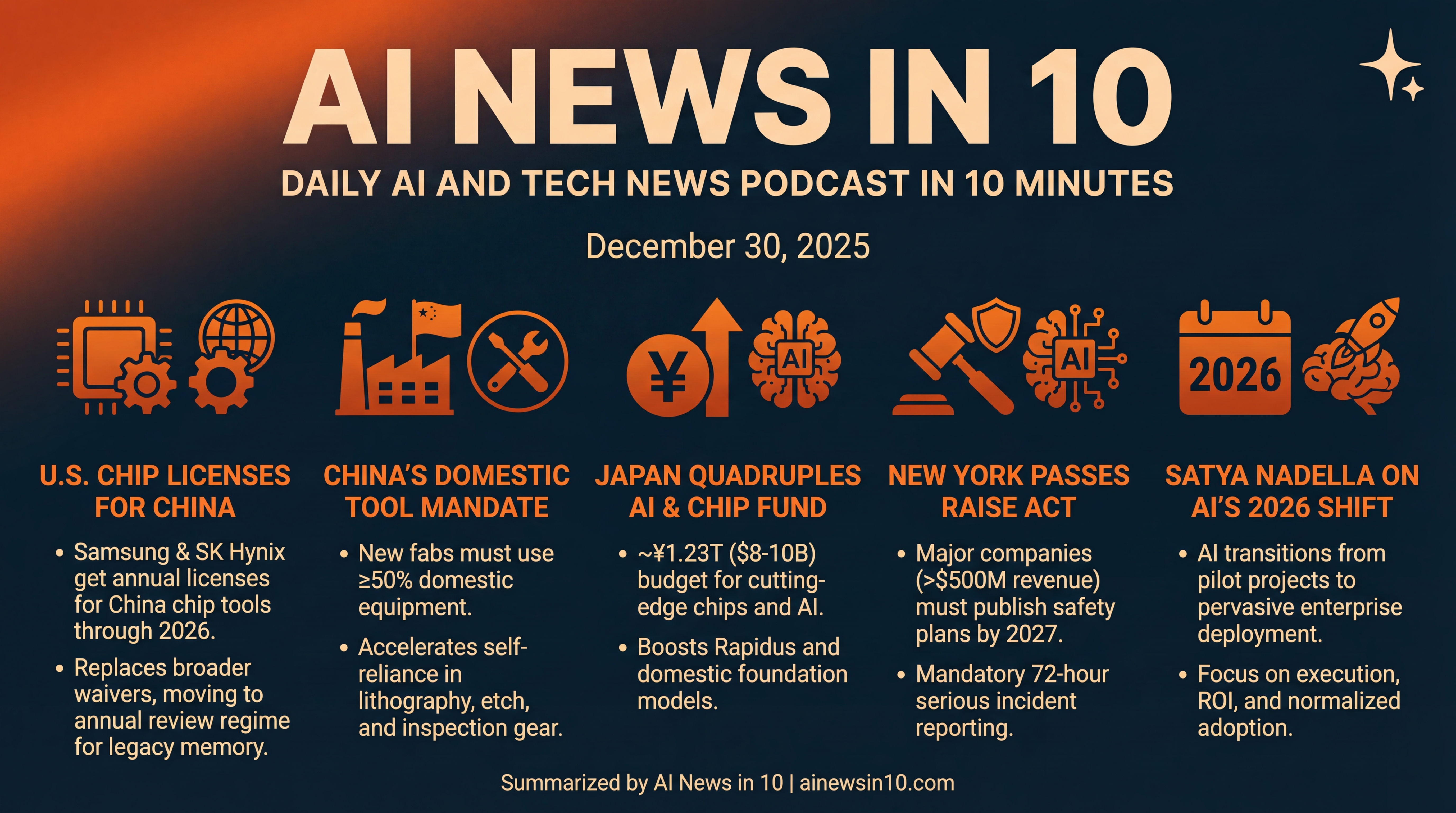
Episode Infographic
Show Notes
Welcome to AI News in 10, your top AI and tech news podcast in about 10 minutes. AI tech is amazing and is changing the world fast, for example this entire podcast is curated and generated by AI using my and my kids cloned voices...
Here's what's moving in AI and tech on Tuesday, December 30, 2025. A trio of major chip policy moves is reshaping where and how the world's compute gets built. New York just passed one of the toughest state AI safety laws in the U.S., and Microsoft's Satya Nadella says 2026 is when AI shifts from experiments to everyday deployment.
We'll unpack what those shifts mean for supply chains, regulation, and the next phase of enterprise adoption... and why all of that could make 2026 a make-or-break year for AI.
[BEGINNING_SPONSORS]
Let's start with semiconductors — because all paths to AI still run through fabs and tools.
The U.S. government has granted Samsung Electronics and SK Hynix annual licenses to ship chipmaking equipment to their factories in China throughout 2026. That replaces the broader waivers set to expire on December 31 — moving everyone to an annual review regime.
Those facilities in Xi'an and Wuxi produce massive volumes of mainstream memory — still the lifeblood of AI servers. Washington's goal is to keep a closer hand on what tools flow into China, without shutting off legacy memory entirely.
There's also a separate move this month allowing some Nvidia H200 exports to China with a 25 percent fee, while keeping the newest Blackwell chips off-limits. Bottom line: the spigot isn't wide open — but it isn't closed either. Supply chains will plan year to year... instead of running on autopilot.
In Beijing, the other shoe drops. If you expand or build a chip fab, at least half of your production tools must come from domestic suppliers. It's not a glossy public decree — more a procurement reality showing up in tenders — but the direction is unmistakable: accelerate self-reliance in lithography, etch, deposition, and inspection gear.
Domestic names like Naura and AMEC are already seeing demand, with pilot deployments edging toward advanced nodes. The policy leaves wiggle room for leading-edge lines where Chinese tools aren't ready... but the long-term aim is 100 percent homegrown equipment. For multinationals, that means the China market will increasingly require a China-specific stack — both for chips and for the tools that make them.
Taken together, those first two stories point to a choppier, more localized chip world in 2026. The U.S. is tightening annual reviews of tool shipments, China is tilting purchases toward domestic vendors, and companies in Korea, Taiwan, Europe, and the U.S. are recalibrating where to put plants, power, and people.
If you're an AI builder, the immediate impact is memory and compute availability — not just who has the fastest GPU, but who can get DRAM and HBM at scale without political delays. And if you're a CFO, risk management now includes knowing whether your AI bill of materials is exposed to a license that expires every December.
Story three keeps us in Asia — and adds fuel to the fire, in a good way. Japan is stepping hard on the accelerator, nearly quadrupling its budget support for cutting-edge semiconductors and AI in the fiscal year that starts in April. The headline number: roughly 1.23 trillion yen — about eight to ten billion dollars.
That includes new money for Rapidus — the state-backed foundry aiming for two-nanometer production later in the decade — and a broader push into domestic foundation models and so-called physical AI, where software controls robots and machines. The takeaway is clear: Tokyo wants to turn sporadic subsidies into steadier, predictable support by shifting more funding into the regular budget — so manufacturers and model builders can plan multi-year roadmaps.
For hyperscalers and chip designers eyeing 2026 capacity, Japan's stance matters. Government reliability can pull private capital off the sidelines, and it dovetails with similar industrial policies in the U.S. and Europe. Put differently, compute isn't just about chips — it's about where the next gigawatt-scale campuses can lock in power, cooling, and talent... with policy tailwinds instead of headwinds.
[MIDPOINT_SPONSORS]
Fourth today: a big move in U.S. AI policy at the state level. New York Governor Kathy Hochul signed the Responsible AI Safety and Education Act — the RAISE Act — on December 20. The law requires companies with more than 500 million dollars in revenue that develop large AI systems to publish and follow safety plans, and to report serious AI-related safety incidents within 72 hours. Enforcement sits in a newly created office at the state Department of Financial Services.
It takes effect January 1, 2027 — giving companies a year plus to operationalize governance, incident response, and documentation. Importantly, New York enacted this despite an executive order from President Trump two weeks earlier that seeks to preempt state AI rules and centralize standards at the federal level. Expect court fights... and, for now, expect companies to prepare for a patchwork.
Why this matters beyond Albany: regulators in California, Colorado, Utah, and others have already moved on niche AI laws, and legal experts suggest the executive branch may not have the authority to wipe those off the books without Congress. In other words, unless there's a federal statute, states may keep asserting themselves — especially on consumer protection and safety. If you run model risk at a bank, or safety at an AI lab, that means building compliance programs that can flex to the toughest jurisdiction you serve.
And finally, a forward-looking signal from Redmond. Microsoft CEO Satya Nadella says 2026 will mark AI's shift from the discovery phase — think research demos and first pilots — into the diffusion phase, where deployments become normalized across industries. He's echoing what many CIOs have felt all year: the proof-of-concept era is winding down, and budgets are moving from experimentation lines into production line items... with ROI targets.
Nadella's framing lines up with what we've seen in 2025: massive capital spending for data centers and chips — yes — but also growing scrutiny on whether AI lifts revenue, cuts costs, or improves customer satisfaction at scale.
The open question for 2026 is execution. On one hand, we're seeing concrete steps that enable diffusion — policy support in Japan for chips and models, a more predictable — if stricter — U.S. export regime for legacy memory tools, and state-level frameworks spelling out what safety should look like in practice. On the other hand, there's a chill in the air: markets have started to punish AI spend without a clear payback, and the year-end vibe check is all about real adoption versus splashy announcements.
If 2024 and early 2025 were about building the rocket, 2026 is about the launch... and proving it can reach orbit repeatedly — not just once.
Quick recap... The U.S. moved Samsung and SK Hynix onto annual licenses for China-bound chip tools, while China told fab builders to source at least half their gear domestically — both moves that will reshape AI hardware supply chains. Japan threw its weight behind chips and AI with a budget that nearly quadruples support next fiscal year. New York set a 2027 deadline for big-company AI safety plans and fast incident reporting — despite a federal push to preempt states. And Microsoft's CEO is calling 2026 the year AI goes from pilot projects to pervasive deployment. If you build or buy AI, the headline for 2026 is simple... execution under new constraints becomes the competitive edge.
Thanks for listening and a quick disclaimer, this podcast was generated and curated by AI using my and my kids' cloned voices, if you want to know how I do it or want to do something similar, reach out to me at emad at ai news in 10 dot com that's ai news in one zero dot com. See you all tomorrow.
