
Agents Rise, N2 Arrives, SoftBank Spends
Meta buys Manus to power agentic assistants, TSMC ramps two‑nanometer chips, and SoftBank pours billions into OpenAI. Plus, Hong Kong’s AI IPO wave and Aflac’s massive breach close out 2025.
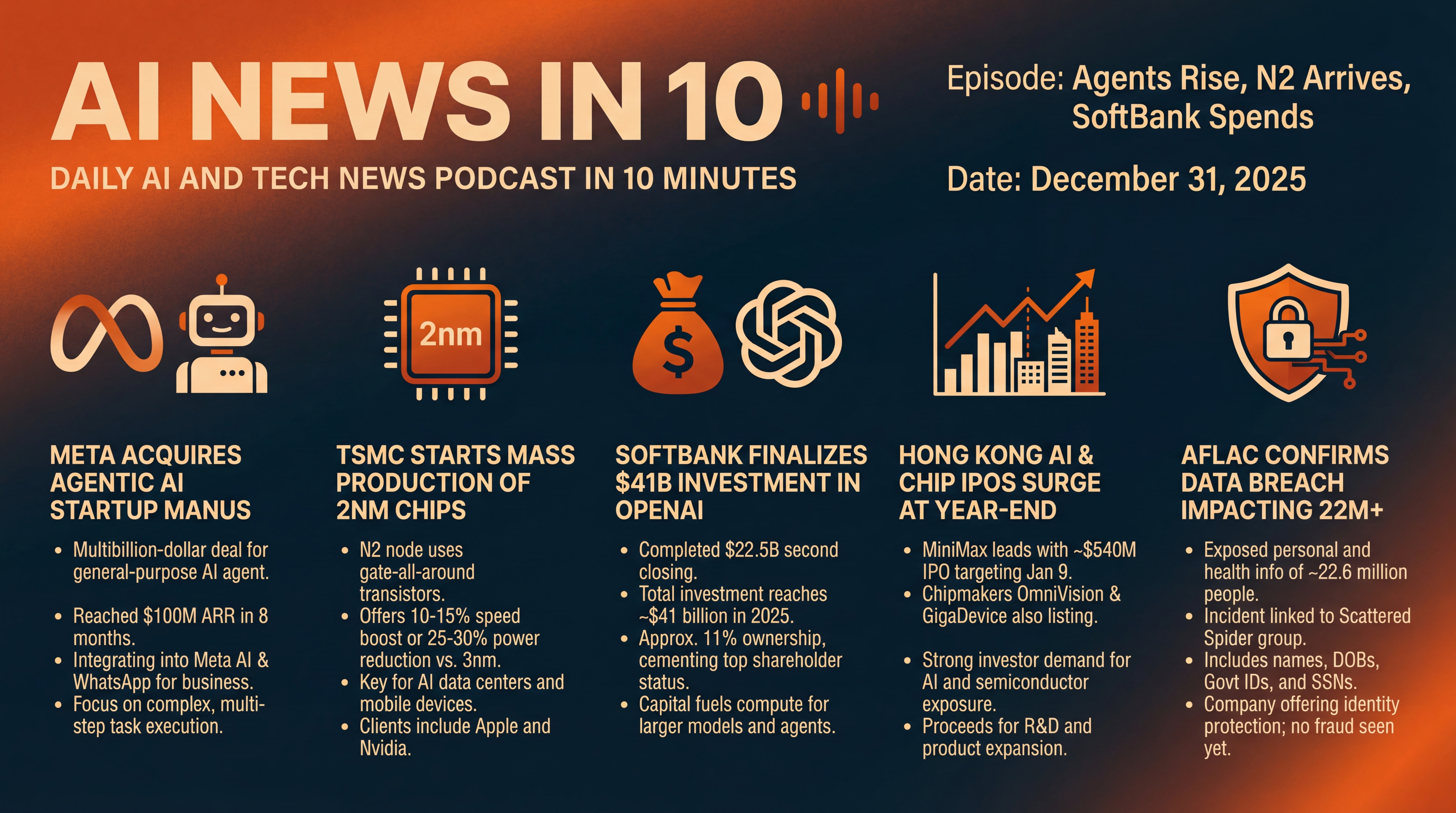
Episode Infographic
Show Notes
Welcome to AI News in 10, your top AI and tech news podcast in about 10 minutes. AI tech is amazing and is changing the world fast, for example this entire podcast is curated and generated by AI using my and my kids cloned voices...
It’s Wednesday, December 31st, and we’re closing the year with big moves in AI and chips. Meta just bought agentic AI startup Manus in a multibillion-dollar deal that could reshape personal and business assistants... TSMC has kicked off mass production of its two-nanometer chips—its most advanced node yet... SoftBank finalized a huge investment in OpenAI, becoming a double-digit shareholder... Hong Kong closes 2025 with a flurry of AI and semiconductor IPOs anchored by MiniMax... and Aflac confirms a data breach impacting more than 22 million people. Let’s get into it.
[BEGINNING_SPONSORS]
Story one: Meta’s big agent play.
Meta is acquiring Manus, the Singapore-based startup behind a fast-growing general-purpose AI agent, for more than two billion dollars.
Manus burst onto the scene this year claiming it could plan and execute complex, multi-step tasks with minimal prompting—things like market research, coding sprints, resume screening, slide creation, and other desk-work chores that normal chatbots still fumble.
According to the company and public filings, Manus reached about 100 million dollars in annual recurring revenue just eight months after launch—eye-popping growth for a tool that lives somewhere between a chatbot and an autonomous assistant.
Meta says it will keep Manus as its own brand while weaving the tech into Meta AI and—crucially—into the WhatsApp small-business ecosystem. That matters because WhatsApp is already a commerce and customer-service backbone for millions of small and mid-sized businesses globally. Plug a reliable agent into that channel and you can see why some analysts are calling the deal transformative.
Meta also emphasized there will be no remaining Chinese ownership after closing, and that Manus will cease any China-facing operations... easing geopolitical concerns over data access and influence.
Zooming out—Meta has been spending heavily on AI this year, from infrastructure to talent, and this acquisition fits its push toward personal and enterprise agents. If the integration sticks, expect agentic workflows to show up in WhatsApp Business and across Meta AI in 2026.
Story two: the next node arrives.
Taiwan Semiconductor Manufacturing Company—TSMC—has started mass production of its two-nanometer chips in the fourth quarter of 2025, confirming a milestone that’s been anticipated for years. The N2 node is TSMC’s first to use gate-all-around nanosheet transistors, with initial production at Fab 22 in Kaohsiung and additional capacity in Hsinchu.
What does two nanometers buy you? TSMC cites either a 10 to 15 percent speed boost at the same power, or a 25 to 30 percent power reduction at the same speed versus its three-nanometer line—gains that matter for everything from iPhones to AI accelerators.
In other words—more performance per watt. That’s exactly what the AI data-center world—and battery-sensitive mobile devices—need. Clients named in reporting include Apple and Nvidia.
The timing is meaningful. As the AI build-out pushes power and thermal limits, every efficiency gain at the transistor level compounds through servers, racks, and entire data centers. And for mobile, two nanometers could unlock new on-device AI features without killing battery life. We’ll be watching how quickly major chip designers migrate flagship parts to N2 throughout 2026.
Story three: SoftBank writes a very large check—again.
SoftBank Group says it has completed the second—and largest—closing of its commitment to OpenAI, adding 22.5 billion dollars and bringing the total to roughly 41 billion invested this year. It now pegs its ownership at about 11 percent, cementing itself as a top shareholder alongside Microsoft and others.
SoftBank frames the move as delivering on its pledge and as a cornerstone in its strategy to back foundational AI and the infrastructure behind it. Regardless of how you feel about the frothy AI market... this is one of the biggest single-year capital commitments into an AI company on record.
Why it matters: capital equals compute. OpenAI’s ambitions—larger reasoning models, agent ecosystems, and power-hungry training runs—consume staggering amounts of silicon, electricity, and real estate. If SoftBank’s money translates quickly into capacity, expect a faster cadence of model upgrades and more enterprise-grade agent features across 2026.
[MIDPOINT_SPONSORS]
Story four: Hong Kong closes the year with an AI IPO burst.
A wave of listings hit the Hong Kong Stock Exchange at year-end, led by Chinese AI firm MiniMax Group, which is seeking up to about 4.2 billion Hong Kong dollars—roughly 540 million U.S. dollars—on a January 9th debut. The six deals together amount to roughly 16.7 billion Hong Kong dollars, capping a dramatic rebound year for Hong Kong’s equity markets—about 36.5 billion U.S. dollars raised across 114 listings in 2025, more than triple 2024.
Chipmakers OmniVision and GigaDevice are in the mix, each targeting around 600 million dollars, and cornerstone investors include names like Alibaba and Abu Dhabi’s sovereign wealth funds. For AI, this window is notable: investors still want exposure to model companies and semiconductor suppliers, increasingly via Asian exchanges and ecosystems as China pushes self-reliance. Proceeds are earmarked for R&D and product expansion.
A quick lens on the why: late-cycle listings often signal founders believe the window is still open and demand is real. For global listeners, it’s another indicator that 2026’s AI competition won’t just be model-to-model—it will also be market-to-market, with financing and public capital formation happening beyond New York.
Story five: a tough cybersecurity headline.
Aflac—one of the largest U.S. insurers—confirmed that a June intrusion exposed personal and health information on about 22.6 million people, spanning customers, beneficiaries, employees, and agents. The company says it contained the breach within hours, has not seen evidence of fraud to date, and is notifying affected individuals while offering identity protection.
Reporting ties the incident to the Scattered Spider group, which has targeted multiple insurers this year. The compromised data varies by person but can include names, addresses, dates of birth, government ID numbers, Social Security numbers, and health insurance or claims information.
This is a reminder that critical data isn’t just in hospitals and banks—insurance carriers hold highly sensitive records that are valuable for identity theft and targeted fraud. If you’re an Aflac customer who receives a notice, consider freezing your credit, enrolling in the offered monitoring, and watching for medical or insurance claim anomalies over the next year.
That’s a wrap: Meta doubles down on autonomous agents... TSMC moves two-nanometer chips from roadmap to reality... SoftBank closes the year with a forty-one-billion-dollar bet on OpenAI... Hong Kong’s IPO window reopens for AI and chips... and Aflac’s breach ends 2025 with a reminder that security basics still matter. We’ll be back tomorrow with the first headlines of 2026—see you then.
Thanks for listening and a quick disclaimer, this podcast was generated and curated by AI using my and my kids' cloned voices, if you want to know how I do it or want to do something similar, reach out to me at emad at ai news in 10 dot com that's ai news in one zero dot com. See you all tomorrow.
