Chips Align, Startups Strain, Apple Steps In
From Baidu’s Kunlunxin IPO and Nvidia’s surprise Intel stake to a quiet AI agent settlement, VCs warn of a 2026 shakeout—while Apple gears up for an AI-first year. We break down why compute, distribution, and real task completion will define the winners.
Episode Infographic
Show Notes
Welcome to AI News in 10, your top AI and tech news podcast in about 10 minutes. AI tech is amazing and is changing the world fast, for example this entire podcast is curated and generated by AI using my and my kids cloned voices...
It’s Friday, January 2nd. We’re kicking off 2026 with fresh filings, big-ticket chip moves, a notable AI lawsuit settlement, and a sober forecast for the startup scene. Here’s the rundown...
Baidu’s AI chip unit Kunlunxin is teeing up a Hong Kong listing. Nvidia just disclosed a multibillion-dollar stake in Intel. X settled its clash with Eliza Labs over agent tech. Venture capitalists warn 2026 could be a do-or-die year for many AI app startups. And Apple’s roadmap points to an AI-first year with new hardware bets. Let’s get into it.
[BEGINNING_SPONSORS]
Story one: Baidu’s Kunlunxin moves toward the public markets.
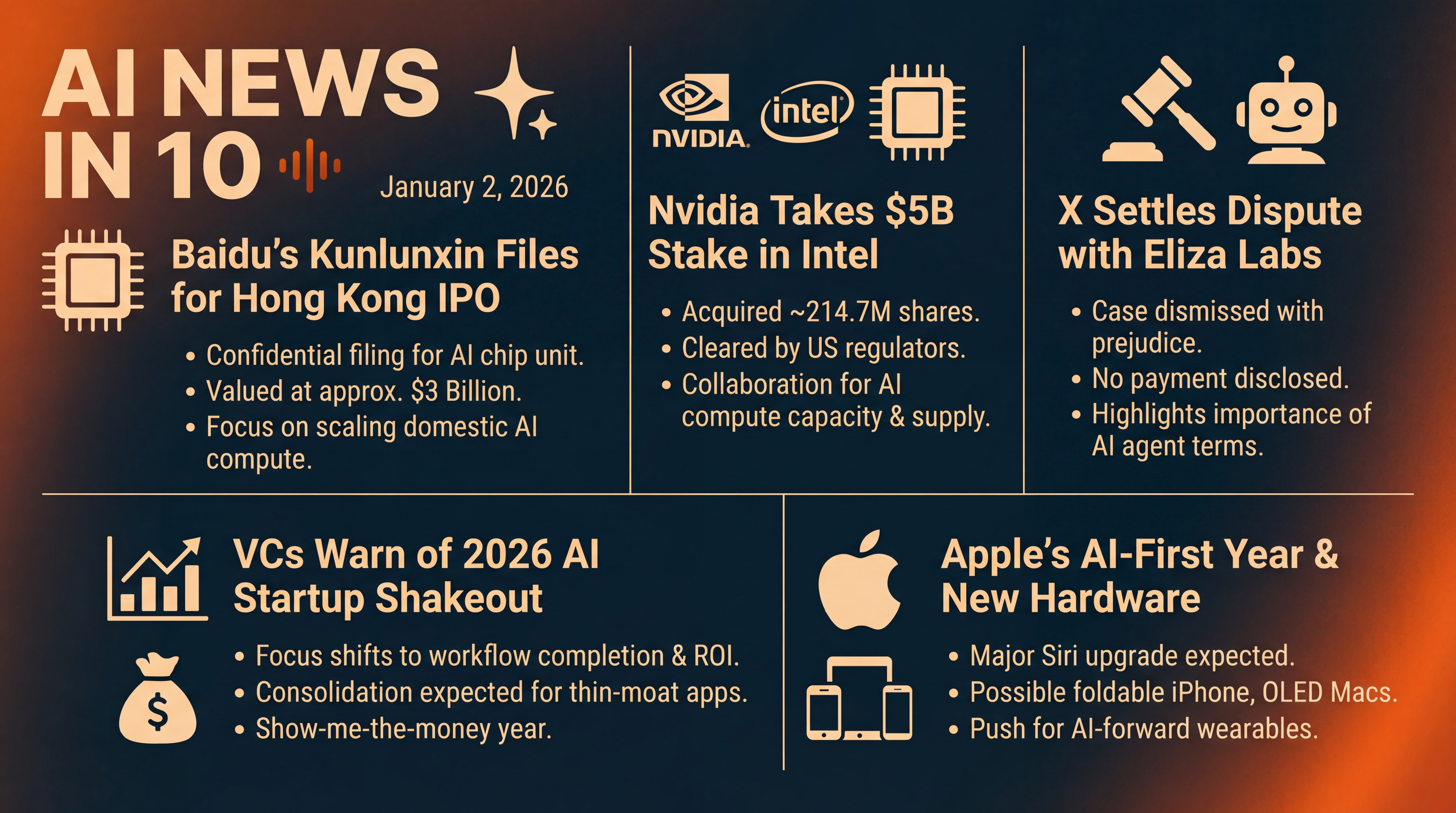
On January 1st, Baidu’s AI chip subsidiary confidentially filed for a Hong Kong IPO, according to Reuters.
Kunlunxin — long the in-house silicon effort behind Baidu’s large-scale AI workloads — was most recently valued at about 21 billion yuan, roughly 3 billion dollars, following a late 2025 fundraising round.
Details like the float size and pricing aren’t public yet, but the filing underscores China’s push to scale domestic AI compute amid ongoing export frictions. Hong Kong’s IPO window also looks more open than it did a year ago — listings in 2025 rebounded to more than triple 2024’s take — so Baidu is choosing a friendlier backdrop for a spin-off that still keeps Kunlunxin under the group umbrella.
For chip buyers and model builders in China, it’s another signal that the local supply chain is seeking capital and independence to keep AI training onshore.
Why it matters... sovereign AI ambitions ultimately hinge on sovereign compute. If Kunlunxin uses an IPO to scale manufacturing and distribution beyond Baidu’s own fleet, it could become a more important merchant supplier in China — especially as demand shifts from headline frontier training to the nuts and bolts of deploying inference at scale. Keep an eye on how proceeds are earmarked — R&D versus capacity — and any signals about third-party customer mix.
Story two: Nvidia and Intel’s ties deepen — with real money.
Just before the holiday, filings revealed Nvidia acquired roughly 214.7 million Intel shares via a private placement — a stake worth about 5 billion dollars at a purchase price of 23 dollars and 28 cents per share. U.S. regulators cleared the deal in December, according to Reuters.
The optics are striking — the AI era’s most valuable chipmaker taking a sizable position in a one-time rival that’s racing to reinvent itself through foundry services and next-gen process tech.
Beyond the symbolism, it reflects the reality of 2026: AI compute demand is so intense that ecosystem partners need each other to stand up capacity, packaging, and supply resilience.
Zooming out... the investment could smooth collaboration as Intel courts leading-edge customers for its foundry and advanced packaging. If Intel executes on process and capacity, Nvidia benefits from additional trusted manufacturing options — particularly for networking silicon and advanced modules. Investors will watch for any co-development announcements tied to packaging or interconnects over the next few quarters.
Story three: A closely watched AI agent dispute ends quietly.
X Corp and Eliza Labs have resolved their lawsuit, and the case has been dismissed with prejudice — no refiling.
Eliza alleged X misappropriated agent technology and engaged in anticompetitive conduct after licensing talks soured. X denied wrongdoing and said it paid nothing to resolve the matter. Terms weren’t disclosed.
Even without a courtroom showdown, the settlement is instructive for the AI agent wave. Rights around agent frameworks, platform access, and data usage will be negotiated hard — often in private — because distribution and integrations on major platforms can make or break a young agent business. Expect 2026 deals to spell out licensing scope, attribution, and platform-policy carve-outs more explicitly to avoid brinkmanship.
[MIDPOINT_SPONSORS]
Story four: The great AI startup shakeout — investors say it’s coming this year.
In a New Year outlook, venture capitalists told the Wall Street Journal they expect many thin-moat AI application startups to struggle or fail in 2026.
The consensus is shifting from shiny chat interfaces to agentic systems that actually complete workflows. Success metrics will move from time in app to tasks completed and cost per task.
That means a higher bar for product-market fit and a need for reliable, controllable execution — often through tight integrations with deterministic systems. The upshot: platforms with data access, distribution, and unit-economics advantages will consolidate share, and secondary markets could see more activity if the IPO window doesn’t fully reopen.
A complementary note from Axios: 2026 is a show-me-the-money year — enterprises want proof that AI is paying its way. The most compelling early productivity gains have been in structured, text-heavy domains like software development. Semi-autonomous agents that struggled with reliability in 2025 will need guardrails and hybrid workflows to earn trust.
Analysts even float the prospect of a marquee AI IPO this year — another reason real KPIs, not demos, will matter. If you’re building in AI right now, your north star is clear: measurable business value per dollar of compute.
Story five: Apple’s 2026 playbook — AI first, with new hardware in the wings.
Reporting from India’s Economic Times sketches a year where Apple leans harder into AI across devices, while lining up headline hardware moves — think a foldable iPhone exploration, OLED expanding to more Macs, and a continued push toward AI-forward wearables or glasses.
None of this is official, but it aligns with prior signals. Bloomberg has reported Apple’s internal target for a major Siri upgrade in spring 2026, and separate reporting points to smart-glasses work on a similar timeframe.
If Apple can pair on-device models with iCloud-scale services under its privacy by design narrative, it could reset perceptions that it’s been late to the consumer AI party. For developers, the key will be new intents, APIs, and clear guidance on when tasks run locally versus in the cloud.
A quick note on expectations: Apple tends to ship when the end-to-end experience is polished — so watch WWDC 2026 for the developer story around agentic actions, personal context, and cross-app orchestration. And if glasses progress this year, the killer app may be pragmatic — contextual assistance, translation, and notification triage — rather than science fiction visuals.
That’s a wrap: Kunlunxin’s confidential IPO kicks off an Asia AI capital story, Nvidia’s Intel stake underscores how intertwined the chip world has become, X and Eliza’s settlement shows how platform power and agent tech will be negotiated this year, investors are bracing for a 2026 shakeout that favors real task completion over hype, and Apple looks set to make 2026 its AI-first year across devices. We’ll keep watching the filings, the fabs, and the features as they land.
Thanks for listening and a quick disclaimer, this podcast was generated and curated by AI using my and my kids' cloned voices, if you want to know how I do it or want to do something similar, reach out to me at emad at ai news in 10 dot com that's ai news in one zero dot com. See you all tomorrow.
