SpaceX Soars, Tesla Slips, OpenAI Listens
SpaceX opens 2026 with a radar satellite launch as Tesla cedes the battery electric crown to BYD. We unpack OpenAI's big push into voice and a coming audio-first device, New York's new labels on addictive social features, and TikTok's GamePlan turning fandom into ticket sales.
Episode Infographic
Show Notes
Welcome to AI News in 10, your top AI and tech news podcast in about 10 minutes. AI tech is amazing and is changing the world fast, for example this entire podcast is curated and generated by AI using my and my kids cloned voices...
Here's what's new in AI and tech today... Saturday, January 3, 2026.
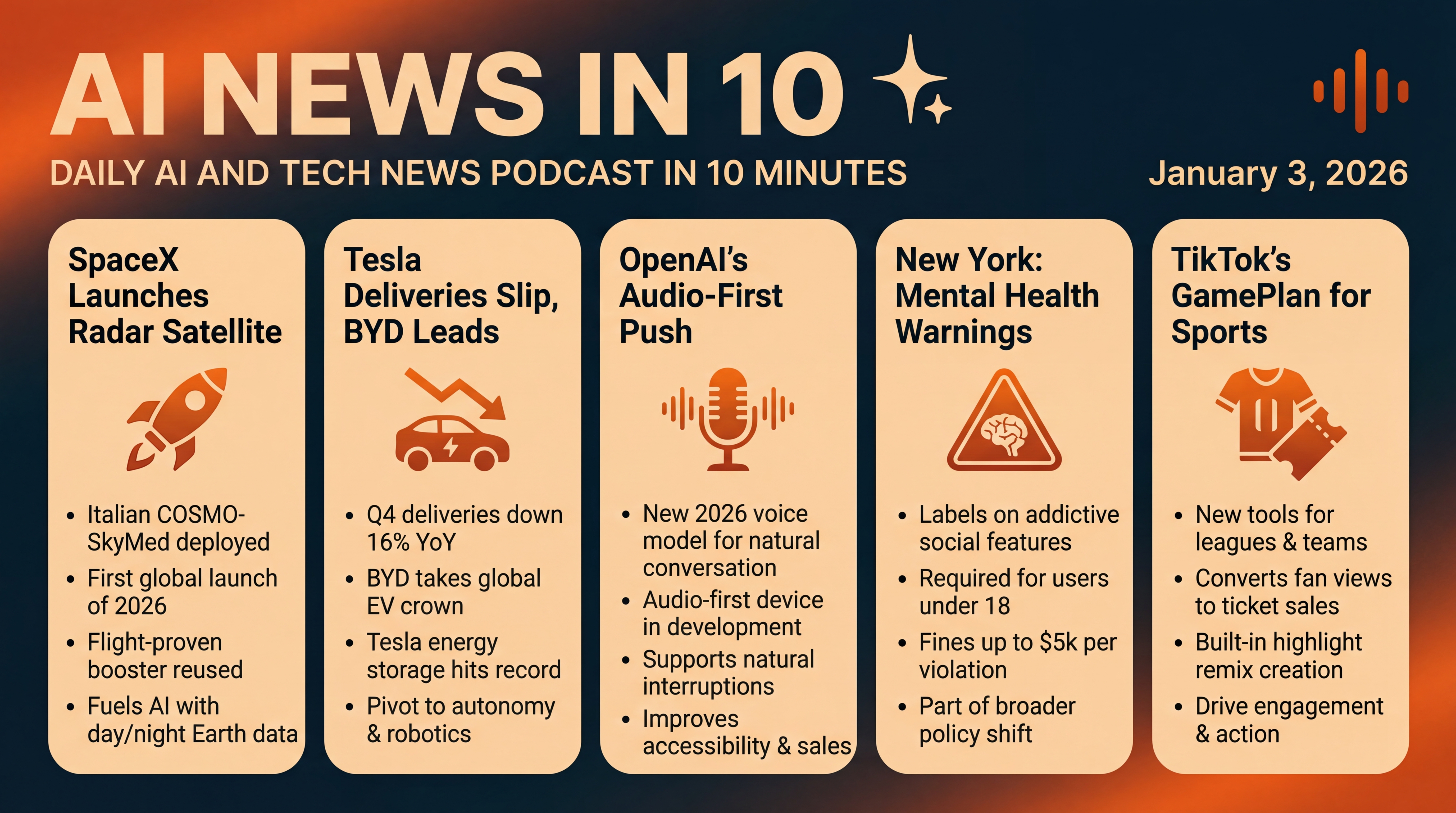
SpaceX kicks off the year with a radar imaging satellite launch for Italy. Tesla's fourth quarter deliveries fall short as BYD takes the global EV lead. OpenAI goes all in on voice with a 2026 audio model—plus an audio first gadget on the horizon. New York orders mental health warning labels on addictive social features. And TikTok launches tools to help teams and broadcasters turn fan views into ticket sales and engagement.
Let's dive in.
[BEGINNING_SPONSORS]
First up, liftoff to start the year.
Late Friday night in California—9:09 p.m. Eastern, 6:09 p.m. local—SpaceX launched a Falcon 9 from Vandenberg Space Force Base, carrying the COSMO-SkyMed Second Generation satellite for the Italian Space Agency and Italy's Ministry of Defence. It was deployed into a roughly 620 kilometer orbit. The spacecraft uses synthetic aperture radar, so it can image Earth day or night—and through clouds—for everything from emergency response to maritime monitoring and agriculture.
This was the first orbital mission of 2026 worldwide... and the flight proven booster notched its twenty first reuse on the way back to Vandenberg's landing zone.
Why should you care about a single radar bird? Because COSMO-SkyMed data fuels a lot of downstream AI—disaster mapping, crop analytics, insurance risk modeling—where modern models fuse radar with optical imagery to produce faster, more reliable insights. And the cadence matters. SpaceX closed 2025 with 165 orbital launches and is already pacing to exceed that this year... which means more fresh data in the pipes for AI companies on the ground.
To autos... and the numbers aren't pretty for Tesla.
The company reported fourth quarter deliveries of 418,227, down about 16 percent year over year, on production of 434,358 vehicles. For all of 2025, Tesla delivered 1.636 million vehicles—an 8 percent annual decline, the second straight year of lower deliveries. Energy storage was the bright spot: a quarterly record of 14.2 gigawatt hours deployed, 46.7 gigawatt hours for the year. But the headline that grabbed markets was competitive—China's BYD beat Tesla for the full year battery electric crown, moving roughly 2.26 million pure electrics to Tesla's 1.64 million.
What's behind the swing? Analysts point to tougher competition at lower price points, waning U.S. incentives in some segments, and brand headwinds in Europe—while Tesla itself continues to frame 2026 as a pivot toward autonomy, robotics, and energy. For now, investors will be watching whether robotaxi pilots, improvements to its Full Self Driving software, and that energy storage growth can offset an aging vehicle lineup... until fresh hardware lands later this year.
Now, a notable strategic bet from OpenAI—it's about your ears, not your eyes.
Reporting this week says OpenAI has unified engineering, product, and research teams to accelerate its audio roadmap. A new voice model slated for early 2026 is designed for true barge in conversations—think natural interruptions, overlapping speech, and better emotional nuance—and it's aimed to power an audio first personal device expected about a year from now. The hardware push traces back to OpenAI's 2025 acquisition of Jony Ive's design firm, a move meant to shift daily computing away from screens and toward ambient, conversational assistants.
If those overlapping speech claims hold up, the implications for customer support, sales, and accessibility are big. Today's call center AIs often fall apart when two people talk at once. A model that keeps context through interruptions—and sounds less robotic—shrinks the gap to service that feels acceptable. Expect a 2026 hiring wave for conversational design and audio UX as companies replatform voice experiences around these capabilities.
[MIDPOINT_SPONSORS]
Policy shift time. New York just put warning labels on what it calls addictive social features.
A law signed December 26 requires platforms that offer infinite scroll, autoplay, algorithmic feeds, like counts, or push notifications to show clear mental health warnings to users under eighteen when those features kick in—and periodically thereafter. The state attorney general can enforce with civil penalties up to five thousand dollars per violation. Governor Kathy Hochul framed it bluntly: keeping kids safe includes curbing features that encourage excessive use. The legislative materials even spell out how long labels must display—ten seconds on login, then thirty seconds after three hours of cumulative use, and hourly thereafter. Rulemaking and enforcement details are now moving forward.
This fits into a broader mosaic. California and several other states brought AI and online safety rules online January 1, and the EU's AI Act phases in through 2026 and 2027. For product teams, that means two simultaneous pressures in 2026—ship AI powered engagement features, and build the rails for disclosures, labels, age checks, and safety defaults that regulators increasingly expect.
And finally, sports meets social... and AI.
TikTok rolled out GamePlan, a new in app destination and toolset for leagues, teams, and broadcasters. The pitch is simple—convert discovery into action. On relevant sports videos, an anchor link takes fans to schedules and standings, official accounts, ticket purchases, the option to add events to your calendar, and built in creation tools to remix highlights—turning passive scrolling into meaningful action. It's a bid to make TikTok the top of funnel and mid funnel for live sports, not just the place fans watch edits the morning after.
Context matters here. TikTok's been tilting into sports partnerships for two seasons, with MLS experiments and team deals—this is the most productized push yet. For rights holders, the draw is measurable lift on ticketing and tune in. For marketers, it's first party signals around intent—who taps add to calendar, who buys, who creates. Expect copycat features elsewhere... and a busy 2026 for AI assisted highlight clipping as leagues try to scale short form without killing their media deals.
Quick recap before we go.
SpaceX opened 2026 with a successful Italian radar satellite launch—underscoring how rocketry fuels AI data pipelines. Tesla's fourth quarter deliveries slipped, and BYD grabbed the battery electric crown, even as Tesla's energy storage set records. OpenAI is racing toward an audio first model and device that could reshape voice UX. New York is slapping warning labels on addictive social features for minors, raising the compliance bar. And TikTok's GamePlan aims to convert sports fandom into actual tickets and tune ins.
We'll be back tomorrow with more AI and tech you can use.
Thanks for listening and a quick disclaimer, this podcast was generated and curated by AI using my and my kids' cloned voices, if you want to know how I do it or want to do something similar, reach out to me at emad at ai news in 10 dot com that's ai news in one zero dot com. See you all tomorrow.
