Samsung's CES First Look, EU Crackdown, Intel AI PCs
Samsung kicks off CES with an AI-heavy First Look as the EU shifts from warnings to enforcement. We preview Intel’s Panther Lake launch, explain why laptop prices are climbing, and break down a chilling ALPHV insider case.
Episode Infographic
Show Notes
Welcome to AI News in 10, your top AI and tech news podcast in about 10 minutes. AI tech is amazing and is changing the world fast, for example this entire podcast is curated and generated by AI using my and my kids cloned voices...
Here’s what’s new in AI and tech for Sunday, January 4th, 2026... Samsung kicks off CES week tonight with an AI-heavy First Look. Europe signals it’s done warning—and ready to enforce big tech rules. Intel sets a firm CES time for its next AI PC chips. PC vendors flag immediate price hikes as memory costs spike. And a sobering cybersecurity case: two U.S. insiders plead guilty to working with the ALPHV ransomware gang.
[BEGINNING_SPONSORS]
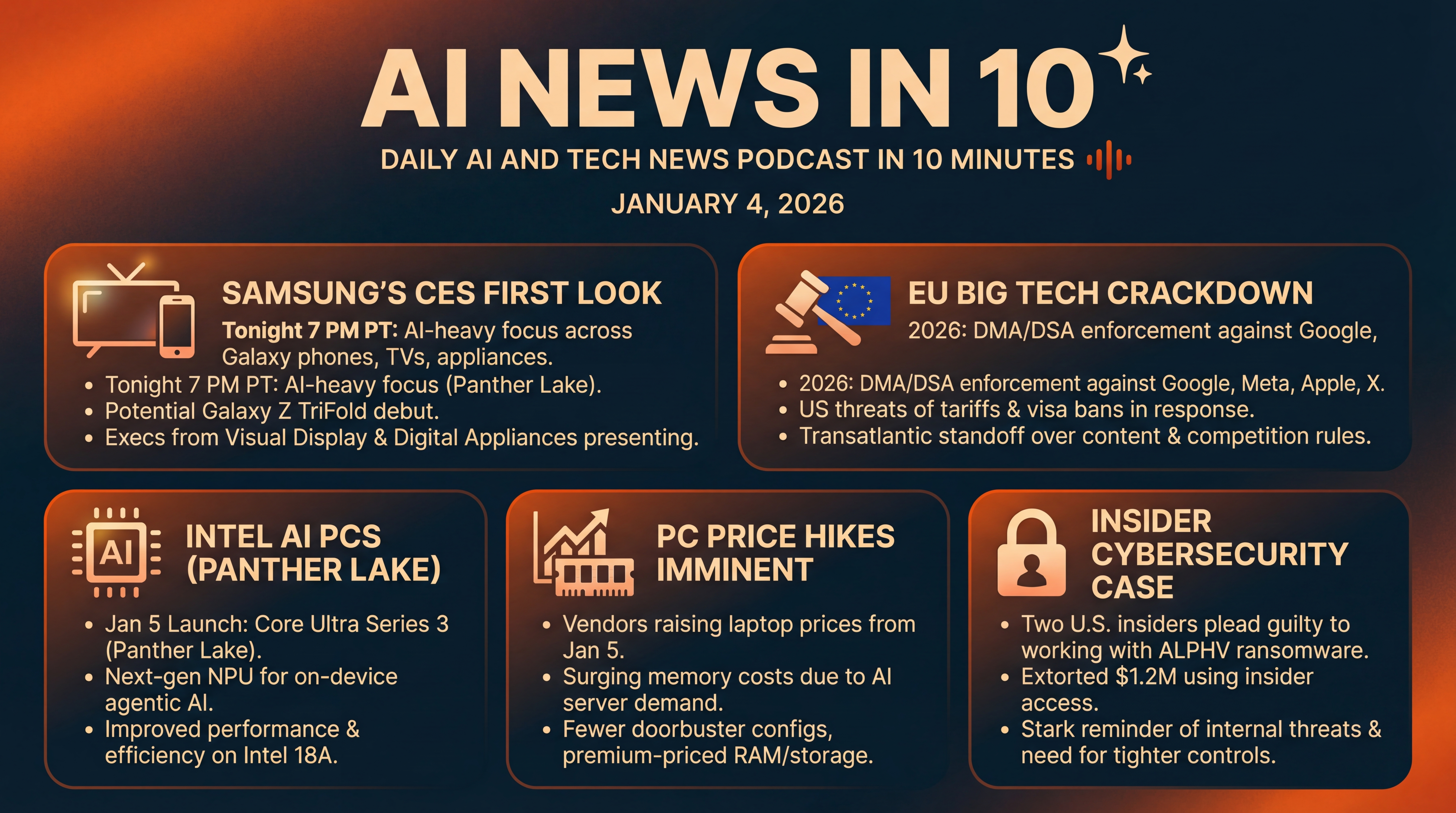
Let’s start in Las Vegas. Samsung’s First Look event lands tonight at 7 p.m. Pacific at the Wynn’s Latour Ballroom—and it’ll stream on Samsung’s YouTube, the Samsung Newsroom, and Samsung TV Plus. The company says it will outline its vision for the Device Experience division—also called DX—with new AI-driven customer experiences, and it’s sending top brass: T M Roh, who leads DX, S W Yong from Visual Display, and Cheolgi Kim from Digital Appliances. That’s a cross-company signal—expect phones, TVs, and appliances to lean harder into on-device and cloud AI this year. According to Samsung’s CES page and Engadget’s schedule rundown, this event is the curtain-raiser for CES 2026.
What might we see? Samsung hasn’t offered specs, but pre-briefs and coverage point to AI features across Galaxy devices, smarter displays, and tighter appliance integrations—plus a continued push on Galaxy AI and Bixby. Some outlets speculate this could be the broader debut stage for the Galaxy Z TriFold—or at least its global rollout details—though Samsung hasn’t confirmed it. So consider it a watch-this-space moment for later tonight...
Zooming out from CES to policy... Europe is signaling that 2026 is the year the Digital Markets Act and Digital Services Act move from words to real consequences. The Financial Times reports Brussels is ramping enforcement against the biggest platforms—Google, Meta, Apple, X—and has already started probing issues like Meta’s use of WhatsApp data and Google’s AI practices. The twist: the report says the Trump administration is threatening tariffs and even visa bans on EU officials as a counter-move, arguing the rules amount to censorship or protectionism. That sets up a fraught transatlantic standoff just as AI products get embedded into search, assistants, and ads.
For tech companies, the message is clear: the EU wants measurable compliance on content moderation and competition—and it’s prepared to test fines and remedies. For U.S. firms, expect more lawyering and potential product changes country by country... and for users, you may see clearer labeling, tighter ad-targeting controls, and—depending on outcomes—features that behave differently in Europe than elsewhere.
Back to Vegas—Intel has circled Monday, January 5th, at 3 p.m. Pacific for the public launch of its Core Ultra Series 3, code-named Panther Lake. It’s Intel’s next big swing at the AI PC market: improved CPU efficiency, a stronger integrated GPU, and a next-gen NPU meant to run more agentic, local AI workloads on laptops without relying entirely on the cloud. Intel’s event page is live, and the company is hosting sessions on scaling agentic AI and turning every PC into an AI powerhouse. Engadget’s CES preview adds context from Intel’s fall teaser—expect a jump in performance and efficiency versus last gen, with Panther Lake fabricated on Intel’s 18A process. The practical translation: thinner laptops that can run more AI features natively—think offline transcription, image generation enhancements, smarter video tools—without nuking your battery. We’ll know the hard numbers tomorrow.
[MIDPOINT_SPONSORS]
Let’s talk pricing—because the AI boom is colliding with your wallet. Asus says it will start raising prices on select products on January 5th, citing surging memory and storage costs driven by AI demand. Other vendors have nudged prices already, and the supply-chain tea leaves aren’t great. TrendForce now projects global notebook shipments to fall around 5.4 percent this year—with downside risk toward 10.1 percent—as DRAM and NAND price spikes squeeze PC makers’ margins. Their late-December note also flags that brands are raising prices and, in some cases, trimming base specs to cope.
If you’re shopping for a new laptop, that means fewer doorbuster configurations—and more premium-priced RAM and storage. The bigger driver is structural: suppliers are prioritizing high-bandwidth memory and server-grade DDR5 for AI data centers, crowding out capacity for consumer PCs and phones. Until server demand cools—or new fab capacity lands—consumer gear pays more.
One more story with real-world stakes. Two U.S. cybersecurity professionals pleaded guilty to conspiring with the ALPHV—also known as BlackCat—ransomware group. Court filings identify them as Ryan Goldberg and Kevin Martin. Prosecutors say they used insider knowledge to run attacks and extort roughly $1.2 million in Bitcoin from a medical device company, with attempted hits on other firms. Sentencing is set for March 12th, and each faces up to 20 years. It’s a stark reminder that the threat isn’t only nation-states or faceless gangs—sometimes it’s people with day-job access and expertise who go dark. For CISOs, that underlines the need to guard the inside straight: tighten privileged access, monitor exfiltration paths, and require second-factor approvals for mass-encrypt actions or admin tool installs—even from trusted responders.
Quick recap... Samsung’s First Look at 7 p.m. Pacific sets the AI tone for its phones, TVs, and appliances. The EU is shifting from rule-writing to aggressive enforcement as Washington bristles. Intel’s Panther Lake AI PC launch hits tomorrow. PC prices are climbing as memory costs spike and shipments likely fall. And the ALPHV case is a wake-up call about insider risk in cybersecurity. That’s your tech slate for Sunday, January 4th—see you back here tomorrow with the first wave of CES headlines.
Thanks for listening and a quick disclaimer, this podcast was generated and curated by AI using my and my kids' cloned voices, if you want to know how I do it or want to do something similar, reach out to me at emad at ai news in 10 dot com that's ai news in one zero dot com. See you all tomorrow.
