CES Kickoff: AI Servers, Afeela, and Legal Battles
From Foxconn’s record AI server quarter and MiniMax’s IPO buzz to CES shifting from EV hype to autonomy, we break down the biggest moves — including Sony Honda’s Afeela pre-production and LG’s Wallpaper OLED comeback. We also look ahead to U.S. court fights over AI copyright and algorithmic collusion that could define 2026.
Episode Infographic
Show Notes
Welcome to AI News in 10, your top AI and tech news podcast in about 10 minutes. AI tech is amazing and is changing the world fast, for example this entire podcast is curated and generated by AI using my and my kids cloned voices...
Here’s your quick tour of today’s biggest AI and tech headlines for Monday, January 5, 2026... and yes, CES week is officially here.
We’ll start with a strong signal that the AI infrastructure cycle hasn’t cooled — Foxconn just posted a record quarter on AI server demand. We’ve also got fresh IPO heat, as Chinese startup MiniMax aims to price at the top of its range in Hong Kong. On the show floor, CES is tilting hard toward autonomy and AI — Sony Honda’s Afeela is stepping into pre-production. LG is reviving its ultra-thin Wallpaper OLED with a new AI processor and, believe it or not, a home robot that claims it can fold laundry. And to round it out, 2026 is shaping up to be the year U.S. courts draw lines around AI copyright and algorithmic collusion... big stakes for everyone building with models.
[BEGINNING_SPONSORS]
Story one — the AI server boom keeps humming.
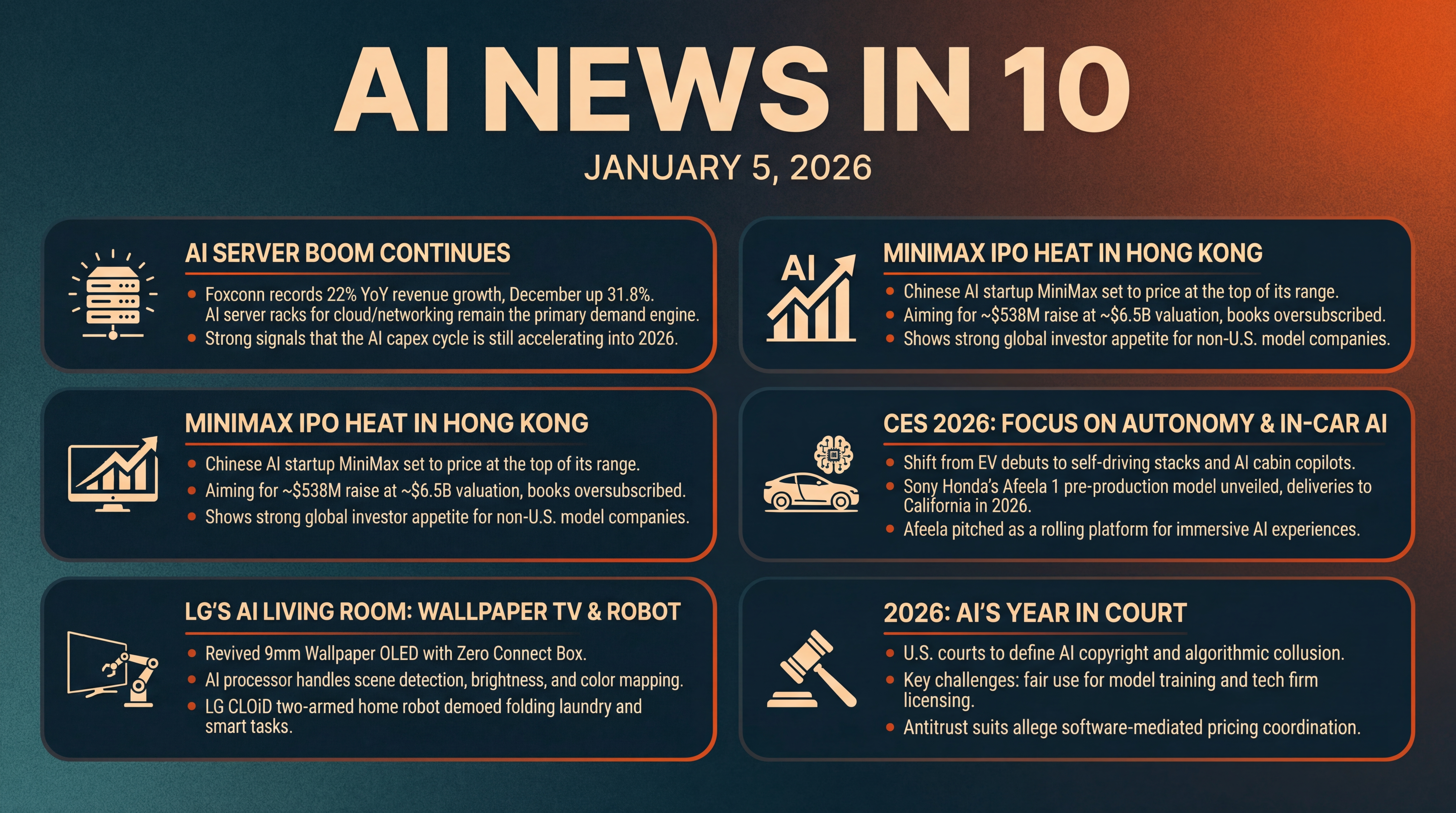
Taiwan’s Foxconn — Apple’s top iPhone assembler, and increasingly a backbone supplier for AI data centers — reported fourth-quarter revenue up 22% year over year, to about 2.603 trillion Taiwan dollars — roughly 82.7 billion U.S. dollars. December alone was a monthly record, up 31.8% year over year.
The company said growth came primarily from its cloud and networking products — the part of Foxconn that racks and ships AI servers — while consumer electronics lagged a bit on exchange rates. Reuters notes the results topped analyst Smart Estimates and set a high base heading into Q1, with management again flagging AI server racks as the demand engine. Investors noticed — chip names tied to that supply chain ticked up pre-market amid anticipation for CES announcements. Source: Reuters, plus market color from Barron’s.
Why this matters: it’s the clearest real-economy read on AI spending you’ll get before earnings season. If Foxconn’s cloud and networking mix is growing faster than phones, the capex cycle for model training and inference gear — GPUs, networking, power, and cooling — is still expanding into 2026. That sets the stage for whatever Nvidia, AMD, and their partners share this week about next-gen accelerators and AI PCs.
Story two — IPO heat out of Hong Kong.
Chinese AI startup MiniMax is set to price its listing at the top of the range, aiming to raise about 538 million dollars at roughly a 6.5 billion valuation. Books were reportedly multiple times oversubscribed, with trading slated to begin Friday, January 9.
Founded in 2022 by former SenseTime executive Yan Junjie, MiniMax works on multimodal models for text, audio, image, video — even music. Reuters frames it as part of a larger wave of Chinese AI and semiconductor listings clustering in Hong Kong, as mainland firms seek international capital while navigating U.S. export rules. For global AI watchers, it’s another data point that investor appetite for model companies — beyond the U.S. cohort — remains strong to kick off 2026. Source: Reuters.
Story three — CES 2026’s center of gravity has shifted from splashy EV debuts to autonomy, driver-assist, and in-car AI.
Reuters says automakers are dialing back some EV ambitions due to incentives and cost pressures, while suppliers flood the show with self-driving stacks, sensors, and AI copilots for the cabin. Add to that a maturing robotaxi narrative — Waymo’s expansion and Tesla’s limited robotaxi pilots — and you’ve got a mobility story that’s less about new sheet metal, and more about software and silicon. Source: Reuters.
One marquee CES update tucked into this theme — Sony Honda Mobility’s Afeela.
The joint venture is holding its first stand-alone press conference today at 5 p.m. Pacific in the Central Hall, unveiling a pre-production Afeela 1 and a new concept. Reservations are open, and deliveries to California are slated to begin in 2026, according to the company’s media notices.
The Afeela 1 is pitched as a rolling platform for autonomy and immersive in-car experiences — think a sensor-rich exterior with a front media bar, and an interior built around software-defined upgrades over time. Sources: Sony Honda Mobility press announcements from November 20, 2025, reaffirmed in CES materials this week.
What to watch as these demos roll: practical autonomy — hands-off in more conditions — with clear safety cases; AI copilots that control more of the cabin; and the supplier ecosystem that makes it real, from Nvidia’s automotive compute to Tier-1s integrating sensors and domain controllers. If CES is the barometer, the car as a consumer AI device is arriving ahead of full self-driving ubiquity.
[MIDPOINT_SPONSORS]
Story four — LG wants your living room to be equal parts gallery and gaming lounge... and it’s turning the dial back to Wallpaper.
The Verge reports LG has revived its ultra-thin OLED concept with the OLED evo W6. It’s a 9-millimeter-class panel that sits flush to the wall, pushing all the video inputs to a wireless Zero Connect Box — so your HDMI cables live off-screen, and video hops wirelessly to the panel.
The new architecture is paired with performance upgrades: a Reflection Free, with Premium certification, for low glare; up to 165 Hz refresh rate; AMD FreeSync Premium and G-Sync compatibility; and LG’s latest picture-optimization tech. Sizes at launch are 77 and 83 inches. Source: The Verge’s CES coverage, with additional product details confirmed in LG’s newsroom.
The AI angle here is subtle but real — LG’s latest webOS layer and Alpha-series processing are doing more of the perceptual heavy lifting: scene detection, brightness and color mapping, and AI-assisted content discovery. Put differently, AI TV this cycle is less about chatbots on the couch, and more about invisible tuning that makes HDR, sports, and games pop regardless of room lighting.
And LG isn’t stopping at screens.
Also on the floor is CLOiD — a two-armed home robot aimed at the so-called zero-labor home. The Verge says LG is demoing tasks like retrieving items from the fridge, baking, and yes... folding laundry — while integrating with the company’s ThinQ smart-home ecosystem. Pricing and ship dates remain to be determined, and the proof will be in reliability... but it’s a sign that physical AI is moving from labs to trade-show carpets. Source: The Verge.
Story five — courtroom season for AI is here.
Reuters flags 2026 as a pivotal year in U.S. courts on two fronts: copyright and algorithmic collusion. On copyright, judges are starting to diverge. One federal judge has described model training on copyrighted works as quintessentially transformative, while another has warned that unchecked training could hollow out creative markets.
Layer in last fall’s landmark settlement — Anthropic agreeing to pay roughly 1.5 billion dollars to authors over allegedly pirated training data — and you have a legal environment where the next rulings could decide whether fair use covers large-scale model training, or whether tech firms need broader licensing and compensation frameworks at scale. Sources: Reuters’ legal preview; settlement details widely reported by outlets including The Guardian and CBS News.
On the competition side, watch the Seattle case alleging large real-estate firms used pricing software to coordinate rents — software-mediated conduct is bringing antitrust and AI together in new ways. Meanwhile, broader privacy and youth mental-health suits against platforms are teeing up questions about old laws applied to new tech. Source: Reuters.
What’s the practical takeaway for teams building with models this year?
Assume courts will demand clearer provenance and permissions for training data; expect more pressure to watermark and disclose AI-generated content; and if you’re deploying optimization software in sensitive markets, make sure product design and governance guard against unintended coordination signals.
Quick recap... Foxconn’s blowout quarter says the AI hardware cycle is still accelerating. MiniMax’s top-of-range pricing signals continued investor appetite for model companies beyond U.S. markets. CES is less about new EVs and more about autonomy, software, and compute — with Sony Honda’s Afeela stepping into pre-production. LG made a splash with a 9-millimeter, true-wireless Wallpaper OLED and a chore-doing home robot. And U.S. courts are poised to set the rules of the road on AI copyright and algorithmic conduct this year. Sources today include Reuters for Foxconn, CES mobility trends, and 2026 litigation; Sony Honda Mobility’s press materials for Afeela’s schedule and timing; The Verge and LG newsroom for the Wallpaper OLED and CLOiD.
That’s it for today’s run — more from the CES keynotes tomorrow. Stay tuned.
Thanks for listening and a quick disclaimer, this podcast was generated and curated by AI using my and my kids' cloned voices, if you want to know how I do it or want to do something similar, reach out to me at emad at ai news in 10 dot com that's ai news in one zero dot com. See you all tomorrow.
