Rubin Rises, Humanoids March, Smart Bricks Click
CES opens with Nvidia’s Rubin rack-scale platform, AMD’s counterpunch, Boston Dynamics teaming with DeepMind, Gemini coming to your TV (and XR), and Lego’s privacy-first Smart Brick. We unpack what’s real, what’s next, and why it matters — from big iron to playful innovation.
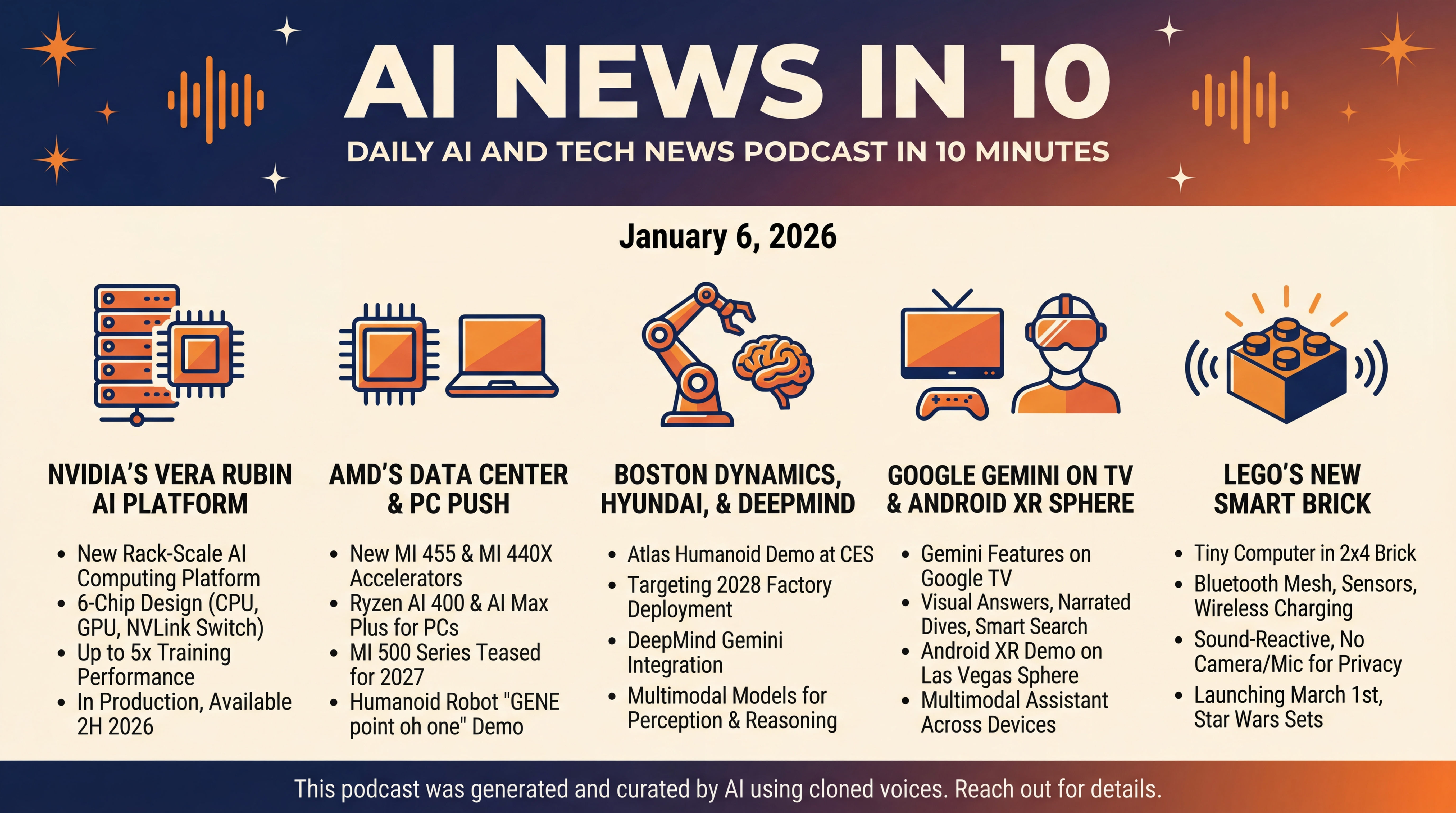
Episode Infographic
Show Notes
Welcome to AI News in 10, your top AI and tech news podcast in about 10 minutes. AI tech is amazing and is changing the world fast, for example this entire podcast is curated and generated by AI using my and my kids cloned voices...
It’s Tuesday, January 6th, and CES is officially open... today’s show is packed.
We’ve got Nvidia kicking off the next wave of data center AI with a new platform called Vera Rubin, AMD firing back with fresh accelerators and PC chips, Boston Dynamics linking up with Google DeepMind as Hyundai puts a date on humanoids in the factory, Google bringing Gemini smarts to the living room and teasing Android XR on the Sphere, and yes... Lego just reinvented the classic two-by-four brick for the smart-toy era.
Let’s get into it.
[BEGINNING_SPONSORS]
Story one: Nvidia is taking a victory lap — and raising the bar — with the Vera Rubin AI computing platform.
Think of Rubin as a rack-scale AI supercomputer, co-designed across six chips: a new Vera CPU, the Rubin GPU, a sixth-gen NVLink switch, the ConnectX-9 NIC, the BlueField-4 DPU, and the Spectrum-X co-packaged-optics switch — all engineered to move and process tokens faster, cheaper, and more securely at the pod level. Nvidia calls Rubin its third-generation rack-scale architecture, backed by more than 80 MGX partners, and paired out of the gate with Red Hat’s hybrid cloud stack. Availability starts in the second half of 2026.
On stage at CES, Jensen Huang went further. The next-gen chips are already in full production, and Rubin systems will scale from flagship servers with 72 GPUs and 36 CPUs, up to pods with over a thousand chips. Nvidia is touting up to five times the AI compute of its prior generation on chatbot-style workloads, plus new context memory and co-packaged optics to reduce bottlenecks. Major clouds — CoreWeave, Microsoft, Oracle, Amazon, Alphabet — were name-checked as early adopters.
Independent outlets broke down the headline claims: up to five times training performance versus Blackwell, third-gen confidential computing, and — importantly — Rubin’s pitch of training mixture of experts models with roughly a quarter of the GPUs at a fraction of the token cost. We’ll see what carries from keynote slides to production systems later this year.
Story two: AMD showed up ready to spar.
Lisa Su unveiled new data center accelerators — the MI 455 for dense server racks, and the MI 440X for more traditional enterprise deployments — aimed squarely at hungry AI customers. OpenAI’s Greg Brockman made an appearance, underscoring the market’s bottomless appetite for compute. AMD also teased its next big leap, the MI 500 series, expected in 2027 with audacious performance targets. For PCs, AMD rolled out Ryzen AI 400 and a higher-end Ryzen AI Max Plus to push more on-device inference into mainstream laptops this year.
AMD even added a little theater, with a cameo from Generative Bionics introducing “GENE point oh one” — a humanoid robot slated for late-2026 production. It’s part of a broader trend: pairing AI silicon announcements with physical-AI demos that make the benefits tangible. Market reaction, at least today, is that Nvidia’s lead is intact — but Su’s message was clear... this is a multi-horse race, and AMD plans to be in every deployment conversation, from the rack to the laptop.
Story three: Humanoids stepped into the spotlight.
Boston Dynamics, now under Hyundai’s umbrella, publicly demoed its Atlas humanoid on the CES stage — walking, waving, and showing the kind of fluid motion we’re used to seeing in lab videos... this time, live. The company framed the demo as a bridge to real work: a production Atlas aimed first at parts-sequencing tasks, then expanding into heavier assembly. Hyundai put a date on it — targeting 2028 for Atlas deployment at its EV plant in Savannah, Georgia — with scope growing into the next decade as safety and quality milestones are met.
What makes this more than a flashy demo is a new Boston Dynamics partnership with Google DeepMind. The plan is to integrate Gemini-class robotics models — multimodal systems built for perception, reasoning, and tool use — into Atlas and Spot, bringing more generalizable intelligence to the hardware. Think robots that can adapt to unstructured environments, follow natural-language instructions, and improve across tasks as the models learn. Research kicks off this year across both teams.
Boston Dynamics says its production Atlas will ship first to Hyundai’s Robotics Metaplant Application Center, with additional customers to follow, while emphasizing “human-centered automation” — robots taking on risky, repetitive work, and people training and supervising them. It’s a pragmatic framing for a category that still has plenty to prove on dexterity, safety, and cost.
[MIDPOINT_SPONSORS]
Story four: Google is bringing Gemini to the biggest screen in your home — your TV — and turning Las Vegas’s Sphere into an Android XR billboard for the next wave of ambient computing.
For the living room, Google previewed Gemini features on Google TV: visually rich answers that adapt to the topic, narrated deep dives for complex subjects, the ability to search your Google Photos with voice and remix memories into cinematic slideshows, and even natural-language tweaks like “the dialogue is too quiet” that apply picture and sound presets without digging through settings. Rollout starts on select TCL devices, expanding across brands in the months ahead.
Beyond the couch, Google lit up the Sphere with an Android XR vignette — using the venue’s massive canvas to tease how Gemini pairs with spatial awareness for headsets and glasses. The demo imagines real-time help in games, mid-air painting, and building virtual workspaces — part marketing spectacle, part signal that Gemini is meant to be a cross-device, multimodal assistant spanning watches, cars, TVs, and now XR.
The TV news builds on Google’s multi-month rollout of Gemini on large screens — including a staged release to Google TV Streamer owners — and the longer arc of pushing Gemini beyond phones into wearables and the car. The throughline is familiar this year: brands racing to turn “assistant” into “agent,” with more context, memory, and actions wherever you are.
Story five: a delightful curveball — Lego’s new Smart Brick.
Debuting March 1st, it’s a tiny computer inside a standard two-by-four brick, with Bluetooth mesh networking, inertial and light sensors, NFC interactions with smart tiles and minifigs, gesture recognition, and wireless charging — all firmware-updatable through your phone. Early sets will center on Star Wars, where minifigs and tiles can trigger lights, sounds, and motion effects when brought near the brick... think humming lightsabers and reactive space battles at minifig scale.
Crucially, Lego says the Smart Brick has no camera and doesn’t record audio — the microphone is used only for sound-reactive interactivity like claps or blowing. It’s a clear privacy-by-design pitch to parents who want smarter toys without always-listening gadgets in the playroom. The company calls this its biggest leap since the minifigure in 1978 — and the core of a broader Smart Play ecosystem. If it clicks, expect the concept to expand into other franchises... yes, even the oft-rumored Pokémon.
Quick recap: Nvidia’s Rubin platform turns the AI server into a co-designed, rack-scale product — and it’s already in production. AMD answered with new accelerators and Ryzen AI chips, staking ground from the data center to the laptop. Boston Dynamics and Google DeepMind are joining forces, as Hyundai sets a 2028 line in the sand for humanoids on the factory floor. Google’s Gemini is moving into your TV and pointing at a spatial future on the Sphere. And Lego is giving the humble two-by-four brick a smart, connected upgrade. Big iron, physical AI, ambient agents, and playful innovation... all in one day at CES.
Thanks for listening and a quick disclaimer, this podcast was generated and curated by AI using my and my kids' cloned voices, if you want to know how I do it or want to do something similar, reach out to me at emad at ai news in 10 dot com that's ai news in one zero dot com. See you all tomorrow.
