Fusion Twins, Airport Robots, and Humanoid Bets
AI leaps into the physical world — from digital twins accelerating fusion to Mobileye’s humanoid push, a potential AV policy shift, autonomous airport ops, and a bathroom scale that tracks over sixty biomarkers. Here’s what’s new in AI and tech for Wednesday, January 7, 2026.
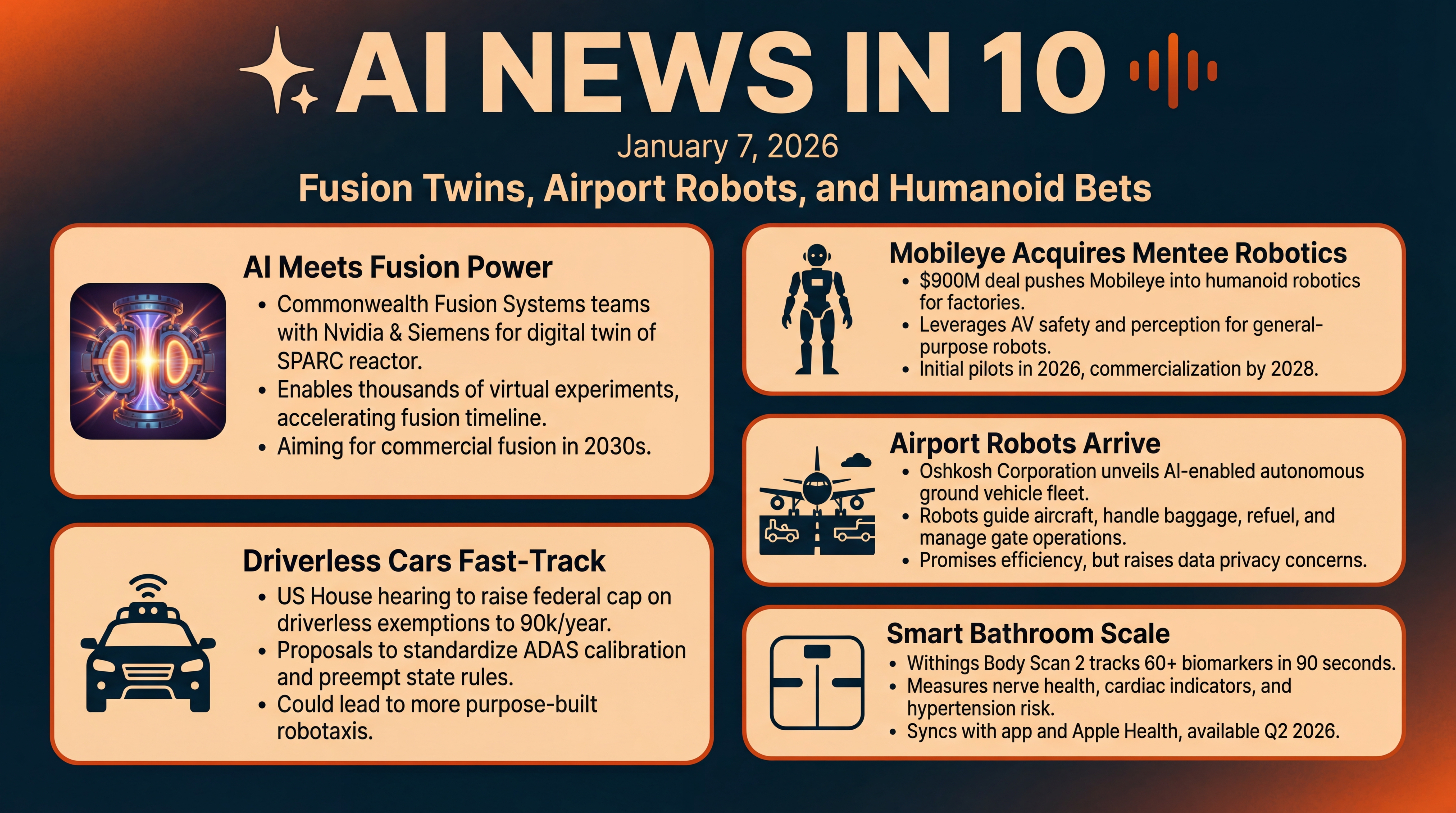
Episode Infographic
Show Notes
Welcome to AI News in 10, your top AI and tech news podcast in about 10 minutes. AI tech is amazing and is changing the world fast, for example this entire podcast is curated and generated by AI using my and my kids cloned voices...
Here’s what’s new in AI and tech today, Wednesday, January 7th, 2026. We’ve got AI jumping from the screen into the physical world — a fusion energy startup teaming with Nvidia and Siemens to build a high-fidelity digital twin, Mobileye making a nine hundred million dollar leap into humanoid robots, Congress setting a hearing that could fast-track driverless cars, autonomous robots rolling onto airport tarmacs, and a health gadget that claims to read more than sixty biomarkers from your bathroom floor. Let’s dive in.
[BEGINNING_SPONSORS]
Story one — AI meets fusion power.
Commonwealth Fusion Systems — CFS for short — is teaming up with Nvidia and Siemens to build a high-fidelity digital twin of its SPARC fusion machine. The plan is to feed Siemens’ Xcelerator industrial data into Nvidia’s Omniverse, built on OpenUSD, so engineers can run thousands of virtual experiments and compare them against the real machine... compressing years of lab work into weeks.
At CES, executives framed this as a path toward commercial fusion in the early 2030s, with the next big milestone being net-energy operations for the SPARC demonstration. CFS says the first high-temperature superconducting magnet is already installed, with more assembly happening through early 2026. According to company materials, the digital twin is designed to sit “alongside” the physical reactor — learning in lockstep as SPARC comes online.
Why does this matter? Data centers, EVs, and AI all need massive clean power. If AI-assisted engineering can de-risk fusion faster — testing control strategies virtually before applying them to plasma — it could accelerate a carbon-free, dispatchable power source. The Wall Street Journal also notes a broader trend: big tech investing around nuclear options to meet future energy needs.
Story two — a big robotics deal at CES.
Mobileye says it will acquire Mentee Robotics for about nine hundred million dollars, signaling a push from self-driving know-how into embodied AI. The logic is straightforward: the sensing, perception, mapping, and decision-making that guide robotaxis also fit humanoid robots navigating factories or warehouses. Mentee’s pitch is efficient training — using a single human demonstration to generate millions of virtual repetitions — aiming for initial customer pilots in 2026 and broader commercialization by 2028. Notably, Mentee was co-founded by Mobileye CEO Amnon Shashua, and the deal lands amid a crowded humanoid race featuring Tesla, Figure AI, and Agility Robotics.
Put it in context... For Mobileye, this is both a hedge and a bet. AV timelines are uneven, but demand for flexible automation is growing. If Mobileye can port its proven safety frameworks — think REM mapping and RSS safety logic — into general-purpose robots, it diversifies beyond passenger cars while staying in its wheelhouse: real-time perception at the edge.
Story three — Washington could unlock more driverless pilots, fast.
A U.S. House committee has scheduled a hearing for Tuesday, January 13th, to consider proposals that would dramatically raise the federal cap on vehicles exempted from legacy “human control” requirements — jumping from the current two thousand five hundred per automaker per year to as high as ninety thousand. Drafts also contemplate preempting state-by-state performance rules for autonomous systems, and pushing NHTSA to standardize calibration guidance for advanced driver-assistance features. Backers say this would help the U.S. compete with China’s deployment pace; skeptics point to safety and labor concerns after high-profile incidents.
If those changes move ahead, expect more purpose-built robotaxis — vehicles without steering wheels or mirrors — on U.S. streets, more quickly. It would also clarify the regulatory path for automakers like Mercedes-Benz, and for fleets from Waymo and Tesla that are expanding in tightly controlled service areas. We’ll see whether Congress channels years of stalled AV legislation into a 2026 breakthrough.
[MIDPOINT_SPONSORS]
Story four — autonomous robots are coming to the airport ramp.
At CES, Oshkosh Corporation showed a fleet concept for “the perfect turn” — that tightly timed window from touchdown to pushback — using AI-enabled ground vehicles to guide aircraft, unload baggage, refuel, scan for debris, and coordinate gate operations. The company says these systems blend autonomy with electrification and a cloud platform called iOPS for real-time monitoring of gate equipment and safety diagnostics. The Consumer Technology Association even recognized Oshkosh with multiple CES Innovation Awards this year for robotics and travel tech.
The promise is fewer delays and better safety checks, but there’s also a conversation about data. As reporters covering CES noted, mobility tech increasingly collects sensitive signals — think biometrics or cabin video — raising calls for clear policies on what gets stored, processed locally, or deleted. The same questions follow airport autonomy: who owns ramp telemetry, how long is it retained, and how is it secured? Expect airports, unions, and regulators to weigh in as pilots move from demo bays to active tarmacs.
Story five — your bathroom scale is getting very, very opinionated.
Withings unveiled the Body Scan 2, a six hundred dollar “home longevity station” that can capture more than sixty biomarkers in roughly ninety seconds. There’s a retractable handle with electrodes, a sensor array in the tempered-glass base to complete a full-body circuit, and on-device processing that estimates nerve and heart health indicators, gauges cardiac efficiency, and flags hypertension risk. Results sync to its app and Apple Health, while an optional subscription layers on longitudinal coaching and a single “Health Trajectory” score. Availability is slated for the second quarter, pending final regulatory clearances in the U.S. and abroad.
A few caveats... As with all consumer health tech, these are screening insights, not diagnoses — accuracy and utility hinge on clearances, good onboarding, and consistent use. But if the measurements prove reliable, Body Scan 2 fits a broader CES theme: ambient, AI-assisted sensing that turns routine moments into health check-ins — without a lab visit.
That’s a wrap. Today we saw AI step deeper into the physical world — accelerating fusion research, reshaping mobility policy, and rolling robots onto the tarmac — while consumer health tech keeps getting smarter at home. Keep an eye on that January 13th Hill hearing, the CFS build-out through summer, and early pilots for airport autonomy. We’ll be back tomorrow with the next wave.
Thanks for listening and a quick disclaimer, this podcast was generated and curated by AI using my and my kids' cloned voices, if you want to know how I do it or want to do something similar, reach out to me at emad at ai news in 10 dot com that's ai news in one zero dot com. See you all tomorrow.
