Valuations, Lawsuits, and Robots Collide in AI
Anthropic chases a 350 billion valuation as courts and regulators redraw AI’s rules. We break down the Musk–OpenAI jury trial, teen-harm chatbot settlements, China’s review of Meta’s Manus deal, and Arm’s new Physical AI push.
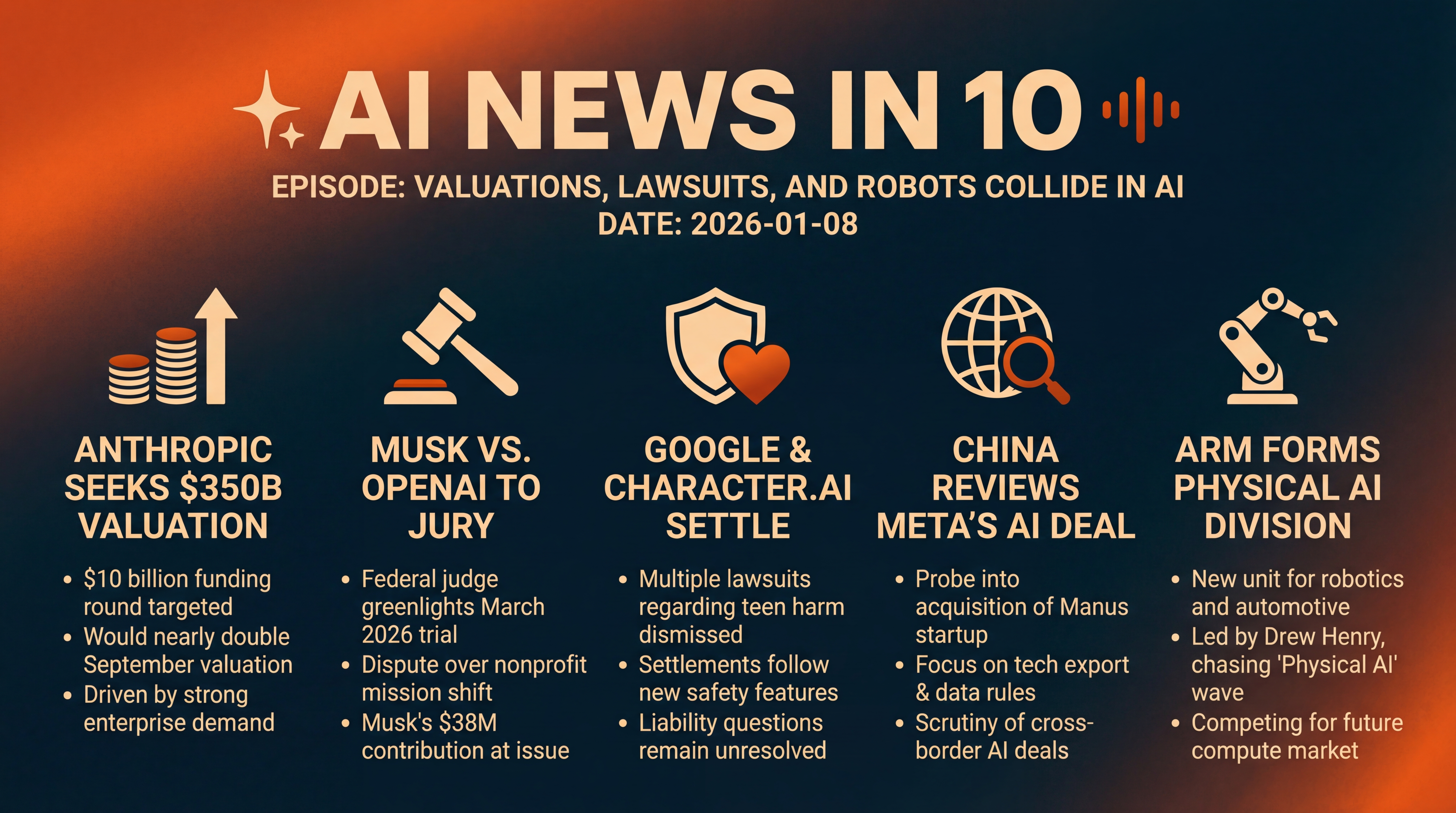
Episode Infographic
Show Notes
Welcome to AI News in 10, your top AI and tech news podcast in about 10 minutes. AI tech is amazing and is changing the world fast, for example this entire podcast is curated and generated by AI using my and my kids cloned voices...
It’s Thursday, January 8th, and today’s lineup is stacked... We’ve got a fresh megafunding target for Anthropic that would nearly double its valuation, a federal judge greenlighting Elon Musk’s lawsuit against OpenAI for a March jury trial, Google and Character.AI moving to settle multiple lawsuits tied to teen harm and chatbots, China opening a review into Meta’s latest AI deal, and chip designer Arm carving out a new Physical AI division to chase the robotics wave. Let’s get into it.
[BEGINNING_SPONSORS]
Story one: The money keeps flowing into foundation models — Anthropic is back in the market for a massive round.
Reuters reports the Claude maker is seeking about 10 billion dollars at a 350 billion dollar valuation, with Singapore’s GIC and Coatue expected to lead. That would be almost double what investors ascribed roughly four months ago, when a September raise valued Anthropic at 183 billion dollars. The new round could close within weeks — terms can still change — but the headline stays the same: demand for AI agents in the enterprise keeps pushing private valuations into uncharted territory.
Anthropic has hired Wilson Sonsini to prep for a possible 2026 IPO, though the company says timing isn’t set. If this round prices anywhere near the target, it would cement Anthropic as one of the most valuable private software companies ever — sitting just behind the tech megacaps. Reuters also says stronger enterprise uptake of Claude is driving a much higher revenue run rate this year. That momentum — and the arms race for compute — explains why investors are still writing big checks. Source: Reuters, with additional confirmation via Yahoo Finance.
What to watch: with valuations this frothy, the pressure shifts to margins and moats — model differentiation, enterprise stickiness, and long-term access to power and GPUs. Also, keep an eye on secondary sales by early backers if this round clears... those deals can signal real market appetite for liquidity.
Story two: Elon Musk versus OpenAI is officially headed to a jury — at least according to yesterday’s hearing.
A U.S. district judge in Oakland said there’s enough in dispute to let a jury consider Musk’s allegations that OpenAI violated its original nonprofit mission when it restructured into a capped-profit entity. A March 2026 trial is on the calendar. OpenAI and Microsoft maintain the suit is baseless and driven by competitive rivalry. Musk says he contributed roughly 38 million dollars — and his credibility — under the premise the project would remain a nonprofit serving the public. The judge also flagged that jurors may need to decide whether the case was filed within the statute of limitations. Big picture: a jury trial could force discovery into internal communications around the shift to for-profit and deals with partners, and it could shape what AI for public benefit legally means in the age of giant commercial partnerships. Source: Reuters.
If you’re OpenAI, you aim to keep the case tightly focused on legal technicalities and timing. If you’re Musk, you want it to be a referendum on mission drift. Either way... March suddenly looks a lot more interesting.
Story three: Google and Character.AI have moved to settle multiple high-profile lawsuits alleging chatbots contributed to teen self-harm and suicides.
The Washington Post reports there are five cases in the process of settlement, including the Orlando case brought by Megan Garcia, the mother of a 14-year-old who died by suicide after extensive interactions with a chatbot. In joint filings this week, the parties said they’re finalizing agreements, and a federal judge dismissed Garcia’s case after a settlement was reached. The Verge notes the settlements follow product changes at Character.AI aimed at minors — including stricter models for under-18 users, new parental controls, and later a ban on open-ended character chats for minors.
A key unresolved question is liability. These settlements avoid a definitive court ruling on when AI makers can be held responsible for outputs that cause harm — but lawmakers are already moving. California passed a bill last fall allowing families to sue chatbot operators that neglect user safety. Expect more state-level activity, and perhaps federal hearings on design-duty standards for highly sticky conversational agents marketed to young users. Sources: The Washington Post and The Verge.
[MIDPOINT_SPONSORS]
Story four: China is taking a hard look at Meta’s latest AI deal.
Beijing’s Commerce Ministry says it will assess and investigate Meta’s acquisition of Manus — the Singapore-based, China-rooted startup behind a general-purpose agent platform — for compliance with Chinese tech export and data rules. The Associated Press reports officials highlighted requirements covering outward investment, tech export, and cross-border mergers and acquisitions. A Beijing university scholar publicly questioned whether any restricted AI technologies developed in China could be transferred without a license.
Meta says there will be no continuing Chinese ownership and that Manus will cease operations in China after the acquisition, continuing from Singapore. Why this matters: it’s rare to see a U.S. platform buy an AI startup with Chinese roots in today’s climate — and this review underscores how national security and export control policies now shape the global AI mergers and acquisitions map. Watch how quickly China’s agencies move, whether conditions are imposed on model weights or talent transfers, and whether this spurs reciprocal scrutiny of Chinese buyers abroad. Source: Associated Press.
Story five: Arm, the linchpin CPU architecture vendor, is formalizing its robotics push.
The company told Reuters it has reorganized around three lines — Cloud and AI, Edge, and a new Physical AI division that unites automotive and robotics, reflecting shared needs around power, safety, sensors, and reliability. The new unit will add staff and is led by Drew Henry, who says physical-world AI can fundamentally enhance labor and free up time — echoing a broader CES theme as robots shift from viral demos to useful work.
Context: Arm doesn’t manufacture chips — it licenses designs to nearly every smartphone maker, and to an increasing number of PC and data center vendors. Planting a flag in robotics signals Arm’s intent to shape the compute roadmap for humanoids, warehouse bots, and autonomous systems — especially as automakers and tech firms race to deploy factory and service robots at scale. Also worth noting, peers are moving: Nvidia’s physical AI stack targets autonomous machines, and Mobileye agreed this week to acquire Mentee Robotics for 900 million dollars to bring more robotics expertise in-house. Source: Reuters.
Before we wrap, here’s why today’s five stories rhyme. The capital story — Anthropic’s eye-popping raise — sits alongside the governance story: courts and regulators on both sides of the Pacific drawing lines around how AI is built, deployed, and bought. We’ve got a potential jury peering into OpenAI’s origin story promises, state laws testing product safety duties for chatbots, China scrutinizing cross-border AI deals, and Arm reorganizing to power a world of robots that actually do things. These aren’t separate threads — they’re the same tapestry: money, rules, and compute determining who gets to build the next layer of intelligence... and where.
Quick recap: Anthropic is chasing a 350 billion dollar valuation in a new 10 billion dollar raise. A federal judge set March for a jury to hear Musk’s claims against OpenAI. Google and Character.AI are moving to settle five teen harm cases — policy tailwinds incoming. China will review Meta’s Manus acquisition under export and data rules. And Arm stood up a Physical AI division to push into robotics and autos. Sources today include Reuters, The Washington Post, the Associated Press, and The Verge.
Thanks for listening and a quick disclaimer, this podcast was generated and curated by AI using my and my kids' cloned voices, if you want to know how I do it or want to do something similar, reach out to me at emad at ai news in 10 dot com that's ai news in one zero dot com. See you all tomorrow.
