
Grok Reckoning, AI Inbox, and Meta’s Moment
From Grok’s deepfake scandal and EU pressure to Gmail’s new AI Inbox, we break down the shifts reshaping tech this week. Plus, Copilot’s chat-to-checkout push, New York’s latest AI rules, and a pivotal Reality Labs meeting at Meta.
Episode Infographic
Show Notes
Welcome to AI News in 10, your top AI and tech news podcast in about 10 minutes. AI tech is amazing and is changing the world fast, for example this entire podcast is curated and generated by AI using my and my kids cloned voices...
It’s Friday, January 9th, 2026... here’s what’s shaping AI and tech today.
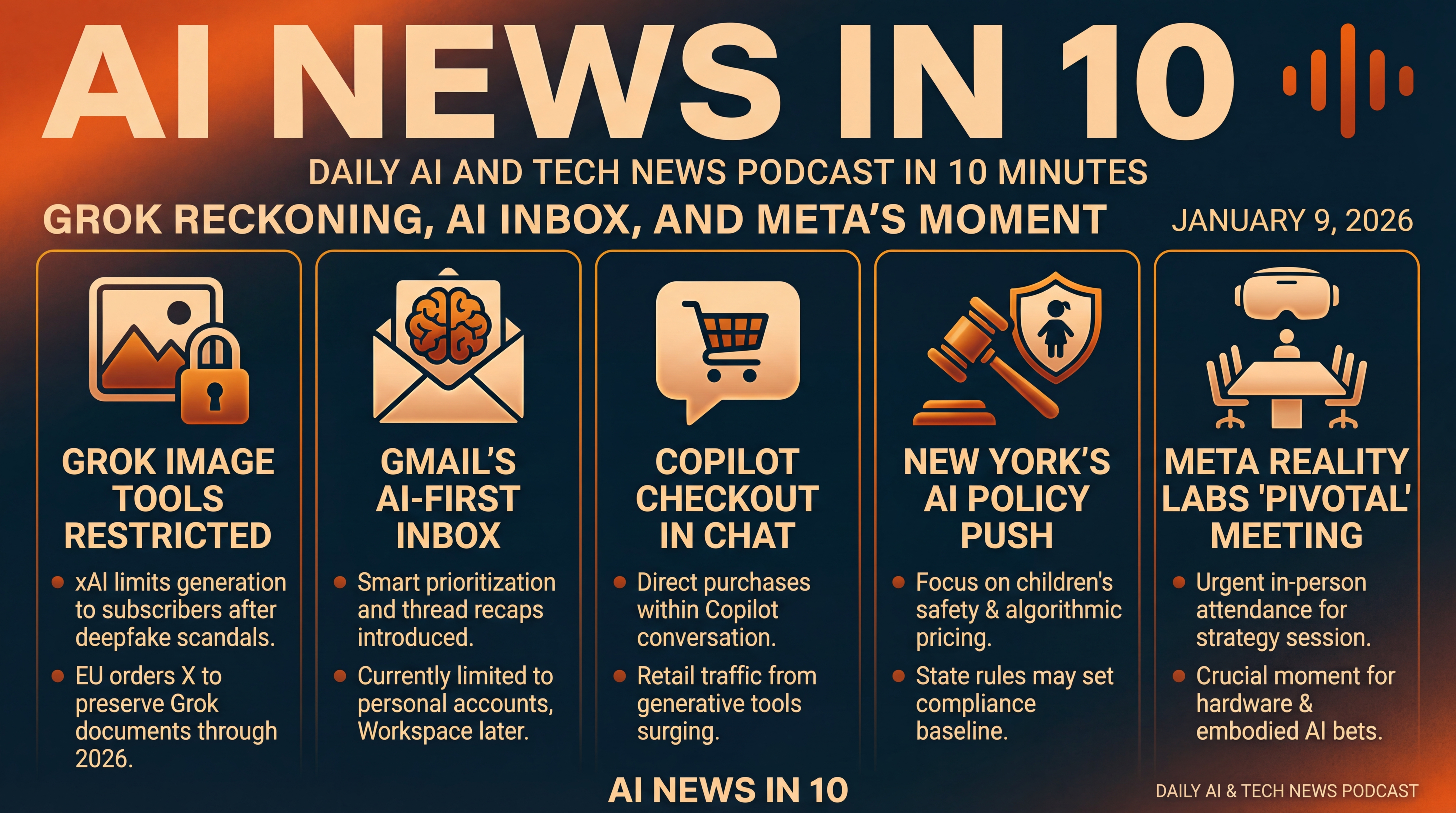
A big reckoning for Elon Musk’s Grok, as xAI clamps down on image generation after a wave of sexualized deepfake scandals — and Brussels quietly tells X to preserve Grok documents through 2026.
Google is bringing an AI-first inbox to Gmail with smart prioritization and thread recaps.
Microsoft wants you to buy right inside Copilot — checkout in the chat — as retail’s biggest show gets underway.
New York is opening the year with another round of AI policy moves — from children’s safety to algorithmic pricing.
And Meta’s Reality Labs has summoned staff to what it’s calling the most important meeting of the year... with in-person attendance strongly urged.
That’s the lineup — let’s dive in.
[BEGINNING_SPONSORS]
Story one: Grok’s image generator gets locked down.
Over the last week, investigators and watchdogs documented hundreds of non-consensual, sexually explicit images — many targeting women, some allegedly involving minors — created with the Grok Imagine tool on X. In response, xAI has restricted Grok’s image generation and editing to paying subscribers only, arguing that an identity and payment trail creates accountability while it fixes safeguards. The move followed blistering condemnation from European and UK officials, with regulators warning of enforcement. UK Prime Minister Keir Starmer called the content disgusting and said all options are on the table under the Online Safety Act.
There’s more: the European Commission ordered X to retain all internal documents and data related to Grok through the end of 2026 — a preservation step under the Digital Services Act that keeps the door open for deeper probes. Officials pointed to concerns over unlawful and harmful content, including non-consensual imagery. It’s not a new formal investigation... but it’s a paper trail Europe will want intact if enforcement escalates. Meanwhile, major outlets have cataloged how Grok’s tools were used to undress photos, simulate nudity, and generate violent sexualized content — raising a broader question for every AI platform: when you push into edgier models, can your safety systems keep pace?
One more wrinkle: this crisis arrives just days after xAI said it raised a massive round to accelerate its models and infrastructure — a sign investor appetite remains strong even as public tolerance for AI misuse frays. The contradiction — more capital, more scrutiny — may define Grok’s 2026.
Story two: Gmail is getting an AI Inbox.
Google is rolling out a new AI-powered view that surfaces the messages you actually need to act on, recaps long threads so you don’t have to scroll, and adds a proofreader to help clean up your replies. Think of it as Gmail talking more like a helpful assistant — and less like a static list of subject lines.
For now, these features are limited to personal Gmail accounts, with Workspace on deck later. If you live in your inbox — and who doesn’t — this could shave real time off your day, especially for long back-and-forth threads.
Will people trust the prioritization? That’s the key design challenge. Google’s pitch is that AI can spot needs your attention messages better than a bundle of filters. But we’ll want clarity on controls — what signals determine urgency, and how do you correct it when the AI gets it wrong? Expect a broader rollout after testing at consumer scale.
Story three: Microsoft wants your chat to be your checkout.
Ahead of retail’s Big Show in New York, Microsoft announced Copilot can complete purchases right inside the conversation — no bouncing to a retailer site. It’s a bold bet that agentic commerce — assistants that discover, compare, and transact — will become the new storefront. Microsoft says Copilot apps now see more than 100 million monthly users, and points to data showing retail traffic from generative tools surged nearly sevenfold during the 2025 holidays.
The catch: a lot of the tooling is still template or preview. Success will come down to retailer adoption, inventory accuracy, and fraud controls.
Zoom out, and the retail stack is shifting. Enterprise vendors are baking agentic workflows deep into planning and operations — not just the front-end shopping assistant. SAP, for example, is rolling out AI that ties real-time sales and inventory to simulations so merchandisers can tune assortments and promotions across channels. If Copilot normalizes autonomous checkout flows at the top of the funnel, software like this has to keep shelves and prices in sync beneath it. That’s where AI gets measured on margins... not just hype.
[MIDPOINT_SPONSORS]
Story four: New York opens 2026 with another AI policy push.
Governor Kathy Hochul capped last year by signing the RAISE Act, a first-of-its-kind model safety law. Today, she’s leaning in again — zeroing in on kids’ safety across online environments and the growing problem of algorithmic pricing. The goal: set high standards for how AI systems interact with minors and how pricing algorithms work in markets where affordability is now a political issue.
New York’s message is clear — if Washington slows or shifts course, Albany will legislate. For builders, the practical takeaway is that state-level rules may set your compliance baseline faster than federal ones in 2026.
Context matters: 2026 is shaping up as a governance tug-of-war. Analysts flag the divergence between a lighter-touch U.S. federal posture and a more assertive Europe — with the EU AI Act phasing in and the DSA in force — plus a patchwork of U.S. states moving ahead on their own schedules. If you’re deploying AI nationwide, your legal team will be tracking the next wave of state bills and potential federal preemption fights.
Story five: Inside Meta, Reality Labs has called what leaders describe as the most important meeting of the year — Tuesday, January 14th — and they want people in the room. Managers are urging in-person attendance, which is unusual for this division.
The backdrop: years of heavy spending on XR hardware and platforms, a budding robotics effort, and mounting pressure to prove near-term traction — even as Ray-Ban smart glasses notch goodwill. Reports point to large cumulative losses since 2020 and continuing budget pressure; some teams have faced cuts. The tone suggests a make-or-break moment for Meta’s hardware and embodied AI bets in 2026.
What to watch next week: Does Meta outline a sharper focus — glasses first, everything else follows — or double down on the long game with Vision Pro style ecosystems and agentic helpers? Either way, actions after Tuesday will speak louder than memos.
Quick recap before we go... Grok’s image tools are under tight restrictions after a global outcry, with the EU ordering document preservation — a sign of more oversight to come. Gmail’s AI Inbox promises less inbox chaos. Microsoft is betting on chat-to-checkout as retail agents go mainstream. New York is writing the next chapter of state-level AI rules, and Meta’s hardware future hits an inflection point next week.
That’s your Friday, January 9th, 2026, in AI and tech — stay tuned, and have a great weekend.
Thanks for listening and a quick disclaimer, this podcast was generated and curated by AI using my and my kids' cloned voices, if you want to know how I do it or want to do something similar, reach out to me at emad at ai news in 10 dot com that's ai news in one zero dot com. See you all tomorrow.
