Twilight Launch, TikTok Split, and AI Rules
A dawn 'Twilight' rideshare sends NASA’s Pandora skyward as Microsoft denies viral layoff rumors and TikTok finalizes its U.S. security JV. New state AI rules collide with a shifting federal stance, while Glean raises big for enterprise search — plus a quick ISS schedule note.
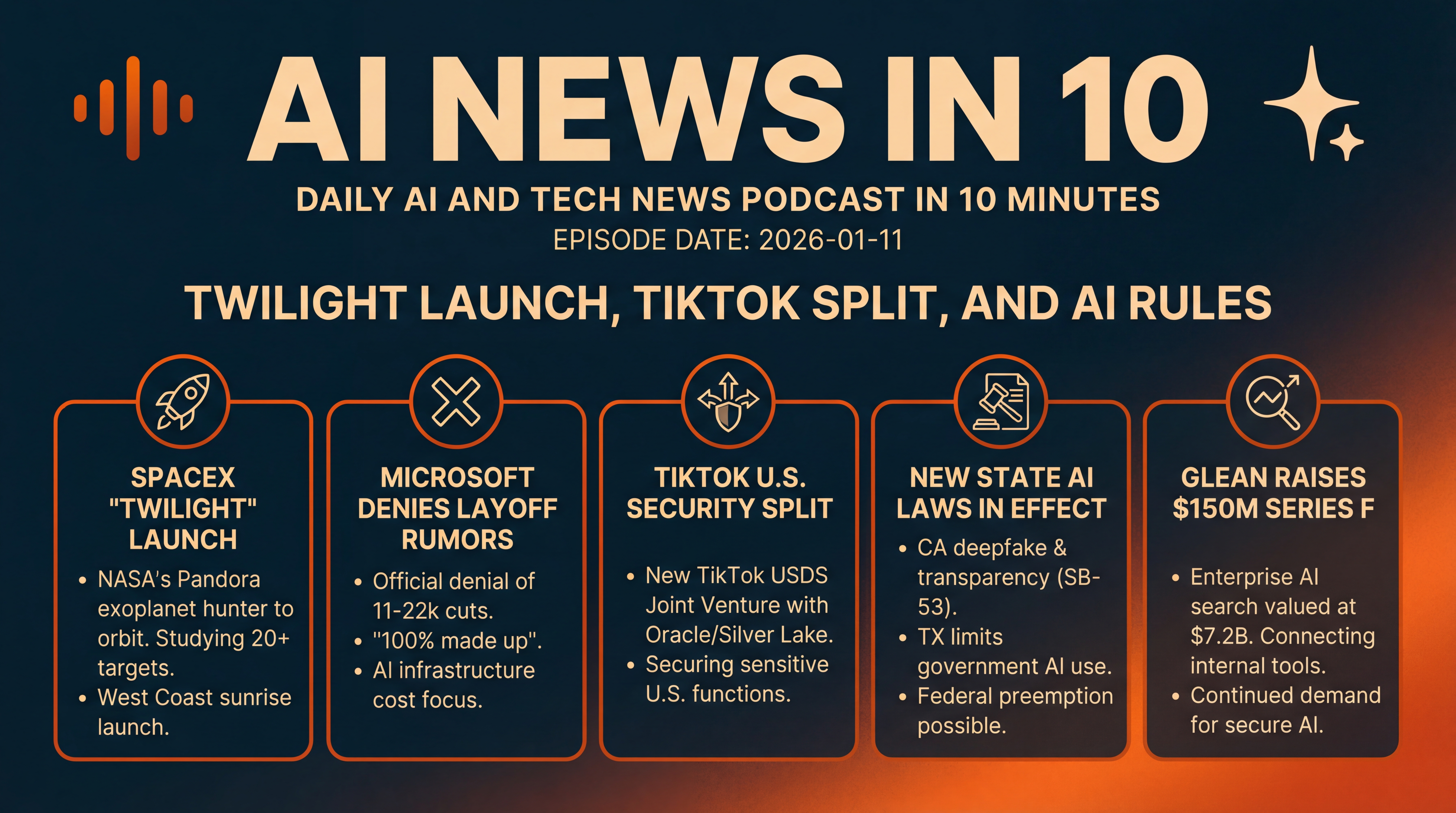
Episode Infographic
Show Notes
Welcome to AI News in 10, your top AI and tech news podcast in about 10 minutes. AI tech is amazing and is changing the world fast, for example this entire podcast is curated and generated by AI using my and my kids cloned voices...
It’s Sunday, January 11, 2026 — and here’s what’s shaping AI and tech today. A sunrise launch on the West Coast is sending NASA’s next exoplanet hunter to orbit. Microsoft is swatting down viral layoff rumors. TikTok is carving up its U.S. org ahead of a security-focused joint venture. New state AI laws just kicked in, with bigger federal implications. And there’s fresh funding for enterprise AI search from Glean... let’s dive in.
[BEGINNING_SPONSORS]
First up, rockets and research. SpaceX is set to launch a Falcon 9 from Vandenberg Space Force Base in California — a rideshare mission nicknamed 'Twilight' — and the headliner is NASA’s Pandora satellite. Liftoff is targeted for a 57-minute window that opens at 5:19 a.m. Pacific, with a backup window tomorrow if needed.
Pandora is a 325-kilogram small space telescope designed to study at least 20 exoplanets by separating the light fingerprints of their atmospheres from their host stars — key prep for deeper studies with the James Webb Space Telescope and future missions. Pandora will observe each target multiple times, in visible and near-infrared, during transits across their stars.
The launch also carries smallsat payloads including SPARCS and BlackCAT, broadening the science return on this rideshare. If you’re up early on the West Coast, you may catch the twilight plume painting the sky... always worth a look. Sources include NASASpaceFlight, Space.com, and NASA.
From liftoff to layoffs... well, rumored ones. Over the last few days, social posts and aggregation blogs claimed Microsoft would cut between 11,000 and 22,000 roles this month, blaming rising AI infrastructure costs. Microsoft’s chief communications officer, Frank X. Shaw, publicly shot that down, calling the reports '100 percent made up... speculative... wrong.'
It’s rare to see a denial that direct. The company also noted it announces workforce changes when they happen — not via rumor churn on forums. For context, big tech has been balancing sky-high AI capex with selective hiring and restructuring through 2025. But as of this weekend, Microsoft is explicitly saying those January mass-layoff claims are false. If anything changes, we’ll flag it... until then, treat the viral posts as just that — viral. Sources include The Spokesman-Review and the Seattle Times.
Next, TikTok’s U.S. reorg ahead of a deadline. With a deal slated to close on January 22, TikTok is splitting U.S. staff into two entities. The TikTok USDS Joint Venture — majority American-owned, with Oracle, Silver Lake, and MGX each expected to hold 15 percent — will house data protection, algorithm security, content moderation, and software assurance.
Commerce, ads, and marketing roles remain within a separate ByteDance-controlled U.S. entity. The structure aims to satisfy national-security terms by giving the JV operational control over sensitive U.S. functions, with Oracle serving as the trusted security partner. Creators and advertisers shouldn’t see immediate product changes, but governance and data flows will be under a new board and audit regime. Sources include Business Insider and the Los Angeles Times.
[MIDPOINT_SPONSORS]
Number four: the rulebook is changing under our feet. Several new state AI laws took effect January 1 — and more come due in the weeks ahead — creating a compliance patchwork that companies are scrambling to interpret.
In California, a package of deepfake and digital-replica laws expanded criminal and civil liability for certain AI-generated content, and requires platforms to remove pornographic deepfakes. Another California law restricts unauthorized post-mortem replicas. And the state’s frontier-model transparency law — SB-53 — requires large model developers to publish catastrophic-risk assessments and incident disclosures, with whistleblower protections built in.
In Texas, the new TRAIGA statute limits manipulation-oriented AI uses in government contexts and sets penalties for certain abuses — signaling how states may carve responsibilities between public and private sectors. Compliance stakes include potential fines per violation and tight timelines for takedowns and reporting.
Layered on top, a recent federal executive-branch move previewed by legal analysts sets the stage for a task force to challenge state AI laws deemed to conflict with federal policy — raising the odds of preemption fights and court tests through spring. Translation: if you build or deploy AI in the U.S., you now need a living playbook that accounts for state-by-state differences... and a shifting federal stance. Sources include The Information, White & Case, CIO, and King & Spalding.
And rounding out today: enterprise AI search keeps attracting serious capital. Glean — known for its workplace search and chat assistant that unify knowledge across tools like Google Workspace, Microsoft 365, Slack, and Salesforce — raised 150 million dollars in a Series F, valuing the company at 7.2 billion.
The startup says it crossed 100 million dollars in annual recurring revenue in late 2025, and is aiming for roughly 235 million by the end of this month — underscoring continued demand for AI copilots that find, summarize, and reason over a company’s internal content securely. The competitive backdrop matters: hyperscalers are bundling AI search directly into suites, yet investors are still backing a best-of-breed approach — betting that tight permissions, relevance ranking, and plug-and-play connectors will win deals even against native offerings. If your organization is piloting AI assistants, expect more vendor options... and tougher questions from security and compliance teams about data residency, access controls, and incident response. Source: The Information.
Quick addendum on the space beat before we close. NASA set a no-earlier-than Wednesday, January 14, for the Crew-11 return from the ISS, following a medical concern involving one astronaut. It’s not AI news, but it will shape space coverage this week — and it’s a reminder of just how dynamic mission planning can be. Source: Reuters.
That’s a wrap: a pre-dawn Falcon 9 lighting up the California sky with NASA’s Pandora... Microsoft forcefully denying viral layoff chatter... TikTok’s U.S. security arm getting carved out ahead of a January 22 close... a thicket of new state AI rules arriving — and possible federal preemption on the horizon... and Glean’s 150 million dollar round showing enterprise AI search is still a hot ticket. We’ll be back tomorrow with the next wave.
Thanks for listening and a quick disclaimer, this podcast was generated and curated by AI using my and my kids' cloned voices, if you want to know how I do it or want to do something similar, reach out to me at emad at ai news in 10 dot com that's ai news in one zero dot com. See you all tomorrow.
