Silicon Statecraft, Smartphone Rules, and AI Freight
From Pax Silica’s Middle East expansion to India’s contentious smartphone security draft, Europe’s defense AI push, TSMC’s earnings momentum, and Spain’s autonomous trucking trials—we unpack the moves shaping tech and geopolitics. Clear context, tight takeaways.
Episode Infographic
Show Notes
Welcome to AI News in 10, your top AI and tech news podcast in about 10 minutes. AI tech is amazing and is changing the world fast, for example this entire podcast is curated and generated by AI using my and my kids cloned voices...
Here’s what’s on deck today... A diplomatic push to lock down AI and chip supply chains. India is floating a sweeping new security regime for smartphones that’s already riling Big Tech. A major European bet on defense AI drones. Taiwan’s TSMC heading into earnings on a wave of AI demand. And autonomous trucking trials expanding in Spain. Let’s get into it.
[BEGINNING_SPONSORS]
First up, the geopolitics of silicon.
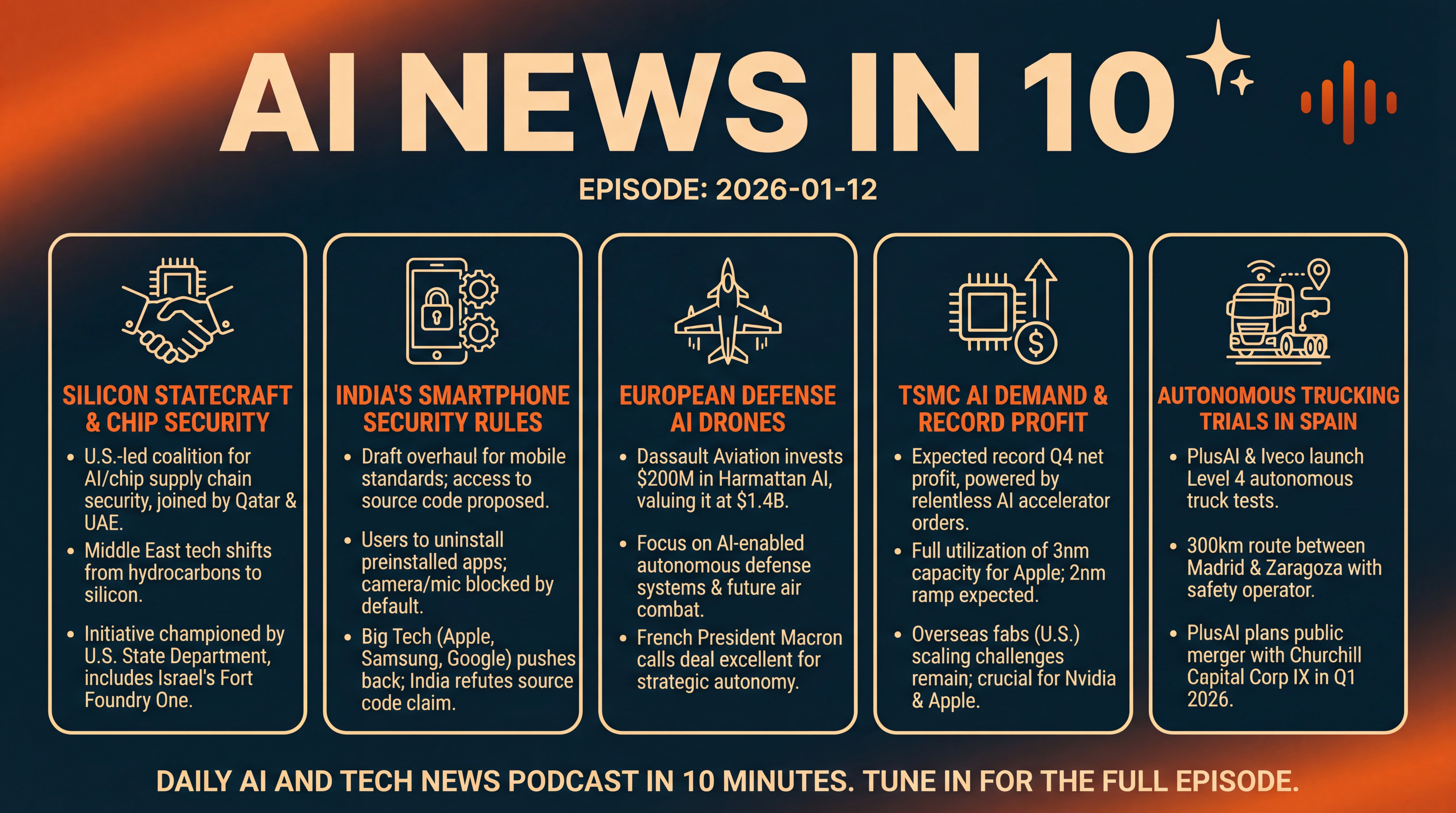
Qatar is set to sign onto Pax Silica—the U.S.-led coalition for AI and semiconductor supply chain security—followed by the United Arab Emirates on January 15. The initiative, championed by Jacob Helberg at the U.S. State Department, frames the Middle East’s tech future as shifting from hydrocarbons to silicon statecraft, with member countries contributing distinct strengths—from critical minerals to data infrastructure.
Plans tied to the framework include Fort Foundry One in Israel, and a tentative AI memorandum targeted for January 16. It’s an unusual mashup of foreign policy and fab strategy... and it signals how AI is now central to economic blocs—not just gadgets. Reuters reports the timing, the signings, and the projects.
Second, India is testing the world’s red lines on device security.
In a draft overhaul of its mobile standards, New Delhi has floated aggressive requirements. Smartphone makers would share source code for review at designated Indian labs. Devices would allow users to uninstall preinstalled apps. Background access to the camera and microphone would be blocked by default. And device logs could be stored for twelve months.
Industry groups representing Apple, Samsung, Google, and Xiaomi have pushed back hard—calling source code access a nonstarter and warning that preapproval of software updates could be unworkable.
Afterward, India’s IT ministry said consultations are routine and refuted the claim that it is considering demanding source code—without detailing any changes to the proposal. The stakes are huge: India has roughly 750 million smartphones, and its rules often ripple across global supply chains and software practices. Reported by Reuters.
Third, a big check for European defense AI.
Dassault Aviation is leading a 200 million dollar round in the Paris-based startup Harmattan AI, valuing it at about 1.4 billion dollars. Harmattan builds autonomous defense systems—think AI-enabled strike and surveillance drones—and Dassault says the tie-up will help infuse its future air combat systems with AI for unmanned operations.
French President Emmanuel Macron called the deal excellent news for strategic autonomy, underscoring how Europe is racing to harden defense capabilities as drone tech evolves on modern battlefields. The round brings sovereign AI deeper into the cockpit—literally—and shows how military programs are increasingly co-developed with startups. Reported by Reuters.
[MIDPOINT_SPONSORS]
Let’s talk chips—because earnings season is about to make AI demand very real on the balance sheet.
Taiwan Semiconductor Manufacturing Company is expected to post a 27 percent jump in fourth-quarter net profit to a record, powered by relentless orders for AI accelerators. Analysts point to full utilization of TSMC’s three-nanometer capacity—feeding Apple’s latest iPhone chips—and a ramp toward two-nanometer that could push 2026 revenue growth into the high twenties percent.
The company already reported fourth-quarter revenue up roughly 20 percent year over year, and it will provide guidance on Thursday during its earnings call. One open question is how quickly its overseas fabs—especially the massive investments in the United States—can scale without denting margins. Make no mistake—TSMC remains the foundry heartbeat behind Nvidia’s and Apple’s most advanced silicon. Figures and timelines via Reuters.
And finally, autonomous freight moves another step onto European roads.
PlusAI and Iveco are launching Southern Europe’s first heavy-duty autonomous truck test program in Spain, running two Iveco S-Way rigs with PlusAI’s Level 4 stack on a roughly 300-kilometer route between Madrid and Zaragoza. Tests begin this year with a safety operator on board, in partnership with Spanish logistics firm Sesé and the Aragon regional government.
PlusAI also reiterated its plan to go public via a merger with Churchill Capital Corp IX, targeting a close in the first quarter of 2026. The takeaway: while robotaxis jockey for headlines, freight autonomy keeps threading the needle—limited routes, predictable loads, and growing logistics partnerships. Reported by Reuters.
Quick recap... Qatar and the UAE are joining a U.S.-led silicon coalition—tech policy is the new geopolitics. India’s security draft puts phone source code under the microscope—and into a political firestorm. Dassault is backing Harmattan to bring AI deeper into European defense aviation. TSMC heads into earnings on record AI chip demand. And PlusAI and Iveco are kicking off Level 4 trucking trials across Spain.
We’ll be back tomorrow with more of the signal, less of the noise.
Thanks for listening and a quick disclaimer, this podcast was generated and curated by AI using my and my kids' cloned voices, if you want to know how I do it or want to do something similar, reach out to me at emad at ai news in 10 dot com that's ai news in one zero dot com. See you all tomorrow.
