Slackbot Grows Up, Robotaxis Upstate, Apple Bundles
Slack turns Slackbot into a true AI agent, New York opens robotaxi lanes outside NYC, and Apple launches a $12.99 creator bundle. We also unpack Google’s UCP debate and Brazil’s order pausing Meta’s WhatsApp chatbot rule.
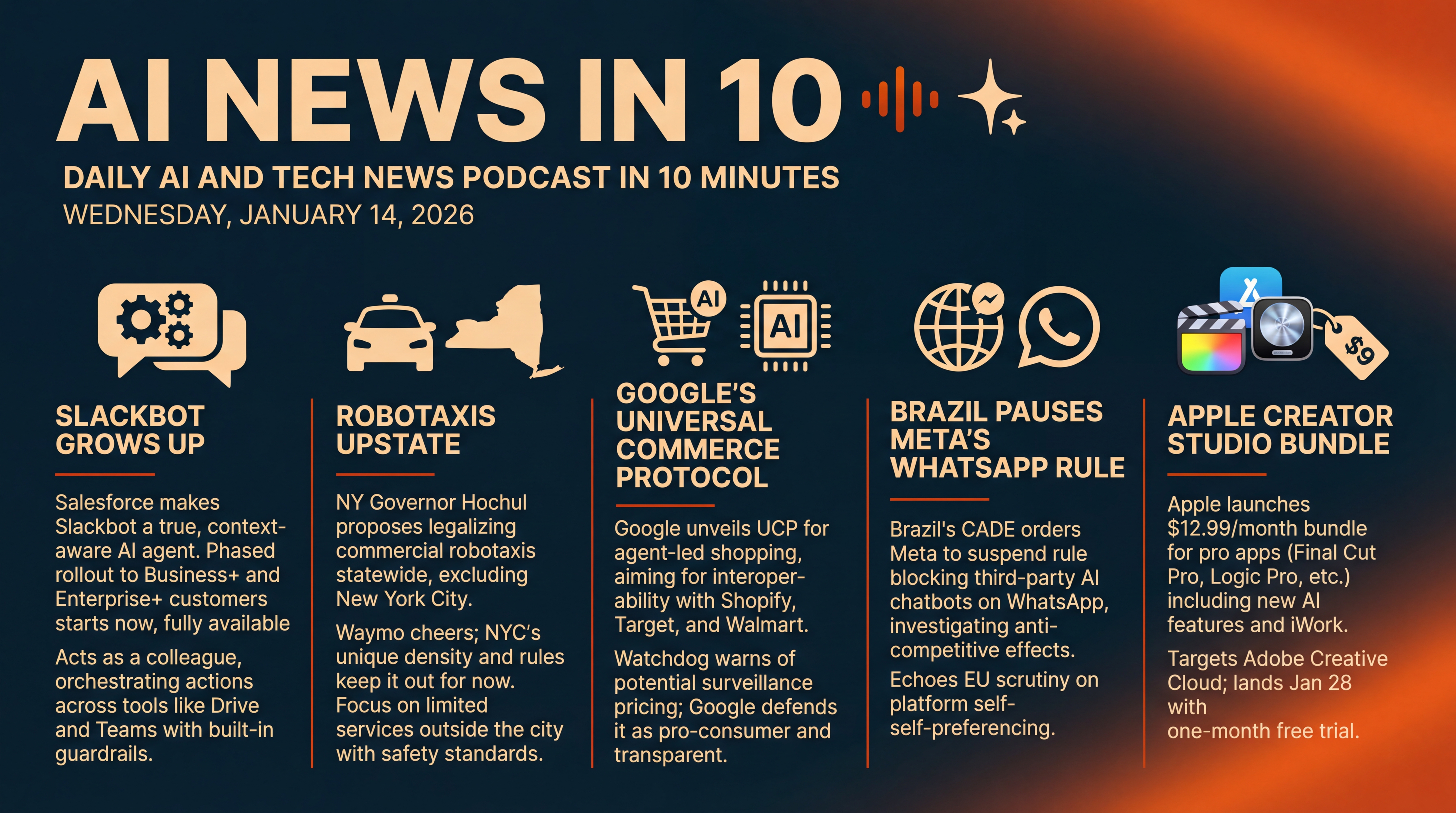
Episode Infographic
Show Notes
Welcome to AI News in 10, your top AI and tech news podcast in about 10 minutes. AI tech is amazing and is changing the world fast, for example this entire podcast is curated and generated by AI using my and my kids cloned voices...
It's Wednesday, January 14, 2026. Here's what's on deck: Slack turns Slackbot into a full-blown AI agent. New York's governor opens the door to robotaxis — everywhere but New York City. Google's new shopping standard sparks a watchdog warning about so-called surveillance pricing. Brazil orders Meta to pause a WhatsApp rule that could squeeze out rival chatbots. And Apple surprises creators with a $12.99 monthly bundle of pro apps… including some new AI tricks. Let's get into it.
[BEGINNING_SPONSORS]
We'll start at work — inside Slack.
Salesforce just made Slackbot a true AI agent and started a phased rollout to Business+ and Enterprise+ customers. The idea is simple: talk to Slackbot like a colleague, and it pulls context from your channels, files, and calendars — respecting your existing permissions — to find answers, draft content, schedule meetings, and orchestrate actions across tools like Google Drive and Microsoft Teams.
This isn't a beta. Salesforce says the new Slackbot is generally available now, and enterprise admins can tune or restrict access during a rollout window through February 10. Salesforce CTO Parker Harris calls Slackbot the front door to the Agentic Enterprise, noting it's the most popular tool they've trialed in years. If you live in Slack all day, the promise is fewer tab switches… and more actual outcomes.
Two quick details if you're weighing this right now.
First, availability: Business+ and Enterprise+ customers get it first, with Business+ workspaces slated to be enabled by late January.
Second, guardrails: Slack says its AI Guardrails layer is built in to reduce risky outputs, and Slackbot operates strictly within your existing access controls — it only sees what you can see. That might be the difference between an impressive demo… and something you trust enough to deploy.
Now to the streets of New York — well, most of them.
Governor Kathy Hochul, in her State of the State address, proposed legislation that would effectively legalize commercial robotaxis in cities across New York State, with one notable exception: New York City. Current state law requires drivers to keep one hand on the wheel at all times, which has limited autonomous testing. Hochul's plan would expand the pilot program to allow limited commercial, for-hire AV deployments outside NYC, with agencies like the DMV, DOT, and State Police in the loop. Waymo — which currently has a small, human-supervised test permit in Manhattan and Brooklyn — cheered the move. Inside NYC, the city's Taxi and Limousine Commission rules still apply. Expect more detail in the governor's executive budget on January 20.
Why carve out NYC? The city's dense, constantly changing streets — and its separate licensing regime — make it a special case. For upstate cities and suburbs, the proposal could fast-track limited commercial services that resemble what we've seen in Phoenix and San Francisco. Early analysis notes the law would require local support and the highest possible safety standards, leaving room for later rulemaking and community input on where and how robotaxis operate.
Over to retail and AI agents.
Google unveiled the Universal Commerce Protocol — UCP for short — at the National Retail Federation show, pitching a common language so AI agents can search, compare, check out, and manage orders across stores without bespoke integrations. Early partners include Shopify, Wayfair, Target, and Walmart, with payments players like Visa, Mastercard, PayPal, and Stripe backing the ecosystem. Google says you'll soon see native buy buttons inside Gemini and in AI Mode for Search. UCP is designed to interoperate with other agent frameworks like Agent2Agent, the Agent Payments Protocol, and the Model Context Protocol.
But a consumer watchdog pushed back on social media, warning that UCP plus agentic shopping could enable surveillance pricing — tuning what you pay based on what your AI chats reveal about you. Google disputes that, saying merchants can't show higher prices on Google than on their own sites, that upselling refers to presenting premium options rather than overcharging, and that its Direct Offers pilot is meant to surface lower prices or perks like free shipping. The debate preview shows the new retail battleground: who controls the agent, who controls the data… and how transparent the rules are when your shopping conversation is the storefront.
[MIDPOINT_SPONSORS]
Let's talk policy.
Brazil's antitrust authority, CADE, ordered Meta to suspend a new WhatsApp Business API rule that would ban third-party AI companies — think OpenAI, Perplexity, Microsoft — from offering chatbots on WhatsApp, pending an investigation into potential anti-competitive effects. The move follows scrutiny in Europe, where Italy's competition authority forced an exemption for Italian users, and the European Commission opened its own probe. Meta argues that external chatbots strain WhatsApp's infrastructure and says businesses can still build their own bots inside WhatsApp — but regulators want to know whether the policy unfairly favors the in-house Meta AI bot. Enforcement could be costly: under EU rules, competition violations can run up to 10% of global revenue.
This is a live test of two trends colliding in 2026: the platform push to become the default AI interface for consumers, and regulators' willingness to police self-preferencing before it hardens into a moat. With WhatsApp's massive reach in Brazil and across the EU, even an interim measure changes the calculus for startups and enterprises hoping to meet users where they already are — inside messaging.
And for creators, Apple just nudged the software market with a services-friendly twist.
The new Apple Creator Studio bundles six pro apps — Final Cut Pro, Logic Pro, Pixelmator Pro, Motion, Compressor, and MainStage — plus premium content and new AI features in iWork, for $12.99 per month or $129 per year. Students and educators get a steep discount at $2.99 per month. Apple says it's still offering one-time purchases of the individual apps, but some of the newest capabilities — like transcript-based search and visual search in Final Cut, and a new content hub with templating features for Keynote and Numbers — will be part of the subscription. The bundle lands January 28 with a one-month free trial.
Strategically, Apple is aiming directly at Adobe's Creative Cloud price point — roughly $69.99 per month for the full suite — while leaning on Apple silicon and iPad support to sweeten the value. Pixelmator Pro, which Apple acquired in 2024, is also coming to iPad for the first time under this bundle. If you're a solo creator or running a school program, the economics just got interesting.
Quick recap before we go.
Slackbot is now a context-aware AI agent rolling out across Business+ and Enterprise+ — a big step toward practical, agentic work inside your chat client. New York's governor wants to legalize limited commercial robotaxis statewide — except NYC — setting up an urban exception even as Waymo and others eye expansion. Google's Universal Commerce Protocol could make agent-led shopping work at scale, but watchdogs want guardrails — and Google insists it's pro-consumer. Brazil halted Meta's WhatsApp policy against rival AI chatbots while regulators investigate, echoing pressure in Italy and Brussels. And Apple's Creator Studio aims straight at Adobe with a $12.99 monthly bundle and new AI-assisted features, arriving January 28. We'll keep watching how these threads — agents, regulation, and creator tools — intertwine through the week.
Thanks for listening and a quick disclaimer, this podcast was generated and curated by AI using my and my kids' cloned voices, if you want to know how I do it or want to do something similar, reach out to me at emad at ai news in 10 dot com that's ai news in one zero dot com. See you all tomorrow.
