Chips Roar, Gemini Personalizes, Verizon Recovers
TSMC’s blowout quarter and capex surge ripple to ASML, Google turns Gemini into an opt-in personal assistant, OpenAI inks a massive Cerebras compute deal, and Verizon’s outage triggers 9-1-1 concerns. Get what happened, why it matters, and what’s next.
Episode Infographic
Show Notes
Welcome to AI News in 10, your top AI and tech news podcast in about 10 minutes. AI tech is amazing and is changing the world fast, for example this entire podcast is curated and generated by AI using my and my kids cloned voices...
Here’s what’s new in AI and tech on Thursday, January 15, 2026... a blockbuster earnings beat from TSMC, a big jump in their spending plans, and a ripple effect that pushed ASML past the half trillion mark. Google is wiring Gemini into your personal Google universe — if you opt in. OpenAI locked down a huge multi-year compute deal with Cerebras. And a nationwide Verizon outage raised 9-1-1 concerns before getting resolved late last night. Let’s dig in.
[BEGINNING_SPONSORS]
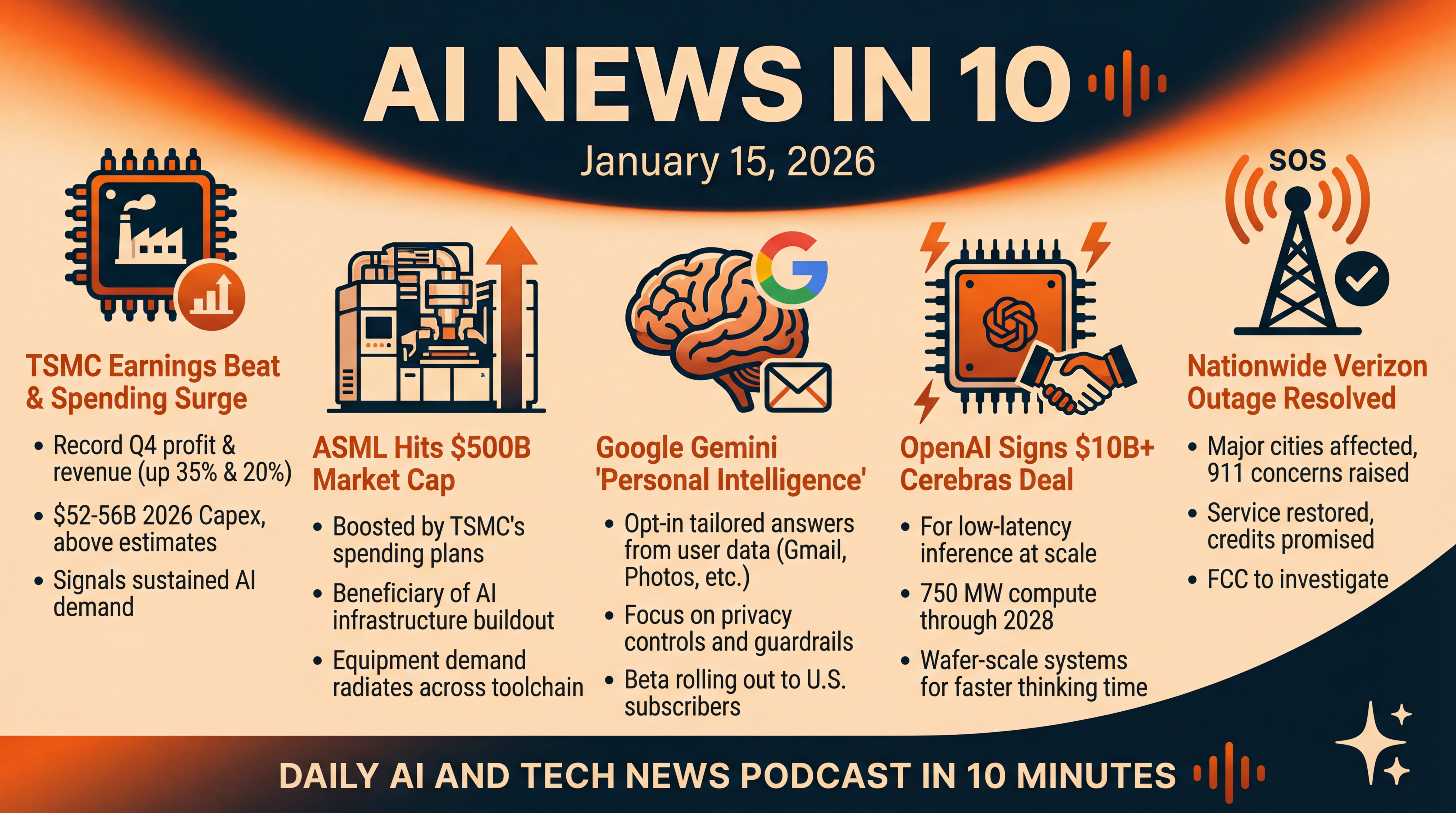
Story one — TSMC just set the tone for chip earnings season. The world’s top contract chipmaker reported fourth quarter 2025 net profit of 505.7 billion New Taiwan dollars — about 16 billion U.S. dollars — up 35 percent year over year and ahead of estimates. Revenue rose 20 percent to 1.046 trillion New Taiwan dollars, according to Reuters.
Management didn’t just celebrate — they opened the wallet. TSMC guided 2026 capital spending to between 52 and 56 billion dollars, well above last year. Translation: they see sustained, very real AI demand at the leading edge — the chips that power Nvidia’s and Apple’s most advanced products. Markets liked it, and analysts read it as confirmation that AI infrastructure is still in go mode.
Beyond the headline numbers, the message was capacity, capacity, capacity — especially for advanced packaging and the 3 nanometer and below nodes. TSMC’s investor materials underscored the focus on utilization, product mix, and whether 2 nanometer ramps can stay on schedule amid insatiable AI orders. If you’re watching the supply chain, this is the signal that 2026 will be another build year for compute.
Story two — the TSMC capex surge had an immediate ripple. ASML, the Dutch lithography giant that makes the EUV tools no one else can, briefly climbed past a 500 billion dollar market cap. If TSMC is spending more than expected — about 21 percent — equipment makers are obvious beneficiaries. Reuters notes ASML shares jumped after TSMC’s outlook, even as ASML’s own guidance remains conservative heading into its January 28 report. It’s a reminder that the AI buildout lifts not just chip designers and foundries, but also the toolmakers enabling those bleeding edge nodes.
Let’s pivot to consumer AI...
Story three — Google announced "Personal Intelligence," a major update to Gemini that, with your permission, lets the assistant draw on your Gmail, Google Photos, Search, and YouTube history to deliver more tailored, context-aware answers. It’s rolling out in beta in the U.S. to paid subscribers first. Google says it’s opt in with app-level controls and guardrails — off by default, with limits on sensitive inferences unless you ask directly. Think: "What’s my license plate number?" pulled from an email, or planning advice that references past trips in Photos. The Verge reports it’s a direct push to turn chat into a true personal assistant that remembers you.
Early coverage also highlights the privacy posture. Google says Gemini won’t train on the full contents of your private data by default; instead, training can occur on the prompts and interactions you choose to share, and you can pick which apps to connect. It’s a competitive shot at OpenAI, Anthropic, and others — leveraging Google’s vast ecosystem — while betting big on user trust. If this sticks, it raises the bar for "an assistant that actually knows me" across the industry, according to The Verge.
[MIDPOINT_SPONSORS]
Story four — OpenAI and Cerebras announced a multi-year pact for 750 megawatts of AI compute through 2028, valued at over 10 billion dollars, according to multiple reports and OpenAI’s own post. The pitch isn’t just more FLOPS — it’s lower latency inference at scale. Cerebras’s wafer-scale systems put massive compute, memory, and bandwidth on a single giant chip, aiming to speed up thinking time for complex tasks so ChatGPT-class systems feel more instantaneous.
OpenAI framed its strategy as a diversified portfolio — match the right hardware to the right workload — and highlighted Cerebras as a dedicated low latency leg of that stool. Cerebras’s CEO put it this way: as broadband transformed the internet, real time inference could transform AI. The Financial Times and Reuters both put the deal north of 10 billion dollars, and OpenAI says capacity will arrive in tranches starting this year.
Story five — a nationwide Verizon outage snarled wireless service across major U.S. cities, leaving some phones stuck in SOS mode and prompting officials to warn that 9-1-1 calling could be affected. At the peak, outage trackers saw well over 100,000 reports, with disruptions spanning New York, D.C., Chicago, Los Angeles, Atlanta, and more. Verizon said late last night — around 10:15 p.m. Eastern — that service was restored, and it will issue account credits to impacted customers. The FCC says it will investigate, according to the Associated Press.
For businesses and city agencies, the outage is another wake up call to stress test failover plans — Wi-Fi calling, satellite messaging on newer phones, and redundant carrier options — especially where emergency communications are at stake. Expect both regulatory scrutiny and renewed carrier investment to harden critical paths, as noted by industry coverage from Barron’s.
Quick recap... TSMC’s record quarter and bigger than expected 2026 capex reinforced that AI’s infrastructure cycle is still accelerating, and ASML’s surge showed how that spending radiates across the toolchain. Google’s Gemini made a big move into opt in personal context — potentially redefining what a helpful assistant feels like. OpenAI locked in a 10 plus billion dollar Cerebras deal to speed up real time AI at scale. And Verizon’s outage was resolved late Wednesday, with credits promised and an FCC probe likely. We’ll be back tomorrow with what moves next.
Thanks for listening and a quick disclaimer, this podcast was generated and curated by AI using my and my kids' cloned voices, if you want to know how I do it or want to do something similar, reach out to me at emad at ai news in 10 dot com that's ai news in one zero dot com. See you all tomorrow.
