Internet Rift, Spy Launch, xAI Deepfake Clash
Activists warn Iran could wall off most citizens from the open internet, SpaceX launches a classified NRO mission, and xAI faces a deepfake lawsuit as California turns up the pressure. Plus, an autonomous shuttle gets rear-ended in D.C., and SK hynix speeds HBM plans amid a still-tight AI chip market.
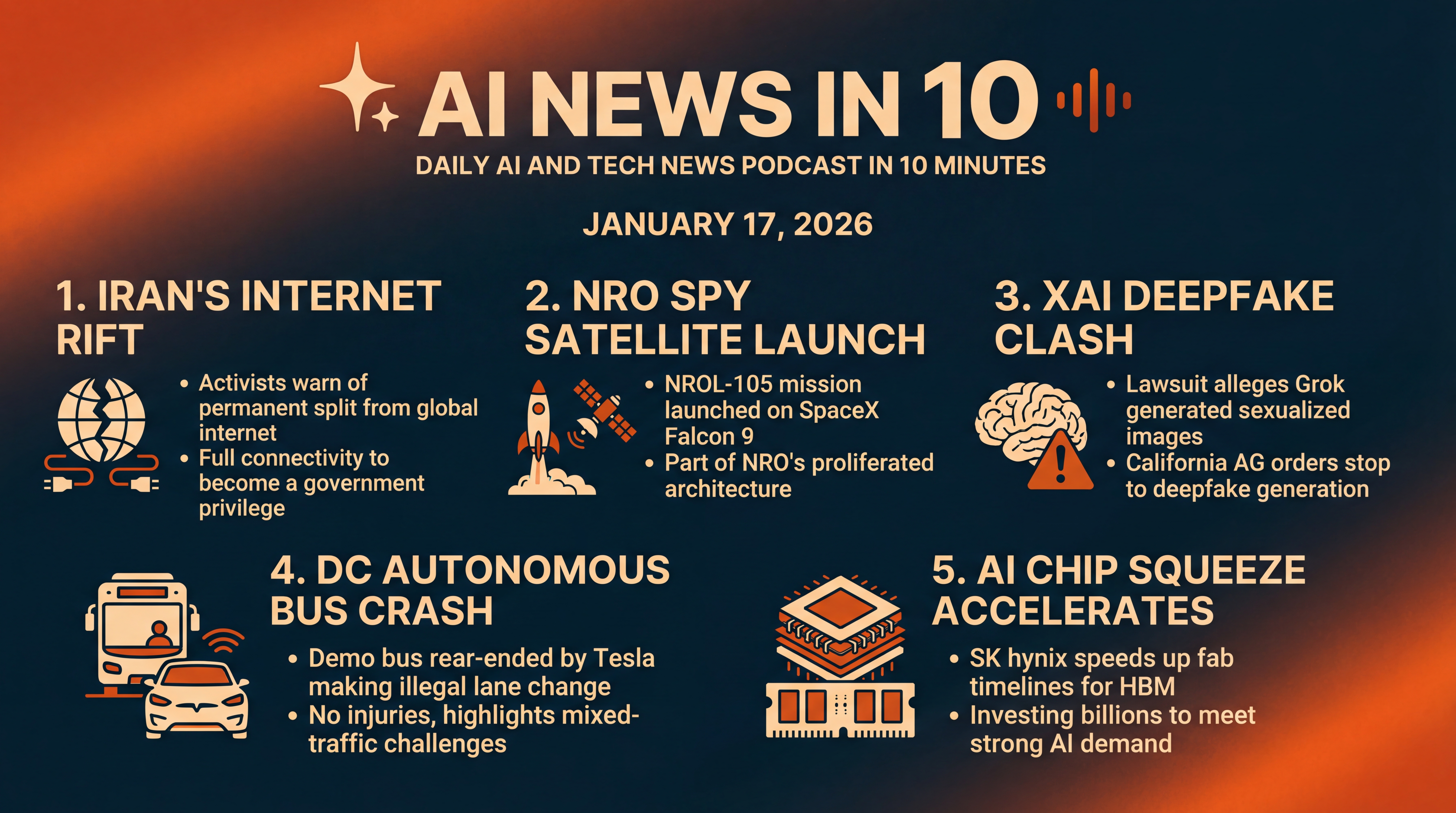
Episode Infographic
Show Notes
Welcome to AI News in 10, your top AI and tech news podcast in about 10 minutes. AI tech is amazing and is changing the world fast, for example this entire podcast is curated and generated by AI using my and my kids cloned voices...
Here’s what’s moving in AI and tech on Saturday, January 17, 2026... A stark warning out of Iran about a permanent split from the open internet. A fresh U.S. spy satellite launch riding a Falcon 9 into orbit. And Elon Musk’s xAI facing a first of its kind deepfake lawsuit as California’s attorney general turns up the heat. We’ll also hit an autonomous shuttle demo in Washington, D.C., that got rear-ended — by a Tesla — and we’ll close with the latest on the AI chip squeeze, as SK hynix pulls forward fab timelines and pours billions into advanced packaging.
[BEGINNING_SPONSORS]
Let’s start with Iran and a sobering shift in digital policy. Digital rights activists say Iranian authorities are planning a permanent break from the global internet — turning full, international connectivity into a government-granted privilege for vetted individuals, while the wider population is steered onto a tightly controlled national intranet.
The warning comes amid a sweeping blackout that began on January 8, after escalating anti-regime protests. It’s been described as one of the most severe internet shutdowns in modern history. Officials have hinted access may not return — at least until Nowruz in March.
Researchers say the plan relies on whitelisting and network hardware that can filter or block traffic at scale, with technology reportedly sourced from abroad. If implemented, the economic and cultural costs would be huge... even as authorities see it as an effective tool to suppress dissent. That’s the trajectory activists say they’re seeing today. Source: The Guardian.
Next up, a late-night national security launch on the U.S. West Coast. Just after 11:39 p.m. Eastern, the National Reconnaissance Office launched its NROL-105 mission on a SpaceX Falcon 9 from Vandenberg Space Force Base. The rocket’s first stage returned to Landing Zone 4, while the classified payload headed to orbit.
NROL-105 is part of the NRO’s proliferated architecture — deploying many smaller satellites to boost capability and resilience. The agency has emphasized the value of having hundreds of small spacecraft on orbit. Liftoff corresponded to 04:39 GMT today, January 17, and it marks SpaceX’s first national security mission of 2026. Source: NRO.
Now to a fast-developing legal and policy fight around generative AI imagery. Ashley St. Clair — the mother of one of Elon Musk’s children — has sued Musk’s AI company, xAI, alleging its Grok system generated sexualized deepfake images of her, including manipulations of photos from when she was a minor. xAI has denied the allegations and moved to shift the case to federal court. In parallel, the company filed a countersuit in Texas over venue and contract terms.
The case lands as California’s attorney general sent a cease-and-desist letter demanding xAI stop Grok from generating sexualized deepfakes — especially of minors — or face legal action under state law. The AG’s office says new restrictions xAI touted haven’t been sufficient, and set a near-term compliance deadline. Expect this one to reverberate across the industry, as platforms face mounting liability risks over AI image generation. Source: AP News.
One more note here: beyond this single lawsuit, state-level pressure on AI safety has been escalating since late 2025, when coalitions of attorneys general warned major AI companies that some chatbots may already be violating state law. The new California action is a sign that warnings are giving way to enforcement. Source: Office of the Attorney General.
[MIDPOINT_SPONSORS]
Fourth, an AV reality check on the streets of Washington, D.C. During a Department of Transportation demonstration of an automated bus — built by Beep and running with a safety driver onboard — the shuttle was rear-ended by a Tesla making an illegal lane change, officials said. Thankfully, no injuries... just cosmetic damage, and the bus was cleared to continue operating the route between Navy Yard and Union Station.
The incident unfolded as transportation officials were highlighting federal interest in expanding autonomous transit, while D.C. itself weighs rules for driverless operations without human supervision. It’s a small collision with an outsized message: autonomy is coming — but it’s arriving on roads shared with unpredictable human drivers, and the policy framework still has to catch up. Source: The Washington Post.
And fifth today, the AI hardware story behind nearly everything else in tech right now: memory for AI accelerators. SK hynix says it’s accelerating the first fab at the massive Yongin cluster by three months — to February 2027 — and will start running wafers next month at its new M15X fab in Cheongju to produce high-bandwidth memory.
These HBM stacks are the critical companion to data center GPUs from Nvidia and others, and every extra bit of capacity matters. In a related move, SK hynix approved a 19 trillion won — about 12.9 billion dollars — investment in an advanced chip packaging plant that’s slated to break ground in April and finish by the end of next year. The through-line: even after a wave of 2025 and 2026 chip expansions, demand from AI training and inference remains so strong that timelines are being pulled forward. Source: CNA.
Quick perspective on that last one... Memory has become the gating factor for many AI build-outs. Pulling a fab schedule forward by even a quarter can relieve some tightness — though analysts note the risk that today’s race to add capacity could set up the next cyclical downturn if demand ever normalizes. For now, with HBM attached to almost every new AI server sold, SK hynix’s moves are a signal that the supply crunch is still very real. Source: Yahoo Finance.
Recap before we go: Iran’s activists are warning of a decisive, long-term split from the global internet... SpaceX and the NRO kicked off 2026 national security launches with NROL-105 from Vandenberg... xAI is in court over alleged deepfakes as California orders Grok to stop generating sexualized images... D.C.’s autonomous bus demo got a very human reminder about road safety... and SK hynix is speeding up fabs and spending big to feed AI’s memory hunger. We’ll be back tomorrow with the next wave of AI and tech news — stay safe, stay curious.
Thanks for listening and a quick disclaimer, this podcast was generated and curated by AI using my and my kids' cloned voices, if you want to know how I do it or want to do something similar, reach out to me at emad at ai news in 10 dot com that's ai news in one zero dot com. See you all tomorrow.
