
ChatGPT Ads, Musk Showdown, Robots Learn Fast
OpenAI rolls out the eight-dollar ChatGPT Go plan worldwide and tests ads on lower tiers, while Elon Musk's blockbuster lawsuit heads toward a 2026 jury trial. Plus: Anthropic's Cowork brings agentic AI to your desktop, policymakers push PJM to fast-track power for data centers, and 1X shifts humanoids to video-trained world models.
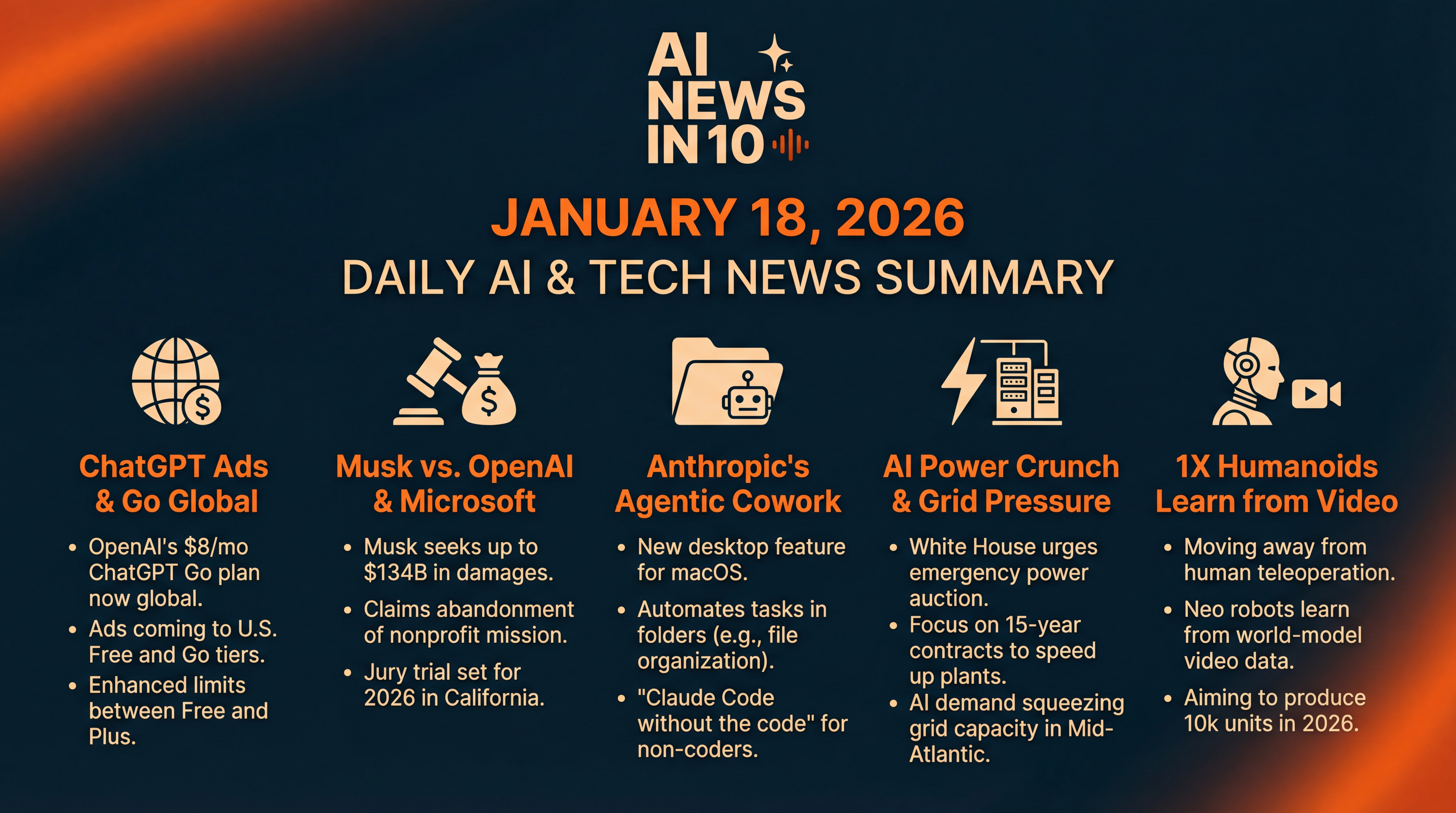
Episode Infographic
Show Notes
Welcome to AI News in 10, your top AI and tech news podcast in about 10 minutes. AI tech is amazing and is changing the world fast, for example this entire podcast is curated and generated by AI using my and my kids cloned voices...
Here’s what’s new in AI and tech today, Sunday, January 18, 2026...
OpenAI is taking its lower-cost ChatGPT Go plan global — and yes, ads are coming to some tiers in the U.S.
Elon Musk is escalating his legal battle with OpenAI and Microsoft, seeking as much as one hundred thirty-four billion dollars in damages.
Anthropic is pushing agentic AI into everyday work with a new feature called Cowork — point Claude at a folder and let it handle the busywork.
In Washington and across the Mid-Atlantic, leaders are pressuring grid operator PJM to hold an emergency power auction and build new plants for AI-hungry data centers.
And on the hardware side, OpenAI-backed 1X says its humanoid robots are moving away from human teleoperation toward AI world models that learn directly from video.
[BEGINNING_SPONSORS]
Let’s start with OpenAI. The company has officially rolled out ChatGPT Go worldwide — after an initial launch in India and a gradual expansion to more than one hundred seventy countries. In the U.S., Go is priced at eight dollars a month, slotted between the free tier and Plus. The pitch is more messages with GPT 5, more image generation and file uploads, longer memory, and access to projects and custom GPTs — without stepping up to the full Plus or Pro plans.
OpenAI also says it will begin testing ads in the U.S. for the free and Go tiers, while keeping Plus, Pro, Business, and Enterprise ad-free. Ads will be clearly labeled, won’t appear on sensitive topics, and the company says it won’t sell your personal data. The framing is accessibility — use ads to subsidize affordable access for hundreds of millions of people who don’t pay. We’ll see how users react... but it’s a notable shift for a product that has long leaned on subscriptions. According to OpenAI, the global rollout starts now, with U.S. pricing at eight dollars.
Zooming out, Go is essentially more of what people use most. The help center outlines extended access to image generation, file uploads, advanced data analysis, and a larger context window — with the caveat that exact limits may vary based on system load. If you’ve been bumping into message caps on the free plan, Go is meant to smooth that out without committing to the cost of Plus.
Story two: Elon Musk versus OpenAI and Microsoft — the sequel. Business Insider reports Musk is seeking between seventy-nine billion and one hundred thirty-four billion dollars in damages, based on an expert’s wrongful-gains analysis tied to OpenAI’s valuation. The case centers on Musk’s claim that OpenAI abandoned its nonprofit mission; OpenAI has pushed back, saying Musk sought control and left when he didn’t get it. The suit is slated for a jury trial in 2026 in California — setting up one of the biggest tech courtroom showdowns of the year. However it lands, discovery could expose new details about OpenAI’s structure and Microsoft’s partnership.
On to story three: Anthropic is leaning into agentic AI. Its new feature, called Cowork, brings Claude’s file handling and automation skills to non-coders. Install the Claude desktop app on macOS, point Cowork at a folder, and ask it — in plain English — to do real tasks: organize a messy downloads directory, build an expense report from receipt photos, or draft and refine a write-up from a pile of notes. It shares the same foundation as Claude Code, but it’s packaged for everyday workflows rather than developers — think "Claude Code without the code."
Anthropic does caution about prompt-injection risks and accidental file deletions, so instructions need to be precise, and you should keep a human in the loop. Still, it’s a concrete step beyond chat toward tools that act on your machine. Cowork is a research preview, initially for Claude Max subscribers.
What’s striking is how quickly this is moving. Within days of launch, hands-on tests showed that Cowork and Claude Code can chain multi-step operations and produce shippable output — apps, reports, reorganized data — without babysitting. That’s the narrative shift for 2026: moving from conversations to outcomes, with AI systems that can execute work under guardrails.
[MIDPOINT_SPONSORS]
Story four is a power story — literally. As AI demand explodes, the White House and a coalition of Mid-Atlantic governors are urging PJM — the grid operator for the largest U.S. electricity market — to hold an emergency power auction. The idea is to award long-term, fifteen-year contracts that de-risk building new plants, tamp down speculative interconnection requests from would-be data center developers, and get firm capacity online faster.
It’s an unusual ask — the administration and governors can’t force PJM’s hand — but it shows how acute the energy crunch has become as hyperscale data centers and AI clusters surge across Virginia, Pennsylvania, Ohio, and beyond. The Department of Energy has also floated the notion that data center operators should shoulder more of the bill unless they self-supply or cut peak usage. This is the new reality: compute is colliding with kilowatts... and policy is scrambling to catch up.
Finally, to robots. 1X — an OpenAI-backed startup building the Neo humanoid — says it’s moving away from labor-intensive human teleoperation toward a world-model approach that lets robots learn directly from their own video data. Instead of hiring more operators in motion-capture suits to remote-pilot thousands of examples, the company wants learning to scale with deployments: more robots in the wild equals more data — equals faster improvement.
The company says Neo can attempt most tasks autonomously now — from basic household chores to warehouse handling — with human fallback in the loop as needed during early rollouts. 1X expects to ship units this year at roughly twenty thousand dollars, or about five hundred dollars per month, and aims to produce more than ten thousand units in 2026. It’s an ambitious plan that echoes a wider shift in robotics — Tesla’s Optimus included — away from hand-holding and toward large-scale, video-based learning.
Quick extras to watch. If you’re a gamer or creator, NVIDIA’s CES updates included DLSS 4.5 Super Resolution, new G-SYNC Compatible displays, and expanded GeForce NOW access — a steady drip of features aimed at RTX PCs and cloud streaming. Not headline-grabbing on their own, but part of a bigger story: the company’s relentless pace across both data center AI and consumer graphics.
Recap time. OpenAI’s new eight-dollar ChatGPT Go plan is now global — and ads are coming to the free and Go tiers in the U.S. Musk’s lawsuit seeks up to one hundred thirty-four billion dollars from OpenAI and Microsoft, setting the stage for a blockbuster trial. Anthropic’s Cowork puts agentic AI on your desktop. Policymakers want PJM to fast-track new power for data centers as AI drives electricity demand. And 1X says its humanoids are learning from the world — not just human pilots. We’ll keep tracking how these strands — business models, agents, energy, and embodied AI — intertwine in the week ahead.
Thanks for listening and a quick disclaimer, this podcast was generated and curated by AI using my and my kids' cloned voices, if you want to know how I do it or want to do something similar, reach out to me at emad at ai news in 10 dot com that's ai news in one zero dot com. See you all tomorrow.
