Davos Dispatch: AI Results, Rights, and Risks
Real-world AI wins, a child-rights framework at the UN, and the IMF's latest outlook set the tone as Davos 2026 kicks off. Plus India's Partner with Bharat pitch and a human-led governance manifesto signal where adoption and accountability are heading.
Episode Infographic
Show Notes
Welcome to AI News in 10, your top AI and tech news podcast in about 10 minutes. AI tech is amazing and is changing the world fast, for example this entire podcast is curated and generated by AI using my and my kids cloned voices...
Here's what's new in AI and tech on Monday, January 19th... Davos 2026 kicks off with a flurry of announcements about AI's impact on business, policy, and society. We'll break down a fresh World Economic Forum report on how AI is actually delivering results, a UN-backed statement that puts children's rights at the center of AI policy, and the IMF's latest economic outlook—dropping today—with AI's investment boom in the spotlight. We'll also look at India's Partner with Bharat pitch to global investors, and a new manifesto from WISeKey arguing for human-led governance in an era of AGI and quantum computing. Buckle up... it's a big Monday.
[BEGINNING_SPONSORS]
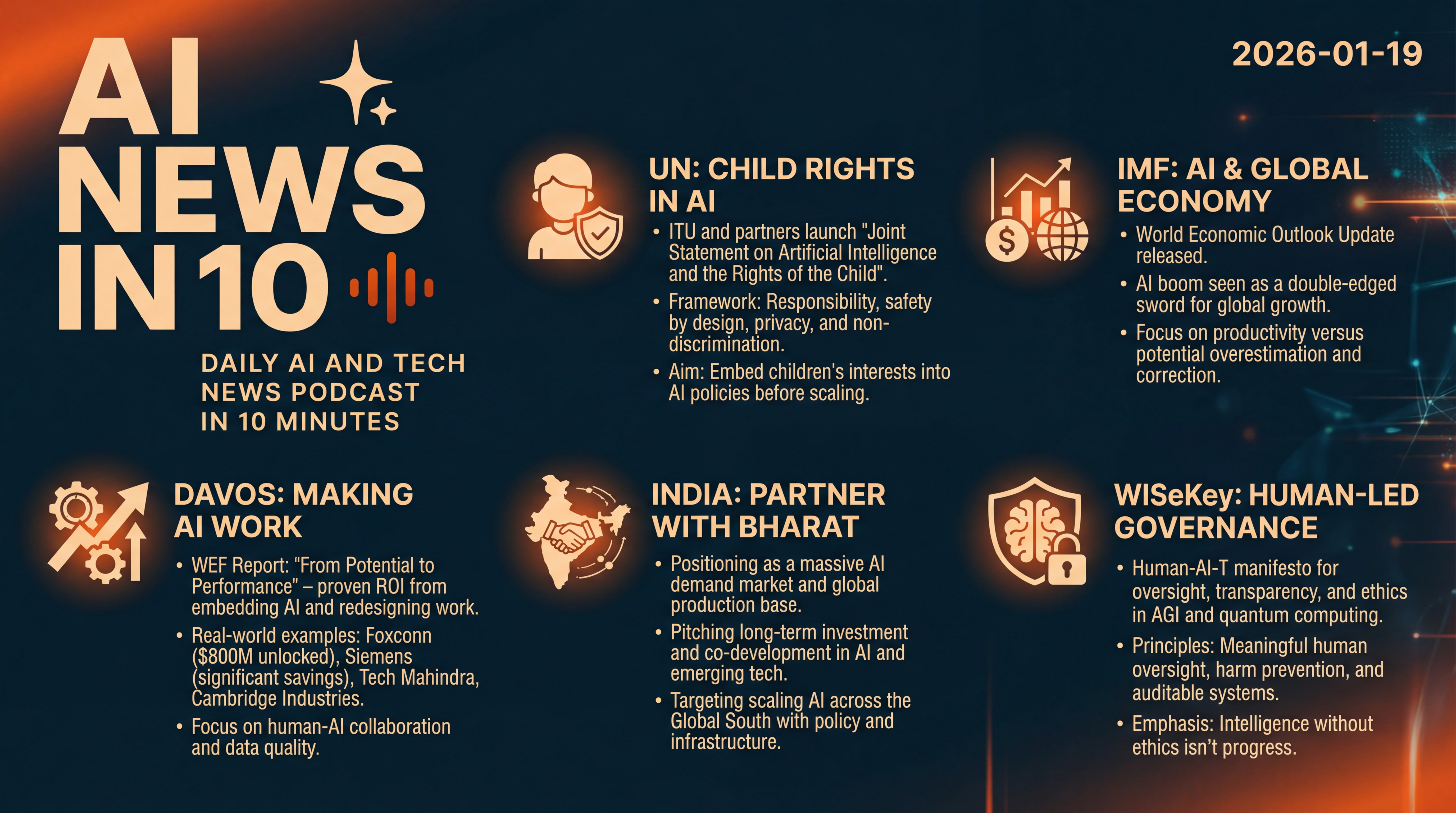
Let's start in Davos, where the World Economic Forum released a new report titled: From Potential to Performance: How Leading Organizations Are Making AI Work. The Forum studied successful scale-ups in more than 30 countries and across 20 industries, and it highlights a simple playbook: embed AI into strategy, redesign work for human-AI collaboration, and strengthen data foundations. It's not just principles—there are receipts.
Foxconn and BCG reportedly scaled an AI agent ecosystem that automates about 80 percent of decision workflows in global operations—unlocking an estimated eight hundred million dollars in value.
Siemens, working with EthonAI, standardized AI visual inspection in factories, with savings of between thirty thousand and one hundred thousand euros per station.
Tech Mahindra scaled multilingual large language models to handle 3.8 million monthly queries at about 92 percent accuracy for inclusive digital services.
A U.S. example: Cambridge Industries says edge-governed large language models cut emergency road repair costs by nearly half. That's the kind of ROI leaders have been demanding—and it's why the Forum is naming a new cohort of MINDS pioneers to showcase proven, high-impact deployments.
Beyond case studies, the WEF's day-one message is that AI's winners are getting serious about redesigning processes—think data quality at the source, human-in-the-loop guardrails, and clear accountability as teams scale agents from the lab to the front line. If your AI roadmap is still a patchwork of tools... this report is a useful benchmark for what good looks like in 2026.
Story two—also today—moves from boardrooms to the big picture of human rights. The UN's International Telecommunication Union and partners are launching a Joint Statement on Artificial Intelligence and the Rights of the Child, with a high-level signing ceremony at 1:00 p.m. CET in Geneva. The framework puts child rights at the heart of AI governance: responsibility and transparency for deployers, safety by design, strong privacy and data protections, non-discrimination and inclusion, and even environmental considerations. The aim is to bake children's interests into AI policies and standards—before systems scale into classrooms, healthcare, and social services. For governments and platforms alike, this is a nudge to move from child-safety features to child-rights architecture.
Zooming out just a few blocks in Geneva—today also features the UN's Informal Working Group on Artificial Intelligence, meeting at the Palais des Nations. These sessions aren't splashy product launches, but they're part of the plumbing of global governance—how multilateral bodies coordinate definitions, risk frameworks, and practical next steps for AI oversight. In short, the rules keep inching forward... even when the headlines are elsewhere.
Story three: the macro lens. The IMF's World Economic Outlook Update drops today at 10:30 a.m. CET in Brussels. Why should the AI world care? Because the Fund has been explicit that U.S. AI investment is a key prop for global growth—while warning that exuberance can flip fast. In earlier remarks, IMF chief economist Pierre-Olivier Gourinchas called the AI boom a double-edged sword: it's supporting demand and financial conditions, but history shows that path-breaking technologies often bring overestimation and corrections. Watch today's briefing for how the IMF threads that needle—does it see AI productivity arriving ahead of schedule, or more froth than fundamentals? Either way, signals from today's update will ripple through capital spending and hiring plans across the AI stack.
[MIDPOINT_SPONSORS]
On to story four: India's opening bid at Davos. Under the banner Partner with Bharat, India is positioning itself as both a massive AI demand market and a global production base. The pitch emphasizes investment and co-development in AI and emerging tech—framed as a long-term partnership rather than just market entry. This follows a broader push to anchor cloud and compute locally, skill millions, and attract hyperscale data center investment. For founders and funds roaming Davos this week, the signal is clear: India wants to be the go-to partner for scaling AI across the Global South, with policy and public digital infrastructure to match.
And story five—one of the more philosophical turns of the day. Cybersecurity firm WISeKey used the Davos stage to debut its Human-AI-T manifesto—Human, Artificial Intelligence, Trust—arguing that as AI autonomy grows and quantum tech looms, governance must remain explicitly human-led. The principles: maintain meaningful human oversight; design to prevent harm; require transparency, explainability, and auditability; and treat privacy and data sovereignty as fundamental rights. The pitch: intelligence without ethics isn't progress... and power without accountability isn't innovation. Whether you view it as marketing or momentum, it reflects a real mood at Davos—big AI ambitions paired with a demand for demonstrable trust.
A quick coda to connect the dots... Today's WEF report gives leaders a blueprint for scaling AI that actually pays. The UN actions in Geneva push child rights and global coordination into the center of AI governance. The IMF's outlook reminds investors and operators alike that exuberance can be fragile... even as AI remains a bright spot in growth projections. India's message to Davos is that it wants to be the growth engine and the lab for AI deployment at population scale. And the Human-AI-T manifesto echoes a chorus we've heard for months: show us alignment, transparency, and real-world guardrails as you scale.
That's the wrap for today—five stories that frame how AI will be built, funded, and governed in 2026: what works, what needs work, and what to watch next. We'll keep the Davos pulse going tomorrow... until then, stay curious.
Thanks for listening and a quick disclaimer, this podcast was generated and curated by AI using my and my kids' cloned voices, if you want to know how I do it or want to do something similar, reach out to me at emad at ai news in 10 dot com that's ai news in one zero dot com. See you all tomorrow.
