
Memory Bets, Agentic Commerce, and Policy Fights
Micron doubles down on memory capacity as payment networks draft rules for agentic checkout, while Satya Nadella calls for broader, cost-aware AI adoption. We also look at Telangana’s new proving ground and a Florida bill that could spark a state versus federal showdown on AI governance.
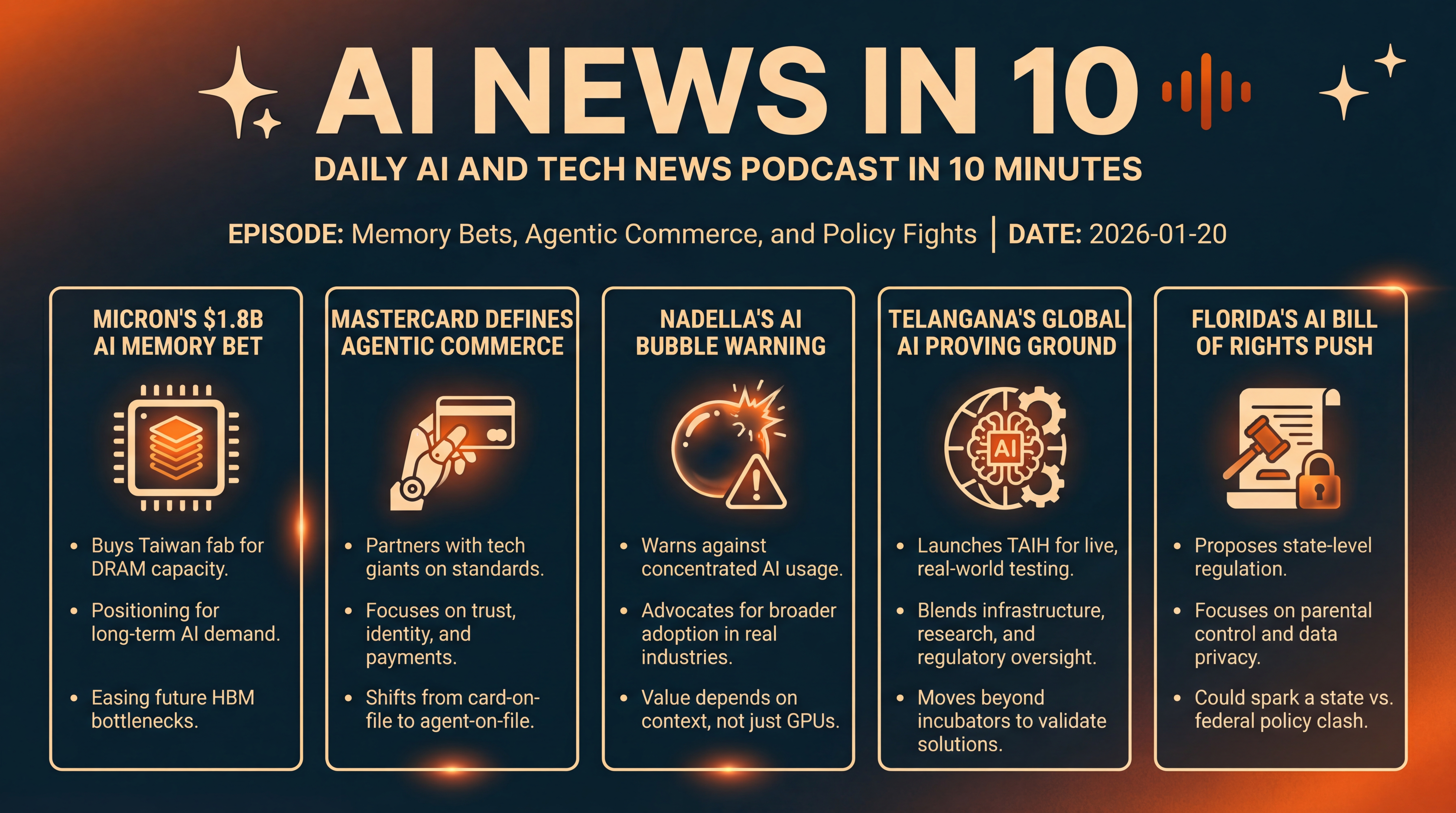
Episode Infographic
Show Notes
Welcome to AI News in 10, your top AI and tech news podcast in about 10 minutes. AI tech is amazing and is changing the world fast, for example this entire podcast is curated and generated by AI using my and my kids cloned voices...
Today we’re tracking a big chip deal shaping the AI supply chain... new rules for AI agents at the checkout... pointed warnings about an AI investment bubble from Microsoft’s CEO... a state-level moonshot to turn India’s Telangana into a global proving ground for AI... and a fresh Florida bill that could set up a state versus federal clash over AI regulation. Let’s get into it.
[BEGINNING_SPONSORS]
Story one... Micron is buying capacity, not hype.
Micron signed a letter of intent to acquire Powerchip’s P5 fab site in Tongluo, Taiwan, for $1.8 billion — adding about 300,000 square feet of cleanroom space. That space is critical for DRAM and, by extension, the high-bandwidth memory pipelines feeding AI data centers.
The company says the deal could close by the second quarter of 2026, with significant production ramping in 2027. That timing matters: industry trackers say DRAM prices jumped 40 to 50 percent late last year, and leading suppliers are effectively sold out into 2026 as AI servers soak up supply.
Proximity to Micron’s Taichung operations creates logistics synergies, and a longer-term partnership with Powerchip covers packaging and support for legacy DRAM. Put simply... Micron is positioning to catch a multi-year AI demand wave — not just a one-quarter pop.
Why should you care? Memory has quietly become the swing factor in AI system costs. If Micron can add DRAM capacity while HBM demand stays red-hot, it could ease bottlenecks by late 2027... or, if demand cools, risk oversupply. For now, it’s a strategic bet on the AI everywhere thesis.
Sources include Micron’s investor release, the Wall Street Journal, DataCenterDynamics, and TrendForce.
Story two... Who writes the rules when your AI agent buys things for you? Mastercard is stepping in.
The company told Axios it’s partnering with the big platforms — think Google and Microsoft — to define standards for what it calls agentic commerce, where AI agents browse, compare, and pay on a user’s behalf.
The key isn’t just model horsepower... it’s trust: identity, authentication, dispute resolution, and who’s liable when an agent gets it wrong.
Mastercard says the winners won’t be a single model or app, but an ecosystem that secures identity across retailers and wallets — and makes machine-to-merchant transactions auditable by default.
That’s a shift from today’s one-click checkouts and card-on-file to something more like an agent-on-file... with policy guardrails and payment network rules embedded from the start.
The takeaway... If agent shopping is going to scale beyond demos, consumers need to feel as protected as they do with a card swipe. The payment networks have decades of fraud and chargeback playbooks. Baking those into AI agents early could accelerate adoption — without waiting for a patchwork of new laws later.
Source: Axios.
Story three... At Davos, Microsoft’s Satya Nadella poured a bit of cold water on the most exuberant AI narratives — and he’s probably right.
Speaking to the Financial Times, he warned the AI boom could look bubbly if usage remains concentrated among a few tech giants and wealthy countries. The antidote, in his view, is to broaden adoption in real industries and emerging markets, and let companies mix and match models — including open source — to hit outcomes at the right cost.
He stressed that success won’t hinge on one provider, and that value creation depends on putting AI in the context of a firm’s own data and workflows.
This matters because it reframes the conversation. Instead of asking how many GPUs you can buy — ask where the productivity gains actually land. If AI’s benefits diffuse across healthcare, manufacturing, and small businesses, the current capex surge looks more like railroads or broadband... massive, messy, but ultimately society-scale. If not, we risk ending up with a narrow, expensive stack that few can afford to use at scale.
Source: the Financial Times.
[MIDPOINT_SPONSORS]
Story four... India’s Telangana state is launching what it calls a Global AI Proving Ground — unveiled at Davos.
The Telangana AI Innovation Hub, or TAIH, is framed as an autonomous institution that blends infrastructure, research, startups, capital, and live testing to convert AI talk into applied deep-tech outcomes across chip design, quantum, and advanced sensors.
The state’s chief minister is unveiling the hub today, positioning Telangana as a top-20 innovation center and pitching TAIH as a live sandbox where enterprise-grade solutions are validated at scale.
The idea is to move beyond incubators and white papers... and pressure-test new systems in the wild with industry partners and regulatory oversight.
Why it’s noteworthy... As companies wrestle with how to safely test agentic systems — especially ones that control tools, handle sensitive data, or act in the physical world — jurisdictions that offer credible sandboxes can attract both capital and talent. If Telangana executes, it could become a go-to staging ground for companies seeking results, not just research papers.
Source: the Times of India.
Story five... Florida is moving to regulate AI at the state level — setting up a likely collision with Washington and Big Tech.
A new proposal, Senate Bill 482, would give parents explicit rights to monitor and control their kids’ interactions with AI technologies and establish an Artificial Intelligence Bill of Rights focused on data privacy and parental oversight.
Axios’ Tampa Bay bureau reports the push from Governor Ron DeSantis faces strong opposition from industry groups — and potentially the White House, which has argued AI policy should be set federally.
Recall that a 2025 presidential order centralized federal AI policy and rolled back prior directives. Florida’s move could become a test case for how far states can go on AI governance when it touches interstate digital services.
The stakes... We’re already seeing deepfake harms and youth-safety concerns escalate globally. But a 50-state patchwork could be a nightmare for deployers — especially if rules diverge on consent, age verification, and enforcement. Expect tech firms to push for federal preemption while states experiment. Florida’s bill, if it advances, will show us how hard that pendulum is swinging.
Sources: Axios Local Tampa Bay and the White House presidential actions archive.
Quick recap... Micron’s $1.8 billion Taiwan fab deal shows how memory makers are arming for multi-year AI demand... Mastercard wants to standardize agentic checkout with identity and payment rails built in... Satya Nadella says the AI boom only works if adoption spreads beyond the tech elite... Telangana is staking a claim as a global AI proving ground... and Florida’s new bill could spark a state versus federal showdown on how AI is governed.
Sources include Micron’s release plus the Wall Street Journal, TrendForce, and DataCenterDynamics; Axios on Mastercard; the Financial Times on Nadella; the Times of India on Telangana; and Axios Local Tampa Bay with White House archives for policy context.
Thanks for listening and a quick disclaimer, this podcast was generated and curated by AI using my and my kids' cloned voices, if you want to know how I do it or want to do something similar, reach out to me at emad at ai news in 10 dot com that's ai news in one zero dot com. See you all tomorrow.
