Rules, Tools, and Fuel: Today in AI
South Korea’s landmark AI law goes live as Adobe turns PDFs into podcasts and decks, Sony teams with TCL on Bravia, UK MPs push regulators on AI risk in finance, and Micron rides the HBM supercycle. We connect the dots on rules, tools, and the silicon fueling it all.
Episode Infographic
Show Notes
Welcome to AI News in 10, your top AI and tech news podcast in about 10 minutes. AI tech is amazing and is changing the world fast, for example this entire podcast is curated and generated by AI using my and my kids cloned voices...
It’s Thursday, January 22, 2026. Here’s what’s shaping AI and tech today — South Korea flips the switch on a first-of-its-kind national AI law, Adobe turns your PDFs into auto-generated podcasts and decks, Sony hands majority control of its Bravia TV business to TCL, UK lawmakers urge regulators to stop the wait-and-see on AI risk in finance, and Micron gets a fresh Wall Street endorsement as the memory supercycle rolls on... fueled by AI’s appetite for HBM. Let’s jump in.
[BEGINNING_SPONSORS]
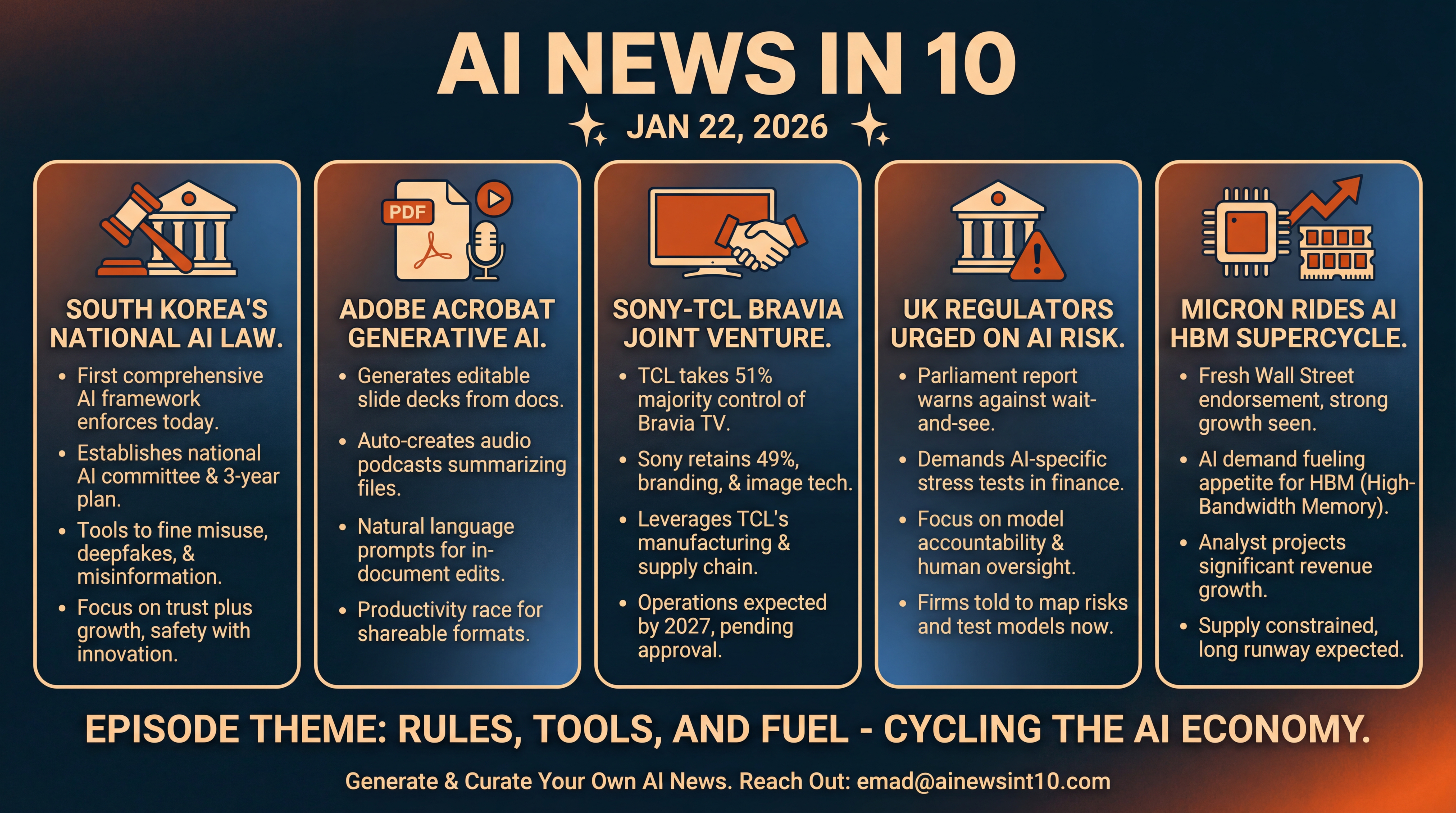
We’ll start in Seoul. South Korea’s AI Basic Act takes effect today — making the country the first to enforce a comprehensive, horizontal AI framework. The law establishes a national AI committee, requires a three-year implementation plan, and gives authorities tools to investigate and fine misuse — such as deepfakes and AI-driven misinformation — while also funding innovation and standards work. The government’s pitch is trust plus growth — marrying safety requirements with support for startups and research. If you track compliance, this is the new baseline in Asia: expect disclosure duties for certain systems, transparency norms, and human oversight provisions to ripple through procurement and private deployments. The science ministry confirmed the effective date this morning, and legal analysts note the statute was enacted last January with a one-year runway to today.
A few practical notes for teams operating in Korea. Watch definitions like AI system and the categories that drive obligations. The act sets up governance that can designate high-impact use cases with elevated duties. Sub-laws and guidance will tune thresholds and documentation expectations — and observers expect enforcement to ramp across 2026 as the committee and safety bodies stand up. For multinationals, several firms are already aligning model documentation and incident reporting with Korea’s rules and the EU AI Act timeline to avoid parallel, bespoke processes.
Next up... Adobe just made Acrobat a lot more talkative. New generative AI features rolling out across Acrobat and Acrobat Studio can generate editable slide decks from a bundle of documents and — here’s the flashy bit — spin up an audio podcast that summarizes your files. You can also ask the AI assistant to make in-document edits via natural language prompts — add an e-signature field, remove pages, or rewrite a paragraph — without hunting through menus. Adobe says the presentation flow drafts an outline first, then builds slides you can style in Express, and the podcast defaults to a two-host conversation that walks through the highlights with citations back to the source material. Think NotebookLM-style audio... but native to your PDFs and Spaces.
Why it matters: productivity suites are racing to turn long documents into short, shareable formats — slides, posts, and audio. The adoption trick will be controls — teams will want guardrails around what sources the assistant can touch, how citations are inserted, and a clear audit trail for content that leaves your perimeter. Adobe’s move puts pressure on incumbents across office, note-taking, and knowledge-base tools to meet users where they already store the work — inside PDFs.
Story three — an industry shake-up in living room tech. Sony is handing majority control — 51 percent — of its Bravia TV and home audio business to TCL via a joint venture, with Sony retaining 49 percent. Branding stays Sony and Bravia, but manufacturing scale, panels, and supply chain lean heavily on TCL. The companies aim to close and begin JV operations by 2027, pending approvals.
For consumers, the near term is steady — but in the medium term, expect TCL’s vertical integration to bring more aggressive price performance into higher tiers, while Sony’s image processing and audio tech keep the premium halo alive. Strategically, it’s Sony tilting further toward content, imaging, and PlayStation — while offloading the heavy lift of commodity hardware margins.
[MIDPOINT_SPONSORS]
Fourth — a regulatory drumbeat from London. The UK Parliament’s Treasury Committee says financial regulators risk exposing consumers and markets to serious harm by moving too slowly on AI. The report urges the Bank of England and the Financial Conduct Authority to run AI-specific stress tests and set clearer accountability for model-driven decisions — in credit, insurance claims, and fraud detection. One concern: highly synchronized models can push institutions to react the same way at once, amplifying shocks. Regulators welcomed the recommendations and promised responses, but the message to banks and insurers was blunt — don’t wait for bespoke rules... map risks, document human oversight, and test your models now.
It’s a timely nudge, given the broader European cadence. The EU’s AI Act ramps through 2026, and firms operating across jurisdictions are consolidating model inventories, monitoring emergent bias, and tightening vendor controls. Whether you’re in risk, compliance, or product, the homework is the same — validate model behavior under stress, explain adverse decisions, and prove there’s a human in the loop where required.
And fifth — the AI memory boom keeps minting winners. Micron picked up a fresh Outperform initiation today from William Blair, with a note arguing the HBM supercycle — those tall memory stacks feeding AI accelerators — has years to run. The analyst projects HBM revenue growth of roughly 164 percent in Micron’s fiscal 2026, then another 40 percent in 2027, as tight supply and relentless AI demand drive pricing and mix. In plain English... more training and inference means more high-bandwidth memory per GPU, and even non-AI PCs inherit pricier DRAM as capacity shifts to HBM. Investors have pushed Micron’s market cap sharply higher over the past year. The new call suggests the runway’s still long if supply remains constrained into 2027.
A quick connective thread to close. Today’s stories show the AI economy cycling on three gears — rules, tools, and fuel. Rules — Korea’s AI Basic Act and the UK’s warning signal how fast norms are locking in, especially around safety, documentation, and oversight. Tools — Adobe’s make me a deck and a podcast push is the latest proof that generative features are becoming table stakes inside everyday apps. Fuel — Micron’s HBM surge reminds us that underneath it all is silicon and supply... compute and memory that still can’t be built fast enough.
That’s the download: South Korea’s landmark AI law is live, Adobe turned PDFs into podcasts, Sony’s teaming with TCL on Bravia, UK MPs want tougher AI risk testing in finance, and Micron’s riding the HBM wave with fresh Wall Street conviction. See you tomorrow with more AI News in 10.
Thanks for listening and a quick disclaimer, this podcast was generated and curated by AI using my and my kids' cloned voices, if you want to know how I do it or want to do something similar, reach out to me at emad at ai news in 10 dot com that's ai news in one zero dot com. See you all tomorrow.
