Jobs Shock, Robotaxis, and Mumbai’s AI Hub
From Davos to Mumbai, we unpack the IMF’s AI jobs warning, an Under Armour breach probe, Europe’s looming training opt-outs, Musk’s robotaxis and humanoids, and Maharashtra’s big bet on an AI hub. A fast, informed briefing on where policy, security, and industry are moving next.
Episode Infographic
Show Notes
Welcome to AI News in 10, your top AI and tech news podcast in about 10 minutes. AI tech is amazing and is changing the world fast, for example this entire podcast is curated and generated by AI using my and my kids cloned voices...
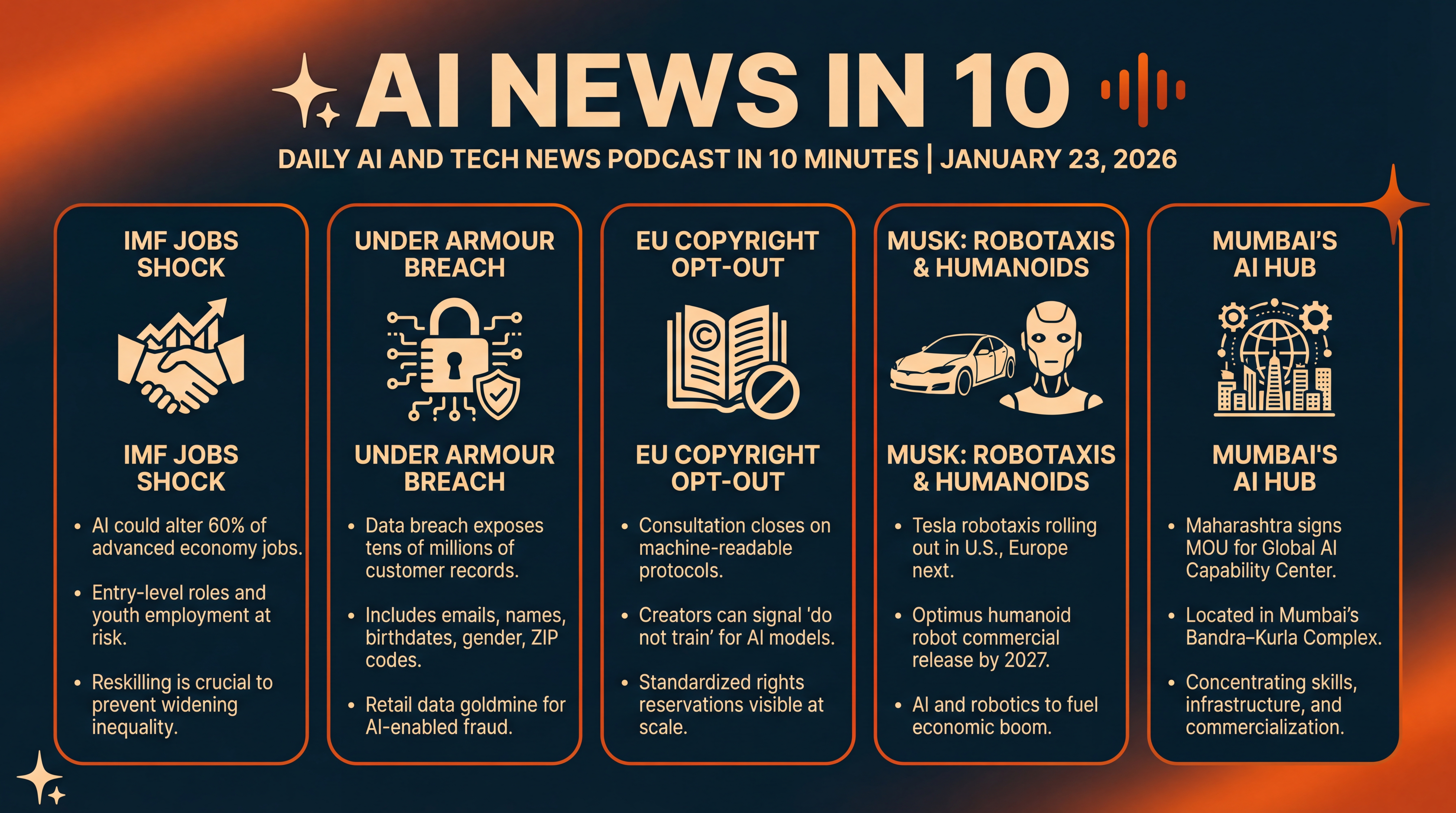
Here’s what’s on deck today: the IMF sounds the alarm on how fast AI could upend labor markets... Under Armour is probing a major customer data breach... Europe is closing a key consultation that could define how creators keep their work out of AI training sets... Elon Musk shows up at Davos to talk robotaxis and humanoids... and India’s state of Maharashtra signs a memorandum of understanding to establish a global AI hub in Mumbai’s Bandra–Kurla Complex. Let’s dive in.
[BEGINNING_SPONSORS]
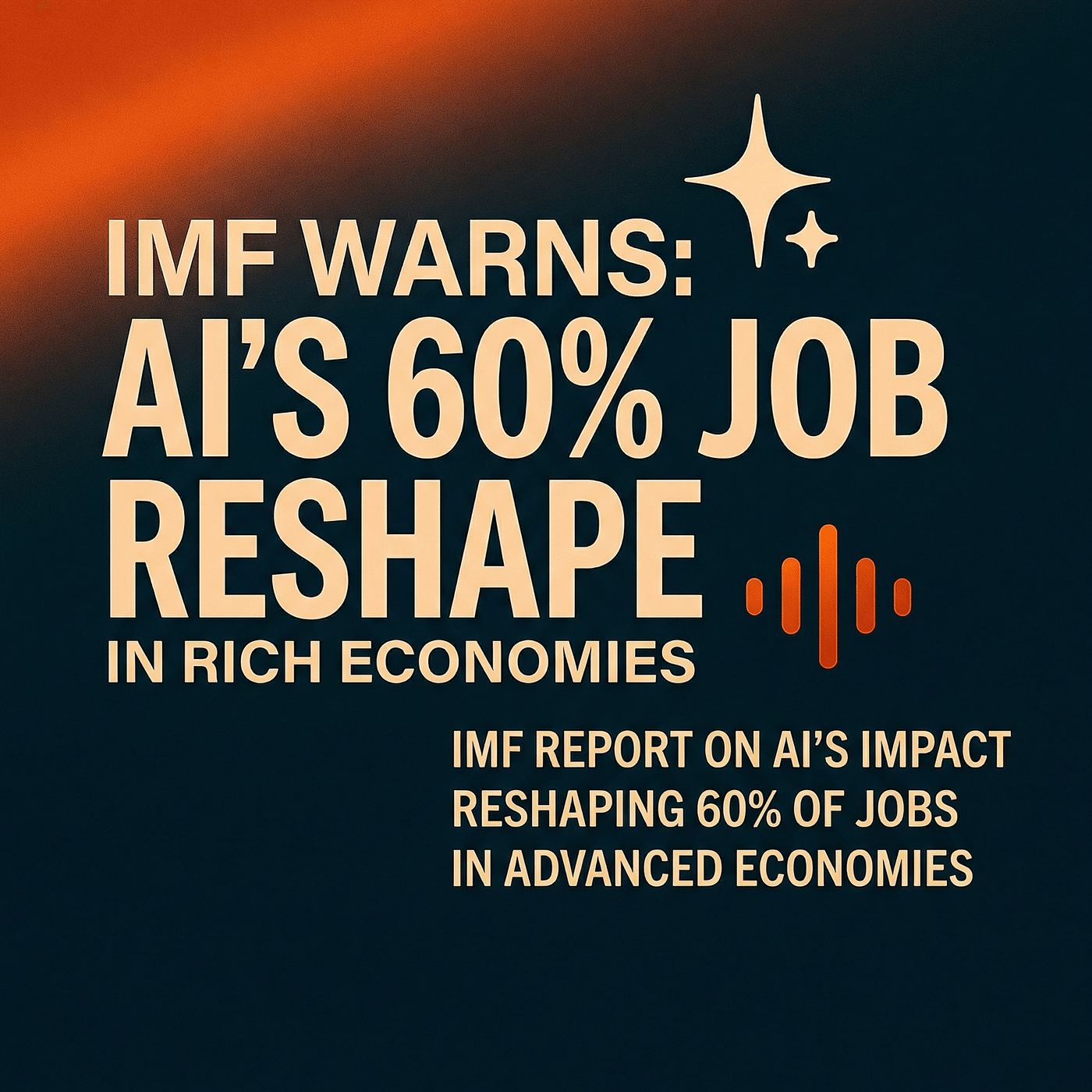
We start in Davos, where the World Economic Forum wraps up today — and the headline is jobs. IMF Managing Director Kristalina Georgieva warned that AI could hit labor markets like a tsunami, altering roughly 60 percent of jobs in advanced economies. She flagged entry-level roles as especially exposed, raising concerns about youth employment and widening inequality if reskilling doesn’t keep pace. It’s a stark framing of a week filled with AI optimism — and anxiety — in the Alps.
Meanwhile, European Central Bank President Christine Lagarde pushed back on talk of a total geopolitical rupture, urging cooperation as AI drives capital-intensive change. The subtext is simple: this transformation will reward countries and companies that invest — not just in hardware — but in human capital.
One more Davos data point. Nvidia CEO Jensen Huang called today’s AI wave a full platform shift, and said five layers have to scale in sync — energy, chips, cloud, the model, and the apps. That’s why, in his words, we’re seeing the largest infrastructure build-out in human history. Put differently, AI isn’t just software... it’s an energy-to-experience stack — and the bottlenecks won’t be solved by code alone.
Next up, a big breach under investigation. Under Armour says it’s looking into claims that a late 2025 intrusion exposed data tied to tens of millions of customers — roughly 72 million email addresses, plus names, birthdates, gender, and ZIP codes. Importantly, the company says there’s no evidence that passwords or payment systems were compromised. Security researchers note that some of the data appears on hacking forums already. A ransomware group has tried to take credit, but Under Armour hasn’t confirmed those details. If you’ve shopped with the brand, it’s a good day to turn on two-factor authentication and watch for phishing.
Why this matters beyond one company: retail data is a goldmine for AI-enabled fraud. With large language models generating convincing emails and voice clones spoofing customer support, attackers can weaponize even basic personal information. It’s a reminder that breach fallout now plays out across an entire AI‑supercharged threat landscape.
Over to Brussels — or technically, to the European Commission’s digital strategy team. Today is the final day of a consultation that could shape how AI companies train models on public content in Europe. The Commission asked stakeholders to weigh in on machine-readable opt-out protocols — signals that rightsholders can use to reserve their works from text-and-data mining for AI training under the AI Act and its General-Purpose AI Code of Practice. After the consultation, the EU plans to publish a list of agreed-upon technical protocols that model providers must respect. It’s a hinge moment: if the final list is widely adopted, creators — from newsrooms to photographers — will have concrete, standardized ways to say, don’t train on this.
The standards world is already engaging. The I P T C — the metadata standards body behind photo tags used across media — says it has submitted input and highlighted mechanisms like its Photo Metadata Data Mining property, along with work tied to W 3 C and I E T F efforts. Translation: there’s a technical runway to make these rights reservations visible and enforceable at internet scale — if platforms implement them.
[MIDPOINT_SPONSORS]
Elon Musk made his first Davos appearance — and he used the stage to plant two big flags. First, robotaxis. Musk says Tesla’s autonomous ride-hail service is rolling out in several U.S. cities now, with plans to expand into Europe. Second, humanoids. He projects a commercial release window for Tesla’s Optimus robot by the end of 2027. As always with Musk, timelines spark debate... but the directional signal is clear: autonomous mobility plus general-purpose robotics are central to his thesis that abundant AI and inexpensive robotics could fuel a broad economic boom.
The strategic angle is worth underscoring. If robotaxis prove reliable — and regulators allow scale — the economics of mobility change. Urban logistics, commuting, even car ownership could be reshaped. Add humanoid labor into warehousing and light manufacturing, and you get a flywheel: software learns from the physical world, the robots get better, and the cost curves bend. Huang’s five-layer stack connects here — none of this happens without massive energy and compute footprints, plus new safety and governance guardrails to match.
Finally, a fast-moving India story with global implications. At Davos, the Maharashtra government signed a memorandum of understanding — an M O U — with U.S.-based Supervity AI to establish what they’re calling the world’s first AI Global Capability Center hub in Mumbai’s Bandra‑Kurla Complex. The goal is to concentrate skills, infrastructure, and commercialization in a single urban district — think financial district for AI, with a pipeline to talent and industry partners. India’s been broadcasting an AI‑first ambition all week; this is a concrete step that signals how local governments want to capture the value — and the jobs — from the AI build-out. Details like incentives, regulatory sandboxes, and the partner roster will be key to watch.
Quick recap. The IMF says the AI jobs shock could feel like a tsunami unless reskilling scales fast... Under Armour is probing a breach that reportedly exposed tens of millions of customer records... the EU’s consultation on machine-readable copyright opt-outs closes today — a major marker for AI training rules... Elon Musk’s Davos debut zeroed in on robotaxis now and Optimus by 2027... and Maharashtra’s memorandum of understanding aims to make Mumbai’s B K C a global AI nerve center. The through-line is simple: AI is accelerating — across policy, security, industry, and cities — and the winners will be those who build skills, safeguard trust, and execute... fast.
Thanks for listening and a quick disclaimer, this podcast was generated and curated by AI using my and my kids' cloned voices, if you want to know how I do it or want to do something similar, reach out to me at emad at ai news in 10 dot com that's ai news in one zero dot com. See you all tomorrow.
