Telecom Crackdown, Nuclear-Powered AI, and Classroom Tools
Europe moves to phase out high-risk telecom suppliers, OpenAI hints at a 2026 device, and Meta inks nuclear deals to power AI. Plus, Gemini-powered classroom tools and a Belgian hospital cyberattack highlight the real-world stakes of our accelerating tech future.
Episode Infographic
Show Notes
Welcome to AI News in 10, your top AI and tech news podcast in about 10 minutes. AI tech is amazing and is changing the world fast, for example this entire podcast is curated and generated by AI using my and my kids cloned voices...
Here’s what’s on deck today: Europe takes a harder line on telecom supply chains, OpenAI finally hints at its first piece of hardware, Meta signs landmark nuclear deals to power AI, Google and Khan Academy roll out new Gemini-powered classroom tools—and a hospital cyberattack in Belgium shows, yet again, how fragile healthcare IT can be. Let’s dive in.
[BEGINNING_SPONSORS]
Story one... Europe is tightening the screws on critical tech infrastructure.
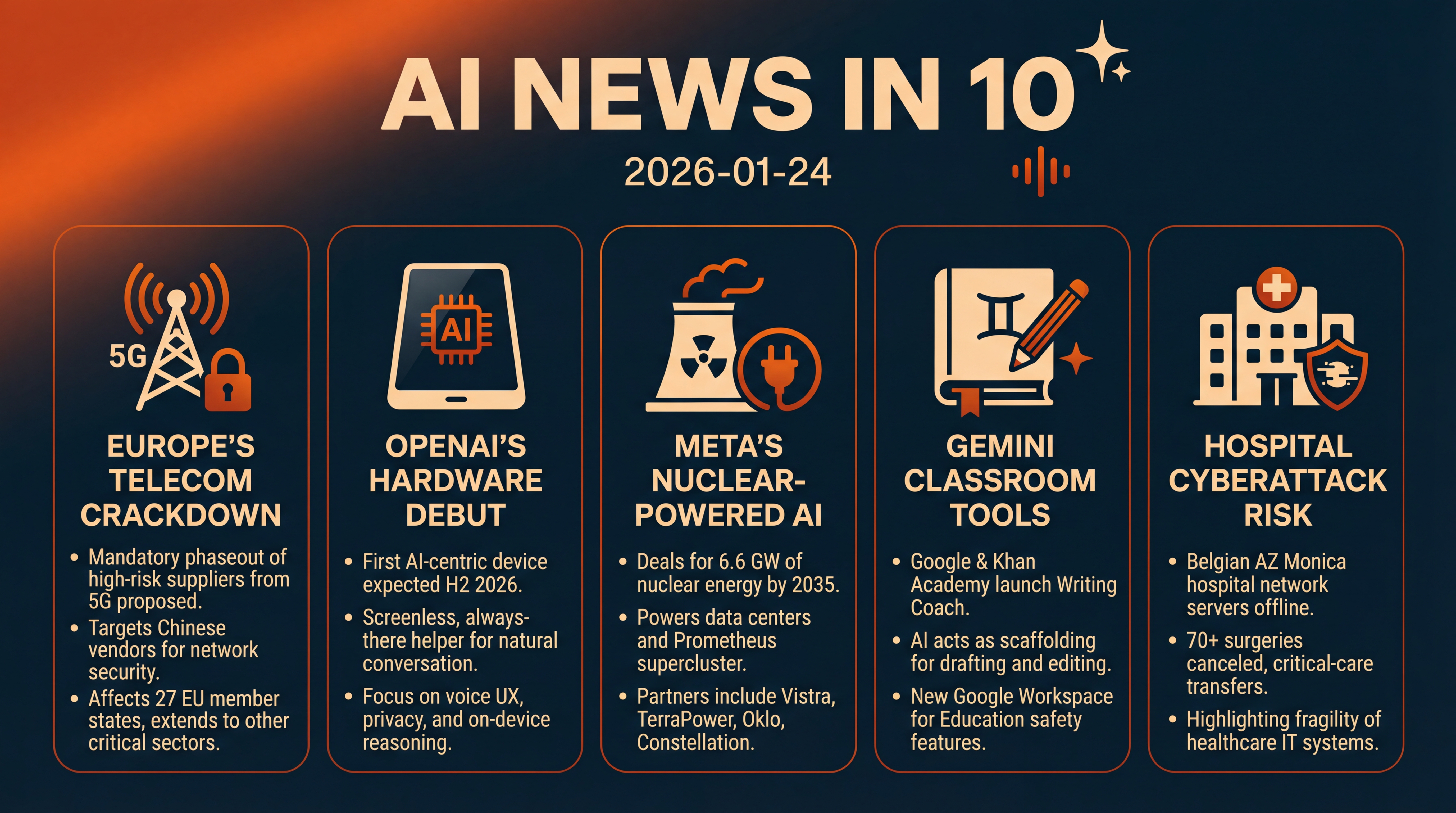
The Associated Press reports the European Commission has proposed a mandatory phaseout of high-risk suppliers from the E.U.’s high-speed telecom networks—think 5G and other core gear—over the next three years. The draft doesn’t name names, but it’s widely read as targeting Chinese vendors like Huawei and ZTE. Why now? The Commission says voluntary guidance created a patchwork; this plan would make compliance consistent across all 27 member states, and extend risk controls beyond telecom into other critical sectors—from border scanners to medical devices. Huawei has already criticized the proposal as discriminatory and contrary to World Trade Organization principles.
If Parliament signs off, operators would face a countdown to rip and replace in sensitive network layers... a costly, complex shift with big supply chain implications.
Big picture—Europe is trying to lock in resilience for the AI era, where data center interconnects and mobile backbones underpin everything from consumer apps to industrial automation. A bloc-wide mandate could accelerate vendor diversification, but it also risks near-term cost spikes and deployment delays as carriers juggle spectrum upgrades, fiber builds—and now, supply chain reshuffles. Expect a flurry of national impact assessments in the coming weeks as operators scope timelines and budgets.
Story two... OpenAI is getting into hardware—finally.
The company aims to debut its first device in the second half of 2026, according to Chris Lehane, OpenAI’s chief global affairs officer. Details are still under wraps, but the long-running rumor mill—fueled in part by Sam Altman’s work with Jony Ive’s design firm—points to a small, likely screenless, AI-centric gadget built for natural conversation and ambient assistance. In other words, less phone replacement... more always-there helper. Axios says we’ll hear more later this year.
If you’re wondering why the timing matters... 2026 is shaping up to be a real battle of AI-native devices—from wearables and smart glasses to in-home assistants—each promising lower latency, on-device reasoning, and tight integration with cloud models for tougher tasks. The winner won’t just be the best model; it’ll be the team that nails ergonomics, battery life, privacy—and voice UX. OpenAI entering this arena suggests it wants tighter control over the end-to-end experience, not just the model in the cloud.
Story three... power—lots of it.
Meta announced a series of nuclear energy agreements that could unlock up to 6.6 gigawatts of reliable capacity by 2035, supporting its growing fleet of data centers and its Prometheus supercluster in New Albany, Ohio. Partners include Vistra, TerraPower, Oklo, and Constellation. Meta frames this as both grid reliability and clean energy strategy: firm, low-carbon power to match always-on AI demand—while, it says, paying the full freight so residential customers aren’t stuck with the bill. It’s a milestone in how hyperscalers plan to meet staggering compute needs. After exhausting wind and solar power purchase agreements, they’re now turning to next-generation nuclear to backstop AI growth.
Why it matters beyond Meta: AI training clusters and inference farms are already reshaping U.S. power markets. Securing multi-gigawatt baseload changes local job creation, transmission planning, and—crucially—the regulatory conversation about where and how to build. Whether you love or loathe the idea, nuclear as an AI power source just went from fringe talking point to playbook item for hyperscalers. Watch who follows.
[MIDPOINT_SPONSORS]
Story four... AI in the classroom is getting an upgrade.
Google and Khan Academy announced a partnership to build new education tools powered by Gemini—starting with Writing Coach for grades seven through twelve, with a Reading Coach coming later this year. The goal is to turn generative AI into a scaffolding tool that guides students through drafting, editing, and comprehension—rather than spitting out finished answers. In parallel, Google rolled out new Workspace for Education safety features: AI media verification, ransomware detection, and more granular admin controls—aimed at keeping schools’ data and systems secure as they adopt these tools.
Teachers have been rightly skeptical about AI’s role in class. These moves aim to close that trust gap—pairing pedagogy-aligned features with guardrails and auditability. The real test will be whether schools see measurable gains... better reading fluency, stronger writing structure, time saved on feedback—without increasing cheating or privacy risk. District pilots this spring should give us early signals on efficacy and safety in the wild.
And story five... a stark reminder of cyber-physical risk in healthcare.
In Antwerp, Belgium, the AZ Monica hospital network suffered a cyberattack that forced servers offline, canceled at least 70 surgeries, and led to seven critical-care patient transfers to other facilities. Emergency departments operated at reduced capacity, and ambulance arrivals were briefly halted while teams worked through contingency plans. Officials have not confirmed whether it was ransomware, but the disruption stretched into a second day as investigators and IT staff assessed the damage. Reported by the Brussels Times.
Hospitals remain prime targets—highly connected, often under-resourced on IT, and with little tolerance for downtime. Best-practice playbooks—segmented networks, off-site immutable backups, tabletop drills, and fast clinician communication workflows—can turn a catastrophe into a controlled incident. As the E.U. and the U.S. push healthcare-specific cyber frameworks, incidents like this keep pressure on vendors and providers alike to upgrade legacy systems before the next wave of attacks. The Register has more context.
That’s a wrap. Today we covered Europe’s move to harden telecom supply chains, OpenAI’s first hardware ambitions, Meta’s nuclear bet to feed AI compute, Google and Khan Academy’s new Gemini-powered learning tools with added school security—and how a Belgian hospital cyberattack underscores the stakes when critical systems go down. Same time tomorrow... stay curious, stay safe—and we’ll see you then.
Thanks for listening and a quick disclaimer, this podcast was generated and curated by AI using my and my kids' cloned voices, if you want to know how I do it or want to do something similar, reach out to me at emad at ai news in 10 dot com that's ai news in one zero dot com. See you all tomorrow.
