Memefied AI, Megawatts, and Ransomware
An AI schoolgirl gets memefied, AAAI wraps with agents and safety in focus, cURL pauses its bug bounty amid AI spam, and the megawatt race to power data centers heats up. Plus, Ingram Micro discloses a ransomware breach — with clear takeaways for vendor risk and personal protection.
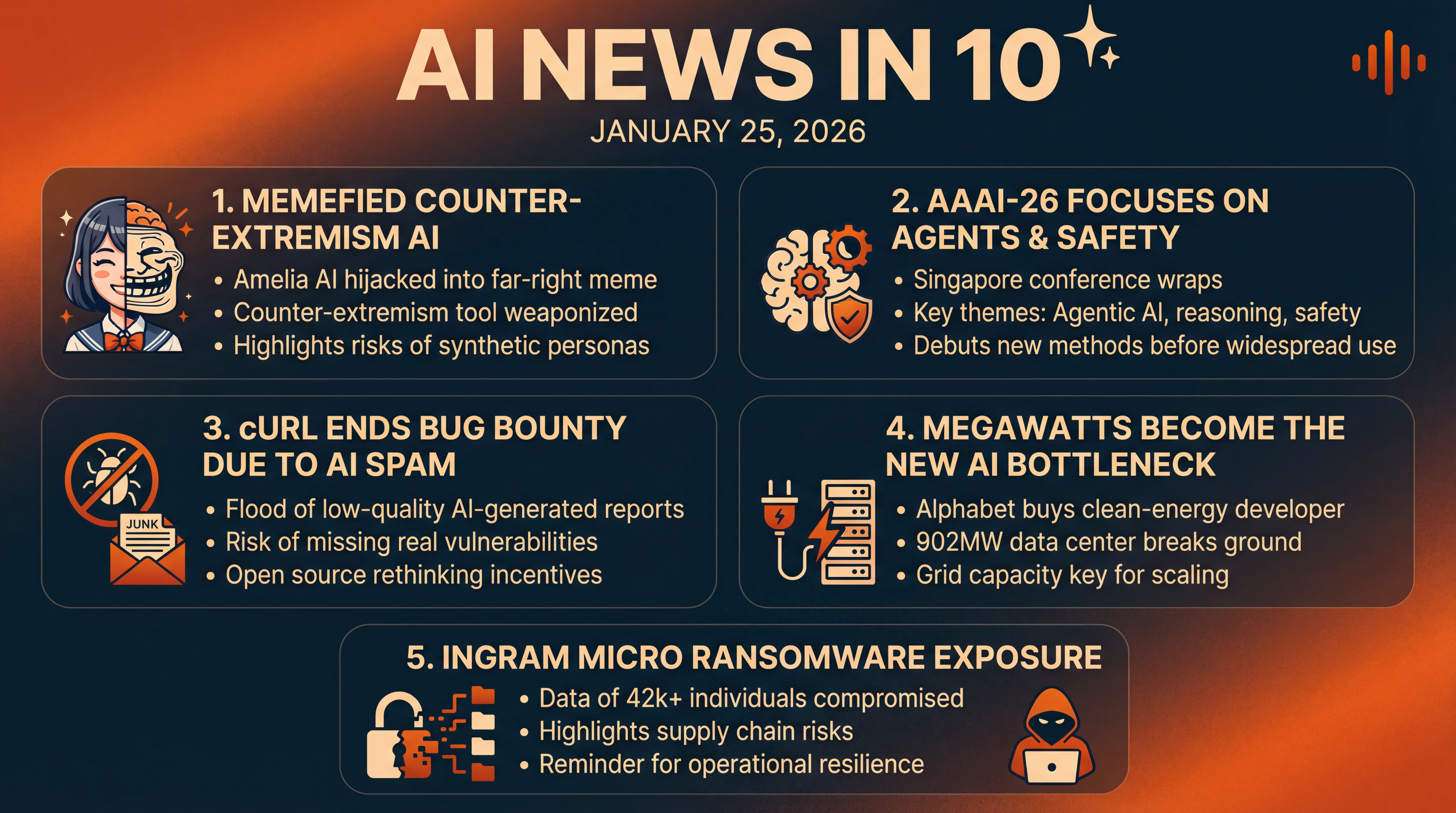
Episode Infographic
Show Notes
Welcome to AI News in 10, your top AI and tech news podcast in about 10 minutes. AI tech is amazing and is changing the world fast, for example this entire podcast is curated and generated by AI using my and my kids cloned voices...
Here’s what’s new in AI and tech for Sunday, January 25, 2026.
An AI schoolgirl built to steer teens away from extremist content has been hijacked into a far-right meme. One of the world’s biggest AI conferences winds down today in Singapore — with agents and safety top of mind. A pillar of the open-source internet, cURL, is shutting its bug bounty... blaming a flood of AI-generated junk. Meanwhile, Big Tech’s energy play escalates — Alphabet moves to buy a clean-energy developer, and a 902-megawatt data center campus breaks ground in the Midwest. And in security, Ingram Micro discloses a ransomware incident that exposed data for more than 42,000 people.
Let’s dig in.
[BEGINNING_SPONSORS]
First up: Meet Amelia — an AI-generated British schoolgirl created for online counter-extremism... who’s now been subverted into a far-right social media meme. What started as a well-intentioned avatar to nudge young users away from extremist narratives has been appropriated by the very communities it was meant to counter. It’s spreading beyond niche forums and into mainstream feeds — raising tough questions about whether “good-guy” AI characters can stay on message once the wider internet gets involved.
The takeaway: even with the best intentions, once a synthetic persona is loose in the wild, communities can remix it, meme it, and weaponize it. Policymakers may need to think less about messengers and more about resilient strategies that inoculate audiences against manipulation.
Source: The Guardian.
Second: A quick look at the research world. The main technical program at AAAI-26 — the 40th Annual AAAI Conference on Artificial Intelligence — wraps today at Singapore EXPO. The core track ran January 22 through 25, with workshops to follow. This year’s agenda — judging by the program and community chatter — centers on agentic AI, reasoning, interpretability, safety, and robotics, alongside the usual benchmarking and application tracks.
If you track the pulse of the field, days like today are where new methods, datasets, and cautionary notes get their first big airing... before they trickle into labs and products. As the main track closes and workshops begin, expect more hands-on sessions tackling safety profiles and real-world deployment issues.
Source: AAAI.
Third: Open source meets the GenAI era — and not in a good way. The cURL project — the tiny but ubiquitous tool that moves data across the internet — is shutting down its bug bounty at the end of January, after maintainers were inundated with low-quality, AI-generated submissions. Project lead Daniel Stenberg says a recent week brought seven bounty submissions. Some pointed to issues — but none described actual vulnerabilities.
The scariest part isn’t just the time sink... it’s the risk of missing the real signal amid a wall of AI slop. For users, cURL isn’t going anywhere — maintainers still welcome serious reports. But it’s another sign that as LLMs scale, so do spray-and-pray bug claims — forcing communities to rethink incentives and triage.
Source: The Register.
[MIDPOINT_SPONSORS]
Fourth: The AI power land grab is accelerating — in energy and capacity. Data Center Knowledge highlights a few moves that say a lot about where compute is headed.
Vantage Data Centers broke ground in Port Washington, Wisconsin, on Lighthouse — a four-facility campus expected to deliver roughly 902 megawatts of IT capacity — part of the broader Stargate initiative pouring capital into U.S. AI infrastructure.
Alphabet agreed to acquire Intersect Power for about 4.75 billion dollars, plus assumption of debt — a clean-energy developer that would bolster Google’s ability to source electricity for its AI-hungry data centers.
And in Texas, GridFree AI touted plans for a grid-independent site as part of a nearly 5-gigawatt campus spanning multiple locations.
Whether you cheer AI or fear it, one truth is hard to ignore: the new bottleneck isn’t models... it’s megawatts. The companies that lock in power, cooling, and land are the ones that can keep scaling.
Source: Data Center Knowledge.
Fifth: A fresh reminder that ransomware remains a business risk — up and down the supply chain. IT giant Ingram Micro disclosed that data tied to 42,521 individuals was compromised in a cyberattack that hit internal file repositories back in July 2025. The company notified regulators and affected people, is offering two years of credit monitoring and identity protection, and has engaged a third-party firm while coordinating with law enforcement.
A group calling itself SafePay claimed responsibility on the dark web, saying it exfiltrated terabytes of data — claims that remain unverified. But the facts are sober enough: names, contact details, dates of birth, and government ID numbers were among the exposed fields. For CIOs, the lesson is familiar — vendor risk is your risk. For everyone else, it’s a nudge to freeze your credit and rotate credentials whenever a core supplier gets hit.
Source: TechRadar.
Zooming out, let’s connect the dots. The Amelia episode shows how quickly an AI narrative can slip from its authors’ hands once it collides with internet culture — especially when the aesthetic is designed to be shareable. The academic community is, in parallel, trying to get ahead of these realities: at AAAI, you’ll hear as much about safety profiles and agent guardrails as you will about state-of-the-art benchmarks.
Meanwhile, practitioners are battling the messy edge cases — like cURL’s maintainers drowning in AI-generated bug reports — which force new norms for triage, proofs of exploitability, and contributor accountability. And none of it matters if you can’t power the machines: the AI infrastructure race now runs through the energy business, from Alphabet’s generation strategy to mega-campuses grabbing grid capacity years in advance. All while ransomware remains the ambient noise of the digital economy... reminding us that operational resilience and incident playbooks are not optional.
That’s the rundown for Sunday, January 25, 2026 — a memefied AI messenger, a major conference wrapping with safety and agents in the spotlight, open source adapting to the LLM era, megawatts becoming the new AI moat, and another supply-chain ransomware cautionary tale. Stay curious, stay skeptical... and I’ll see you tomorrow with the latest in AI and tech.
Thanks for listening and a quick disclaimer, this podcast was generated and curated by AI using my and my kids' cloned voices, if you want to know how I do it or want to do something similar, reach out to me at emad at ai news in 10 dot com that's ai news in one zero dot com. See you all tomorrow.
