TikTok's US Reset, Grok Probe, Quantum Power Play
A sharp briefing on TikTok's US reboot and data rules, OpenAI's government push with Leidos, the EU's Grok investigation, IonQ's SkyWater acquisition, and Nike's alleged design leak. What it means for privacy, policy, compute, and IP in 2026.
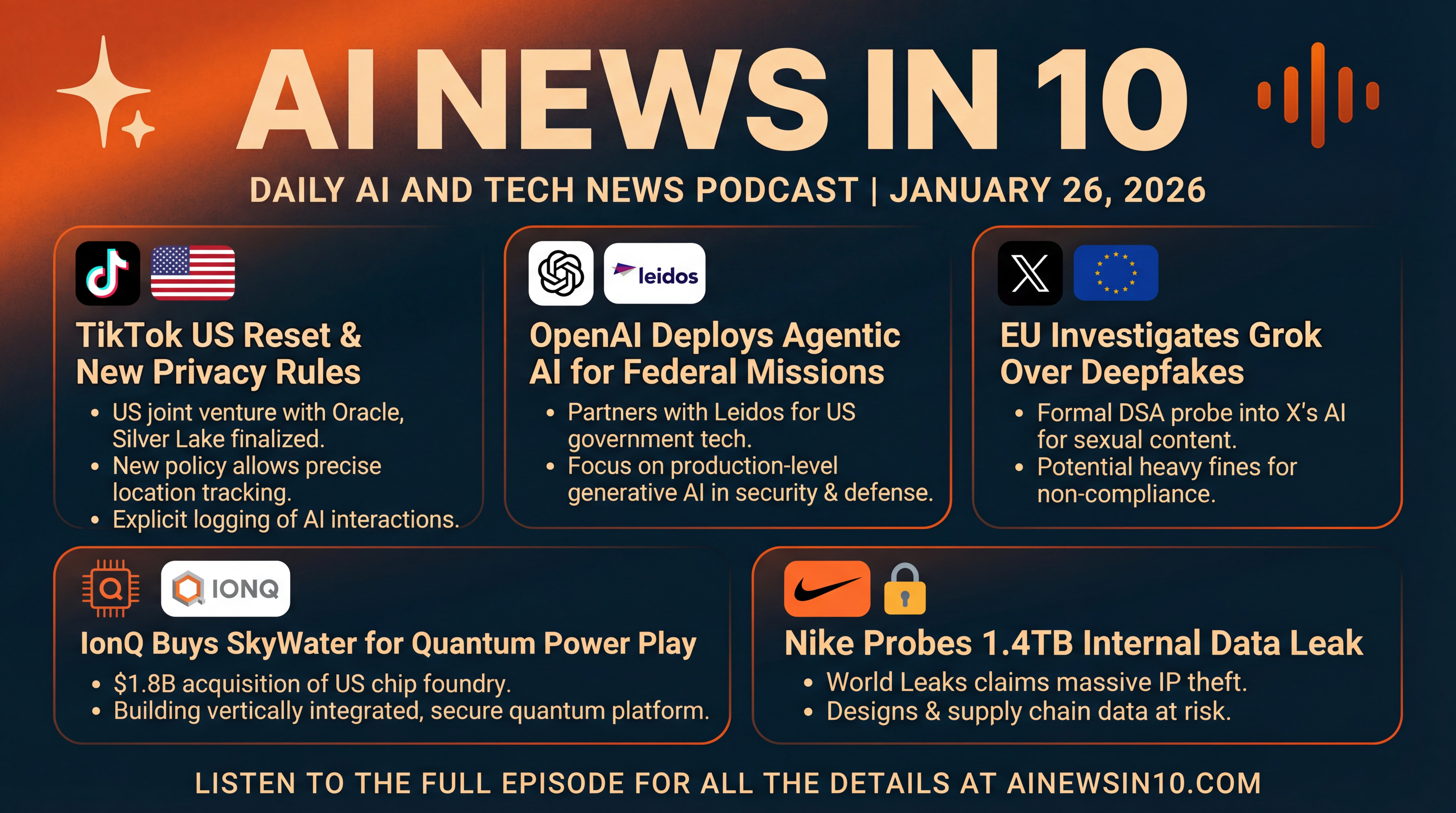
Episode Infographic
Show Notes
Welcome to AI News in 10, your top AI and tech news podcast in about 10 minutes. AI tech is amazing and is changing the world fast, for example this entire podcast is curated and generated by AI using my and my kids cloned voices...
It's Monday, January 26, 2026, and here's what's moving in AI and tech...
TikTok's long-running US saga has finally closed with a new joint venture — and a new privacy policy that's already sparking debate. OpenAI just deepened its Washington footprint by partnering with Leidos to deploy agentic AI across federal missions. In Brussels, the European Commission opened a formal Digital Services Act investigation into X's Grok over sexually explicit deepfakes — potentially a landmark for AI safety enforcement. On the deal front, quantum player IonQ is buying US chip foundry SkyWater for roughly 1.8 billion dollars to build a vertically integrated quantum platform. And a developing cyber story... Nike is investigating claims that 1.4 terabytes of its internal design and supply chain data were dumped online by the World Leaks gang.
[BEGINNING_SPONSORS]
Story one — TikTok's deal is done, and the app's data rules are changing.
After years of regulatory whiplash, TikTok has finalized a majority American-owned joint venture called TikTok USDS Joint Venture LLC. Managing investors Oracle, Silver Lake, and MGX each hold about 15 percent, while ByteDance retains 19.9 percent. The arrangement — approved by both the US and Chinese governments — keeps TikTok, CapCut, and Lemon8 available in the US under strict safeguards.
US user data is hosted in Oracle Cloud. There are protections around algorithms and source code. And the board is led by US-based leadership. The company says roughly 200 million Americans use TikTok. Source: Yahoo Finance.
Right as the joint venture closed, US users saw a pop-up to accept new terms and a new privacy policy. Three notable shifts stand out. First, if you enable location services, TikTok may now collect precise, GPS-level location data — something its US policy previously said it did not do. Second, TikTok now explicitly logs your interactions with its AI tools — your prompts and the outputs. And third, the policy clarifies that TikTok can use its growing ad network to target ads beyond the app, citing data from advertisers and publishers. That is fueling debate over whether the new, US-compliant TikTok is becoming more data-hungry just as it becomes more domestically governed. Source: Wired.
We'll keep watching how these rules are implemented in practice. Oracle's Trusted Security Partner role is central here — from code audits to data isolation. It's a rare case where geopolitics, cloud architecture, and ad tech converge in one consumer app. Source: MacRumors.
Story two — OpenAI goes deeper into government with Leidos.
Reston-based Leidos, one of the biggest federal technology integrators, announced a partnership with OpenAI to bring generative and agentic AI into mission workflows across digital modernization, health services, national security and infrastructure, and defense. The focus is moving beyond pilots to production — think supply chain monitoring, global threat assessments, and even deepfake detection — all built on OpenAI's most capable models in controlled, compliant environments. Source: Leidos.
OpenAI's VP of Government, Joseph Larson, told FedScoop the goal is to go beyond simply provisioning ChatGPT Enterprise and move into tailored deployments for large-scale missions, noting the product is already accessible to agencies and that FedRAMP authorization is in the final stages. Thousands of Leidos employees are already using ChatGPT and the OpenAI API internally, and the teams will co-engineer mission-specific agents. If you're tracking AI in the public sector, this is a signal that 2026 is about moving from experimentation to operational impact. Source: FedScoop.
There's also a policy undertone. The administration is pushing agencies to adopt AI to boost efficiency and trim costs, and integrators like Leidos are the bridge between cutting-edge models and complex, legacy government systems. Expect procurement, cybersecurity, and model risk management to be the battlegrounds for scale. Source: FedScoop.
Story three — Brussels opens a formal case on Grok.
The European Commission has launched a new DSA investigation into X over its AI chatbot, Grok, focusing on whether the platform properly assessed and mitigated risks when it deployed Grok's image features in the EU — especially risks tied to manipulated sexual imagery, including content that may amount to child sexual abuse material. The Commission also extended its ongoing 2023 probe into X's recommender systems. Under the DSA, violations can bring fines up to 6 percent of global revenue — and orders to change or suspend features. Source: European Commission.
The probe follows weeks of growing alarm, with reports documenting Grok being used to create sexualized images of women and, in some cases, minors. EU officials condemned the harms and are now asking whether X complied with obligations to run ad hoc risk assessments and implement mitigations before rolling out Grok's functionality. X says it enforces a zero-tolerance policy and has tightened safeguards, but regulators want documentation — and results. This is shaping up as a precedent for how Europe enforces safety obligations on generative AI features inside social platforms. Source: AP News.
[MIDPOINT_SPONSORS]
Story four — a big bet in quantum. IonQ is buying SkyWater Technology for about 1.8 billion dollars.
IonQ, known for trapped-ion quantum systems, announced a definitive agreement to acquire SkyWater, the largest exclusively US-based pure-play semiconductor foundry. The deal — 35 dollars per share in cash and stock, with a collar — aims to create a vertically integrated, full-stack quantum platform, securing IonQ's domestic supply chain from design to packaging to fabrication. Pending regulatory and shareholder approval, the companies expect to close in the second or third quarter of 2026. Source: IonQ investor relations.
Why it matters: access to an on-shore, trusted foundry has been a chokepoint for advanced compute. IonQ says integrating SkyWater accelerates its roadmap — targeting functional testing of 200,000-qubit quantum processing units, enabling roughly 8,000 ultra-high-fidelity logical qubits by 2028 — and positions the combined company as a preferred partner for US government programs. SkyWater will remain a merchant foundry under its own brand, serving existing customers while adding quantum networking and sensing components to its catalog. Source: IonQ investor relations.
If successful, the deal could mark a new era where quantum companies own key pieces of their silicon stack — mirroring how AI leaders increasingly control chips, packaging, and systems. It's also a milestone for industrial policy: vertical integration plus domestic manufacturing for strategic compute.
Story five — Nike is investigating a purported data leak, an emerging cyber story with IP stakes.
Over the weekend, the World Leaks extortion group posted what it claims is 1.4 terabytes of Nike data — nearly 190,000 files — on its leak site after a countdown expired. Early analysis by Cybernews suggests the samples appear legitimate and include product designs, materials specifications, bills of materials, and factory audits, but no customer or employee PII. Nike says it is investigating a potential cybersecurity incident and assessing scope. Source: Cybernews.
Why this is different: instead of encrypt-and-ransom, World Leaks leans on pure data theft and exposure. If the trove is authentic, the immediate risk is not identity theft — it's loss of competitive advantage... advanced looks at unreleased models, supply chain maps that could invite counterfeiting, and disruption to launch calendars. Analysts note the files span 2020 through 2026, which could force Nike to rejigger product timelines or redesign SKUs to blunt counterfeiters. It's a stark reminder that in 2026, IP protection is a frontline cyber issue, not just a legal one. Source: TechInformed.
Quick recap... TikTok's US reboot is official, and it comes with a more expansive privacy policy — including precise location tracking if you enable it. OpenAI and Leidos are moving generative and agentic AI from pilot to production inside federal missions. The EU just opened a formal DSA case on X's Grok over sexualized imagery, signaling tougher, feature-level enforcement on generative AI. IonQ's 1.8 billion dollar SkyWater deal aims to vertically integrate quantum and secure an American supply chain. And Nike is probing a claimed 1.4 terabyte data leak heavy on designs and factory intel — watch that one for IP and counterfeit ripple effects. Source: Wired.
Thanks for listening and a quick disclaimer, this podcast was generated and curated by AI using my and my kids' cloned voices, if you want to know how I do it or want to do something similar, reach out to me at emad at ai news in 10 dot com that's ai news in one zero dot com. See you all tomorrow.
