AI Budgets Boom, FCC Acts, Starlink Surges
Meta and Microsoft show how fast AI spending is accelerating, with Azure growth surging and Meta's 2026 capex soaring. We preview Apple's report, unpack the FCC's 6 GHz and foreign-ownership moves, and mark Starlink crossing 11,000 satellites.
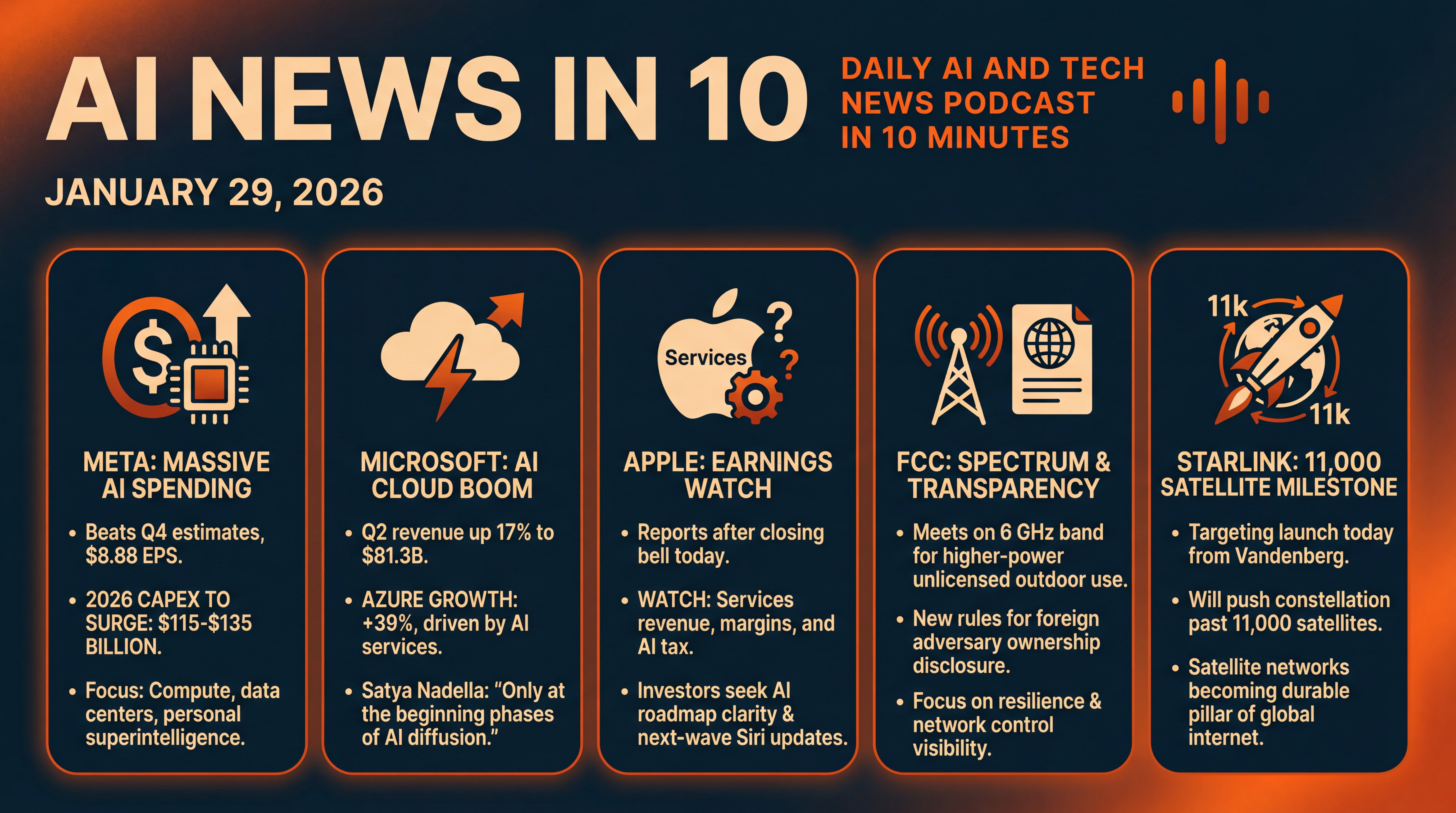
Episode Infographic
Show Notes
Welcome to AI News in 10, your top AI and tech news podcast in about 10 minutes. AI tech is amazing and is changing the world fast, for example this entire podcast is curated and generated by AI using my and my kids cloned voices...
Here's what's on deck today: two heavyweight earnings updates from Meta and Microsoft that show just how fast AI spending is scaling... Apple reports later today, so we'll flag what to watch around AI and Services... Washington gets in the mix as the FCC meets on 6 gigahertz spectrum and foreign ownership disclosures... and SpaceX eyes another Starlink launch that pushes the constellation past an eye-popping milestone.
[BEGINNING_SPONSORS]
Let's start with Meta. The company beat expectations for the December quarter—revenue just under $60 billion, and earnings of $8.88 a share. But the real headline is 2026 spending. Meta guided capital expenditures to a staggering $115 to $135 billion next year, up from roughly $72 billion in 2025.
As Mark Zuckerberg put it, 'We had strong business performance in 2025,' and he talked up plans to advance 'personal superintelligence' in 2026. Investors liked what they heard—shares popped after hours. The check size is enormous... this is about compute, data centers, and the power to run and train models that show up across Facebook, Instagram, WhatsApp, and Meta's expanding smart-glasses push.
Reality Labs still posted multi-billion-dollar operating losses in the quarter, but Meta is clearly betting that AI assistants, ranking, and creation tools are the near-term payoff—and that the long-term platform is worth the capital-spending surge. Meta also noted a 41% operating margin and reiterated its strategy to rapidly build out compute. That tells you the competitive race in AI infrastructure isn't easing up—it's accelerating. Sources: Meta investor materials, Forbes, and Yahoo Finance.
On to Microsoft, which reported fiscal Q2 last night. Revenue rose 17% to about $81.3 billion, with GAAP earnings per share at $5.16—up 60% year over year. The engine: Microsoft Cloud at $51.5 billion, up 26%, and Azure and other cloud services up 39%.
Satya Nadella summed it up: 'We're only at the beginning phases of AI diffusion,' and said Microsoft 'has built an AI business that is larger than some of our biggest franchises.' One accounting note: investments in OpenAI boosted GAAP net income by roughly $7.6 billion this quarter, and Microsoft provided non-GAAP metrics to strip that out for comparability.
Beyond accounting, the strategic picture is clear. Azure's AI services and Copilot-infused software are pulling through more cloud consumption, while the company keeps pushing its own silicon, networking, and data center designs to wring more performance per watt. For IT buyers and developers, remember two numbers—Azure's 39% growth rate, and the jump in Microsoft's commercial remaining performance obligation to about $625 billion. That signals multi-year AI cloud commitments already inked. Source: Microsoft's FY26 Q2 investor release.
With Apple reporting after the bell today—Thursday, January 29—what should you watch? Three things.
First, iPhone and Services. Several analysts expect Services to come tantalizingly close to the $30 billion mark for the quarter, with App Store and advertising trends in focus.
Second, margins. Consensus looks for gross margin in the mid to high 47% range, and Apple's guide here will feed the 'AI tax' debate—how much does on-device AI raise costs, and how much can Apple offset with scale and pricing?
Third, AI roadmap clarity. After last year's Apple Intelligence reveal and staggered rollouts, investors will listen for updates on the timing and breadth of next-wave Siri and on-device features—and how Apple plans to communicate AI value to drive upgrades. Previews this week point to revenue around $139 to $140 billion and EPS in the mid-$2.60s to $2.70s, plus watch-outs around China unit trends. We'll have the numbers for you tomorrow. For now, keep an ear out for Services momentum, margins, and any fresh color on Apple Intelligence in 2026 product cycles. Sources: AppleInsider's earnings preview and street estimates.
[MIDPOINT_SPONSORS]
Policy time. The FCC holds its January Open Meeting today at 10:30 a.m. Eastern, and two agenda items stand out for the tech world.
First, expanding unlicensed operations in the 6 gigahertz band. The Commission will consider a Fourth Report and Order to permit a new class of geofenced, variable-power outdoor devices. Translation: higher-power Wi-Fi-class links outdoors that use automated frequency coordination and geofencing to avoid incumbent microwave users—potentially enabling campus-scale AR, connected industrial sites, and fixed-wireless backhaul without costly licensed spectrum.
Second, transparency on foreign adversary control. The FCC is set to adopt new attestation and disclosure requirements so licensees and authorization holders clearly disclose any such control or influence. The agency will also take up items on modernizing relay services and clarifying foreign ownership rules.
The throughline here is resilience and transparency—more unlicensed capacity for innovation, paired with tighter visibility into who ultimately controls communications networks operating in the U.S. Sources: the Federal Register's Sunshine Act Meeting notice, and FCC and Benton Institute summaries of the tentative agenda.
And we'll close with a launch. SpaceX is targeting a Starlink mission from Vandenberg Space Force Base today. If liftoff goes on time this morning on the West Coast, the flight would push Starlink past roughly 11,000 satellites placed into orbit to date—a staggering figure by any measure.
The Falcon 9 is slated to fly a south-southwest trajectory, with a drone-ship landing attempt on 'Of Course I Still Love You,' and the second stage will target a near-polar orbit—handy for improving coverage at higher latitudes. Beyond the rocket-science trivia, here's why it matters: Starlink's scale is changing the baseline for connectivity—from rural broadband, to aviation and maritime links, to nascent direct-to-cell experiments with carriers. It also raises new coordination challenges for astronomers and space-traffic management. But for today, the milestone tells you that satellite networks are becoming a durable pillar of the global internet—right alongside terrestrial fiber, cable, and 5G. Sources: Spaceflight Now live coverage, NASASpaceflight launch roundups, and Vandenberg schedule context.
Quick recap... Meta beats and plans to pour $115 to $135 billion into AI compute in 2026. Microsoft's AI flywheel shows up in 39% Azure growth and a $51.5 billion cloud quarter. Apple reports after the close today—watch Services, margins, and any fresh AI color. The FCC meets on 6 gigahertz outdoor unlicensed and ownership transparency. And SpaceX aims to add another batch of satellites as Starlink crosses the 11,000 mark. We'll be back tomorrow with Apple's numbers and the FCC votes.
Thanks for listening and a quick disclaimer, this podcast was generated and curated by AI using my and my kids' cloned voices, if you want to know how I do it or want to do something similar, reach out to me at emad at ai news in 10 dot com that's ai news in one zero dot com. See you all tomorrow.
